

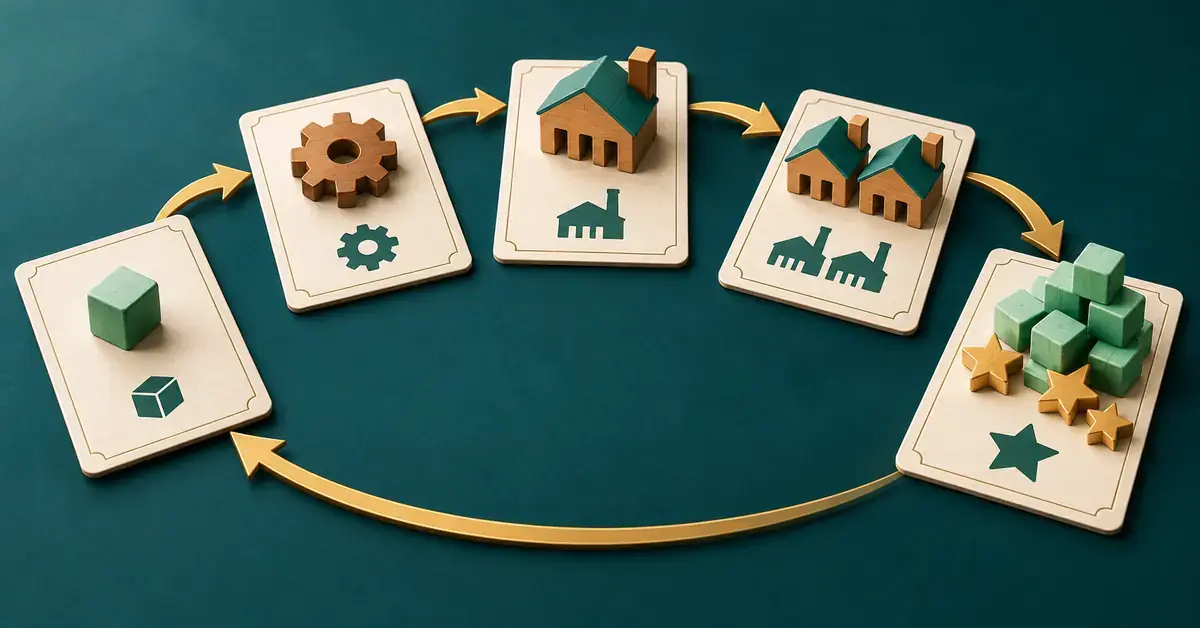
Engine-building games are strategy board games in which your early moves set up a self-reinforcing “machine” that produces more resources, actions, or points as the game goes on. Instead of racing straight for a single goal, you spend the opening turns investing in cards, tiles, or buildings that make every later turn stronger. The satisfying part is watching a slow start snowball into turns where you trigger a cascade of effects from one small action. This guide explains how the mechanic works, the main types of engine-builders, what you need to play, the mistakes that trip up new players, and a few well-reviewed titles to start with.
Key Points
- What it is: a mechanic where early moves build a self-reinforcing “engine” that produces more each turn.
- Core loop: acquire a piece, connect it to what you own, produce resources, then reinvest.
- Signature feel: a slow start that snowballs into powerful, cascading late-game turns.
- Main types: deck-builders, tableau/card engines, dice-and-resource engines, and heavy strategy engines.
- Where to start: Splendor or Machi Koro (light), then Wingspan or Gizmos, then heavier titles.
- Biggest mistake: building too long and never cashing the engine in for points.
What is an engine-building game?
An engine-building game is one where the actions you take on early turns increase what you can do on later turns. The “engine” is the growing collection of cards, tiles, dice, or buildings you have assembled, and each new piece ideally works with the pieces you already own. A turn that once produced one coin might later produce five coins, a card draw, and a point — all at once — because you spent earlier turns connecting those effects together.
The term comes from the feeling of building a motor: you bolt on parts one at a time, and once they interlock the whole thing runs faster with less effort from you. Engine-building is a board game mechanic rather than a single genre, so it shows up inside many different themes, from birdwatching to space colonisation. What unites these games is the shape of play: weak and slow at the start, powerful and fast by the end.
How do engine-building games work?
Engine-building games work on an invest-now, pay-off-later loop: you convert current resources into permanent capabilities, then use those capabilities to gather even more resources next turn. The core cycle usually looks like this:
- Acquire — buy, draft, or build a new piece (a card, tile, worker, or building) using the resources you have.
- Connect — place it where it combines with pieces you already own, creating a chain of effects.
- Produce — trigger the engine to generate resources, actions, or points.
- Reinvest — spend the new output to add the next piece and repeat, a little stronger each time.
The invest-now, pay-off-later curve
The defining sign of an engine-builder is a slow opening. Early turns feel underwhelming because you are deliberately giving up short-term points to buy long-term capacity. A player who scores nothing for the first few rounds can still win if their engine is producing far more than everyone else’s by the final rounds. The skill lies in judging when to stop building and start cashing in — build too long and the game ends before your engine pays off; cash in too early and you leave power on the table.
Engines, tableaus, and combos
Most engine-builders give each player a personal play area, often called a tableau, that fills up over the game. As it grows, you look for synergies — pieces that boost each other. A card that gives a bonus “every time you gain a coin” becomes far stronger once you own three cards that each gain coins. Chasing these combinations is the heart of the genre, and it is why two players can build completely different engines from the same starting position.
What types of engine-building games are there?
Engine-building appears in several forms, usually defined by what the engine is physically made of. Understanding the sub-types makes it much easier to pick a game that suits your group.
Deck-builders
Deck-builders turn your deck of cards into the engine. You start with a weak hand, buy stronger cards into your deck as you play, and remove weak ones so good cards come up more often. Dominion (Donald X. Vaccarino, Rio Grande Games, 2008) launched this style and won the Spiel des Jahres in 2009. Because the engine is a shuffled deck, there is a luck-of-the-draw element that pure tableau games avoid. Deck-building is close enough to engine-building that the two terms overlap, so it is worth reading our dedicated guide to deck-building games for the full picture.
Tableau and card-engine games
In tableau builders, the cards you acquire stay in front of you and keep working every turn, so the engine is visible and permanent rather than shuffled away. Splendor (Marc André, Space Cowboys, 2014) is the classic gateway example: you collect gem tokens, buy gem cards that act as permanent discounts, and those discounts let you buy more expensive cards faster. Wingspan (Elizabeth Hargrave, Stonemaier Games, 2019), a Kennerspiel des Jahres winner, and Race for the Galaxy (Tom Lehmann, Rio Grande Games, 2007) are deeper takes where each card can trigger others in a chain.
Dice and resource engines
Some engines are powered by dice or physical resource tokens instead of cards. In Machi Koro (Masao Suganuma, Grounding Inc., 2012), you roll dice each turn and the buildings you own “activate” when their number comes up, so buying more buildings means more of your turns — and your opponents’ turns — produce income. Gizmos (Phil Walker-Harding, CMON, 2018) uses a dispenser of coloured energy marbles as currency, and each contraption you build can chain into others for free. These tend to be lighter and quicker to teach.
Heavier strategy engines
At the complex end sit long games where the engine is one layer among many. Terraforming Mars (Jacob Fryxelius, FryxGames, 2016) has you play project cards that raise your production of different resources every generation. Everdell (James A. Wilson, Starling Games, 2018) blends engine-building with worker-placement games, and Ark Nova (Mathias Wigge, Capstone Games, 2021) layers a card engine over zoo-building. These reward players who enjoy a 90-minute-plus planning puzzle.
Comparison
| Game | Designer / Publisher | Year | Players | Approx. time | Engine type |
|---|---|---|---|---|---|
| Splendor | Marc André / Space Cowboys | 2014 | 2–4 | ~30 min | Tableau (gem discounts) |
| Machi Koro | Masao Suganuma / Grounding Inc. | 2012 | 2–4 | ~30 min | Dice / buildings |
| Dominion | Donald X. Vaccarino / Rio Grande Games | 2008 | 2–4 | ~30 min | Deck-builder |
| Gizmos | Phil Walker-Harding / CMON | 2018 | 2–4 | ~40–50 min | Marble / card chains |
| Wingspan | Elizabeth Hargrave / Stonemaier Games | 2019 | 1–5 | ~40–70 min | Card tableau |
| Everdell | James A. Wilson / Starling Games | 2018 | 1–4 | ~40–80 min | Worker placement + tableau |
| Race for the Galaxy | Tom Lehmann / Rio Grande Games | 2007 | 2–4 | ~30–45 min | Card tableau |
| Terraforming Mars | Jacob Fryxelius / FryxGames | 2016 | 1–5 | ~90–120 min | Production / card engine |
| Ark Nova | Mathias Wigge / Capstone Games | 2021 | 1–4 | ~90–150 min | Heavy card engine |
Where should you start with engine-building games?
Start with a short, low-rules game and work up in weight as your group gets comfortable with the invest-then-reap rhythm. A sensible progression looks like this:
- First engine: Splendor or Machi Koro — about 30 minutes, simple rules, and the “snowball” effect is obvious and satisfying.
- Next step: Wingspan or Gizmos — more card synergies to discover without a heavy rulebook.
- Deeper dive: Everdell or Race for the Galaxy — richer combos and tighter timing decisions.
- Full weight: Terraforming Mars or Ark Nova — long sessions where your engine is just one of several systems to manage.
If your group already enjoys the production and trading rhythm of a game like Catan, you are most of the way to enjoying a dedicated engine-builder, since Catan’s “settlements produce resources that buy more settlements” loop is a light engine in disguise.
What do you need to play, and how long do games take?
You need only the boxed game itself — engine-builders are self-contained and do not require apps, batteries, or extra equipment. Most include cards, tokens, player boards, and a scorepad or score track. Beyond that, the practical requirements are modest:
- Players: commonly 2–4, with several supporting one player solo and a few scaling to 5.
- Time: roughly 30 minutes for gateway titles up to 90–150 minutes for the heaviest.
- Table space: more than you might expect, because each player’s tableau grows outward as the engine expands.
- Age: lighter engine-builders suit ages 8–10 and up; complex ones are usually rated 14+.
Prices vary by weight and component count, so always check a current retailer or the publisher’s own store before buying rather than relying on an old figure.
What are the most common mistakes in engine-building games?
The most common mistake is building your engine for too long and never cashing it in. Because the genre rewards investment, new players often keep adding parts right up to the final turn and finish with an impressive machine but a low score. A few recurring errors to watch for:
- Over-building. Every engine needs an exit plan. Watch the end-game trigger (a fixed number of rounds, an emptying supply, or a point threshold) and switch to scoring before it arrives.
- Ignoring synergy. Buying the “best” individual card is weaker than buying cards that feed each other. A mediocre card that doubles three others is worth more than a strong card that stands alone.
- Spreading too thin. Trying to build in every direction usually produces a slow, generic engine. Commit to one or two strategies early.
- Not thinning or focusing. In deck-builders especially, failing to remove weak starting cards clogs your deck so your good cards appear less often.
- Misreading the pace. In a fast game, a complex engine never gets going. Match your ambition to how many turns remain.
How does engine-building compare to other mechanics?
Engine-building differs from most other mechanics in its timing: the payoff is backloaded rather than steady. In an area-control or combat game you fight over the board from turn one, and in a pure Eurogame set-collection design you may score fairly evenly throughout. Engine-builders instead ask you to accept a weak start in exchange for an explosive finish.
The mechanic also overlaps with others rather than replacing them. Worker-placement games can contain engines (your buildings improve what your workers produce), and tile-laying games sometimes do too. The dividing line is whether the point of the game is growing your own capacity over time; if it is, you are playing an engine-builder, whatever else is bolted on. Pros include high replay value and a strong sense of progress; cons include slow openings, the risk of a “runaway leader” whose engine outpaces everyone, and analysis paralysis when a tableau offers many options. If a term in this comparison is unfamiliar, our board game glossary defines the common ones.
Who are engine-building games for?
Engine-building games suit players who enjoy planning, optimisation, and the feeling of a plan coming together, rather than direct conflict. They are a natural fit for fans of puzzles and strategy who like low-luck, decision-heavy play. Gateway titles like Splendor also work well for families and newcomers because the core idea — buy things that help you buy more things — is intuitive once seen in action.
They are a weaker fit for groups that want fast, chaotic, highly interactive games, since much of the action happens in each player’s own tableau. Players who dislike slow starts or who find open-ended optimisation stressful may prefer more direct mechanics. For most mixed groups, keeping a light engine-builder on the shelf alongside heavier ones covers the widest range of moods.
Sources
Frequently Asked Questions (FAQ)
What does “engine building” mean in board games?
It means setting up a combination of cards, tiles, or buildings so that your early investments make your later turns produce more resources, actions, or points. The “engine” is the growing set of pieces you own, and the goal is to make it run more efficiently each turn.
Is deck-building the same as engine-building?
Not quite. Deck-building is one way to build an engine, where your deck of cards is the engine you improve. Engine-building is the broader idea and also covers tableau, dice, and building-based engines that do not use a shuffled deck.
What is a good first engine-building game?
Splendor and Machi Koro are popular starting points because they play in about 30 minutes, have simple rules, and show the “snowball” effect clearly. From there, Wingspan and Gizmos add more synergy without a heavy rulebook.
Why do I keep losing engine-building games?
The usual reason is building for too long and not converting your engine into points before the game ends. Watch the end-game trigger and switch from investing to scoring in the final rounds, and focus on cards that work together rather than strong cards that stand alone.
How long do engine-building games take to play?
Lighter titles such as Splendor or Machi Koro take around 30 minutes, mid-weight games like Wingspan or Everdell run 40–80 minutes, and heavy ones such as Terraforming Mars or Ark Nova can last 90–150 minutes.
