

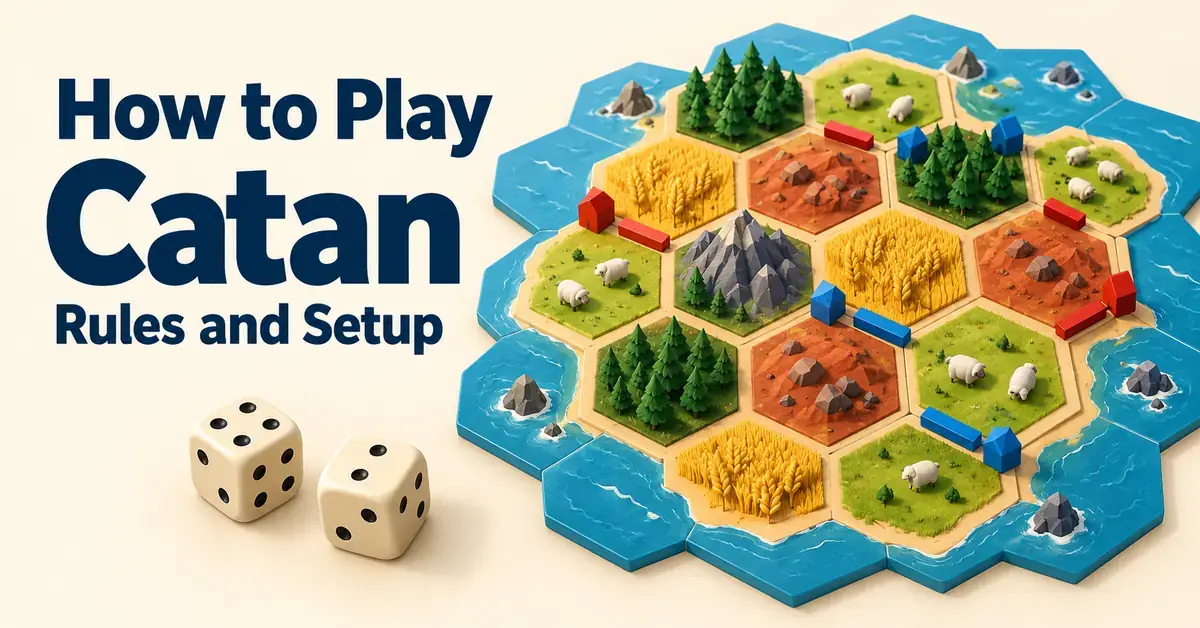
Catan is a game about building a small civilisation on a resource-rich island: you place settlements, collect brick, lumber, wool, grain and ore, trade for what you lack, and expand until you reach 10 victory points. First published in 1995, it is the game most often credited with bringing European-style board games to a mainstream audience, and its mix of dice luck, negotiation and long-term planning still makes it one of the best starting points for anyone new to modern tabletop gaming. This guide walks through the full rules and setup step by step, so you can open the box and start your first game with confidence.
Key Points
- Players: 3–4 in the base game (ages 10+)
- Playing time: about 60–90 minutes
- Goal: be the first to reach 10 victory points on your turn
- Core loop: roll for resources → trade → build roads, settlements and cities
- Five resources: brick, lumber, wool, grain and ore
- Watch the dice: the red 6 and 8 produce most often; a 7 triggers the robber
- Bonuses: Longest Road and Largest Army are worth 2 points each
What is Catan?
Catan is a competitive strategy board game for 3 to 4 players (ages 10 and up) that usually takes 60 to 90 minutes. Designed by the late Klaus Teuber and first released in German as Die Siedler von Catan in 1995, it was long sold in English as “The Settlers of Catan” before the name was shortened to simply Catan in 2015. Players take the role of settlers founding colonies on the uninhabited island of Catan, racing to develop their holdings faster than their rivals.
The game is the textbook example of a “Eurogame”: a style that rewards efficient resource management and indirect competition over direct conflict and player elimination. If you want the wider context, our overview of board game genres and mechanics explains how Eurogames differ from American-style games. Catan also sits alongside titles like chess and backgammon in our collection of classic board game rules, and if this is your first modern board game it is worth skimming our beginner’s guide to how to play board games first.
What do you need to play Catan?
Everything comes in the base-game box. The main components are:
- 19 terrain hexes that form the island: 4 forests (produce lumber), 4 pastures (wool), 4 fields (grain), 3 hills (brick), 3 mountains (ore) and 1 desert (produces nothing).
- 6 sea frame pieces and 9 harbour pieces that border the island.
- 18 circular number tokens marked 2 to 12 (there is no 7 token).
- 95 resource cards — 19 each of brick, lumber, wool, grain and ore.
- 25 development cards (14 Knights, 6 progress cards and 5 victory point cards).
- Wooden pieces per player in one colour: 5 settlements, 4 cities and 15 roads.
- 2 special cards: Longest Road and Largest Army.
- 1 robber pawn and 2 dice.
Each player also gets a building-costs reference card summarising what everything costs to build.
How do you set up Catan?
Setup builds the island and gives every player a foothold before the first roll. Work through these stages in order.
1. Build the island
Assemble the sea frame, then lay the 19 terrain hexes inside it. For your first game the rulebook suggests a fixed beginner layout; after that, shuffle the hexes and place them face up at random for a different island every time. Put the robber on the desert hex to start.
2. Place the number tokens
Deal a number token onto every terrain hex except the desert. In a random setup the tokens are placed in a set alphabetical sequence around the island. These numbers show which dice roll makes a hex produce resources. The 6 and 8 tokens are printed in red and marked with the most dots because they come up most often — note where they sit, because tiles next to high-probability numbers are the most valuable.
3. Place your first settlements and roads
Players take turns placing their two starting settlements and two starting roads. Settlements go on the corners (intersections) where hexes meet, never in the middle of a hex, and no two settlements may ever sit on adjacent corners — this is the “distance rule.” In the first round, players place one settlement and one connecting road each going around the table; in the second round the order reverses, so the last player places twice in a row. Each road must connect to one of your own settlements.
4. Collect starting resources
After the second settlement is placed, each player takes one resource card for every hex touching that second settlement. These cards are your opening hand and seed your first few turns.
What are the resources in Catan?
There are five resources, each produced by one terrain type, and everything you build is paid for with some combination of them:
- Brick — from hills. Used for roads and settlements.
- Lumber — from forests. Used for roads and settlements.
- Wool — from pastures. Used for settlements and development cards.
- Grain — from fields. Used for settlements, cities and development cards.
- Ore — from mountains. Used for cities and development cards.
Brick and lumber fuel early expansion; grain and ore drive the late game through cities and development cards.
How does a turn work in Catan?
A turn always follows the same three phases, in order.
1. Roll for production
Roll both dice. Every hex marked with the total just rolled produces its resource, and each player who owns a settlement touching that hex takes one matching resource card (a city touching it takes two). Rolling a 7 is the exception — it triggers the robber instead of production (see below).
2. Trade
After rolling, you may trade resources. Trading is a core part of the game and gets its own section below.
3. Build and buy
Spend resources to build roads, settlements and cities, or to buy development cards. You may build as much as you can afford in any order, then play passes to the player on your left.
How much does everything cost to build?
Building is how you convert resources into victory points and board presence. The four things you can pay for are roads, settlements, city upgrades and development cards, and their costs never change.
Building Costs
| Build | Cost | Victory points | Pieces you start with |
|---|---|---|---|
| Road | 1 brick + 1 lumber | 0 (counts toward Longest Road) | 15 |
| Settlement | 1 brick + 1 lumber + 1 wool + 1 grain | 1 | 5 |
| City (upgrades a settlement) | 2 grain + 3 ore | 2 | 4 |
| Development card | 1 wool + 1 grain + 1 ore | Some are worth 1 (hidden) | Drawn from a 25-card deck |
- Road (1 brick + 1 lumber): extends your network so you can reach new intersections. Roads score no points on their own but are the path to the Longest Road bonus.
- Settlement (1 brick + 1 lumber + 1 wool + 1 grain): must be built on an empty intersection connected to your road network and obeying the distance rule. Each settlement is worth 1 victory point and collects one resource from every adjacent producing hex.
- City (2 grain + 3 ore): upgrades an existing settlement in place, returning that settlement piece to your supply. A city is worth 2 victory points and collects two resources from each adjacent hex instead of one.
- Development card (1 wool + 1 grain + 1 ore): drawn blind from the shuffled deck — see the next section.
What do development cards do?
Development cards add hidden options and are bought, not built, so they cannot be blocked by the robber. The 25-card deck breaks down into three types:
- Knights (14 cards): playing one lets you move the robber and steal a resource, exactly as if you had rolled a 7. Knights also count toward the Largest Army award.
- Progress cards (6 cards): two Road Building (place two free roads), two Year of Plenty (take any two resources from the bank) and two Monopoly (name a resource and take every copy of it from all other players).
- Victory point cards (5 cards): each is worth 1 point and stays hidden in your hand until you win, which lets you reach 10 points as a surprise.
You may play only one development card per turn, and never on the same turn you bought it (victory point cards are the exception — they are simply revealed when you win).
What happens when you roll a 7? The robber
Rolling a 7 is the most disruptive moment in Catan, and nothing is produced that turn. Three things happen in sequence:
- Discard. Every player holding 8 or more resource cards must discard half of them, rounded down. A player with 9 cards discards 4; a player with 7 or fewer keeps everything.
- Move the robber. The player who rolled moves the robber onto any terrain hex. While it sits there, that hex produces nothing for anyone, even on its number.
- Steal. The mover then takes one random resource card from a player who has a settlement or city touching the robber’s new hex.
Because a 7 is the single most common dice result, carrying a big hand is risky — you are a target every time someone rolls.
How does trading work in Catan?
Trading is what keeps every player involved on every turn. There are two kinds:
- Player trades: on your turn you may offer resources to and accept them from other players in any amounts both sides agree to. You cannot trade on another player’s turn, and you may not simply give cards away. Players may not trade development cards.
- Bank trades: at any time on your turn you may trade 4 identical resources to the bank for 1 of your choice. If one of your settlements or cities sits on a harbour, you get a better rate — 3:1 at a generic harbour, or 2:1 for one specific resource at a specialised harbour.
Skilful negotiation often matters more than the dice, which is why trading is a recurring theme in wider board game strategy.
What are Longest Road and Largest Army?
These two special cards are bonus victory points that change hands during play.
- Longest Road goes to the first player to build a continuous road of at least 5 segments. It is worth 2 victory points. If another player later builds a strictly longer unbroken road, they take the card. A road broken by an opponent’s settlement can lose you the bonus.
- Largest Army goes to the first player to play 3 Knight cards, and is also worth 2 victory points. It likewise passes to anyone who later has more played knights than the current holder.
Because each is worth 2 points, controlling one or both can swing the game — but relying on a bonus you might lose is a classic trap.
How do you win Catan?
You win Catan the moment you reach 10 victory points on your own turn. Points come from several sources that add up quietly:
- Each settlement: 1 point
- Each city: 2 points
- Longest Road: 2 points
- Largest Army: 2 points
- Each victory point development card: 1 point (kept hidden)
You may only declare victory and end the game during your turn, so if you reach 10 points through another player’s action (for example, losing a bonus that drops you back), the game continues until someone hits 10 on their own turn. Hidden victory point cards make it possible to leap from 8 to 10 in a single turn before anyone can react.
Common mistakes beginners make
Knowing the rules is only half the battle; most first-time losses come from a handful of avoidable errors:
- Ignoring the numbers. Placing settlements on tiles marked 2 or 12 starves you of resources. Favour the red 6 and 8 and the surrounding high-probability numbers.
- Hoarding cards. Sitting on 8 or more resources makes you the obvious robber target and risks a painful discard on any 7. Spend or trade before your hand gets dangerous.
- Refusing to trade. A deal that helps an opponent a little but helps you a lot is still a good deal. Never trading at all usually means falling behind.
- Chasing only settlements. Upgrading to cities and buying development cards often scores faster than spreading thin across the board.
- Forgetting resource variety. Try to cover all five resources across your two opening settlements so you are never completely locked out of a build.
Catan variants and expansions
The base game is built for 3 to 4 players, but the system scales. The official 5–6 Player Extension adds pieces and hexes for larger groups, while standalone and expansion sets such as Seafarers, Cities & Knights and Traders & Barbarians layer on ships, combat and new goals once you know the basics. There is also a two-player-focused Catan: New Energies and card-game adaptations. Learn the core rules here first; the expansions assume you already understand resources, building and the robber.
Sources
Who is Catan good for?
Catan suits players who enjoy planning, negotiation and steady progress rather than quick luck or elimination. It is rated for ages 10 and up, plays in roughly one to two hours, and works best with 3–4 players (or up to 6 with the extension). Because no one is ever knocked out and every roll can give you resources, it is a friendly entry point into modern board gaming — and a natural stepping stone to deeper strategy games. When you are ready to improve, our introduction to board game strategy covers the thinking that applies here, and you can explore more titles in our collection of classic board game rules.
Frequently Asked Questions (FAQ)
How many players do you need for Catan?
The base game is designed for 3 to 4 players aged 10 and up. With the official 5–6 Player Extension you can add more seats, but the standard box tops out at four.
How long does a game of Catan take?
A typical game runs about 60 to 90 minutes. First games take longer while players learn setup and the turn structure; experienced groups often finish a four-player game in around an hour.
What do you roll a 7 for in Catan?
A 7 produces no resources. Instead, any player holding 8 or more resource cards discards half, the roller moves the robber to block a hex, and then steals one random card from a player next to that hex.
How many points do you need to win Catan?
You need 10 victory points, and you can only declare the win on your own turn. Points come from settlements, cities, the Longest Road and Largest Army cards, and hidden victory point development cards.
Can you trade on another player’s turn in Catan?
No. You may only make trades during your own turn. On other players’ turns you can neither initiate nor accept resource trades, though you can always discuss future deals.
