

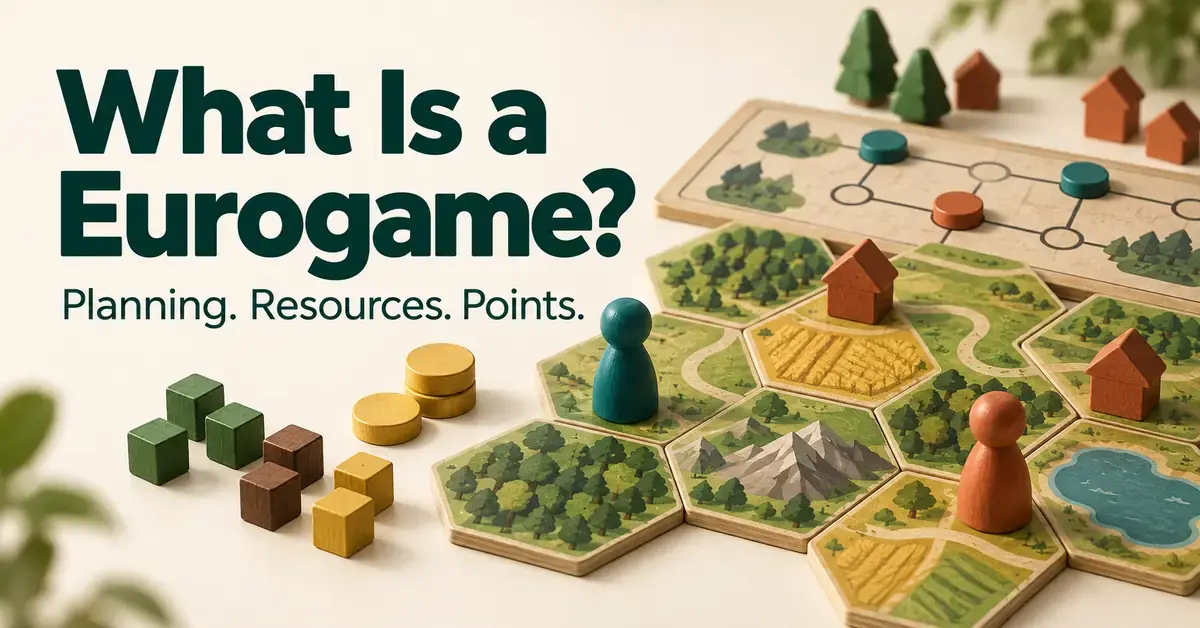
A eurogame is a style of modern strategy board game built around careful planning, resource management and multiple ways to score points — rather than luck, dice-driven combat or knocking other players out. The name is short for “European game” (the style is also called a German-style board game), and titles like Catan, Carcassonne and Ticket to Ride are the examples most people recognise. This guide explains what the term actually means, where the genre came from, the features that define it, the mechanics it uses, how it differs from American-style games, and who it suits.
Key Points
- Definition: a eurogame is a strategy board game built around planning, resource management and scoring points rather than luck or combat.
- Also called: a German-style board game; the English term dates from the mid-1990s.
- Breakthrough title: The Settlers of Catan (1995) by Klaus Teuber.
- Hallmarks: indirect competition, low managed luck, no player elimination, several paths to victory points, mechanics over theme.
- Common mechanics: worker placement, tile-laying, deck-building, engine-building, drafting, set collection.
- Not a strict category: it is a style on a spectrum, with light “gateway” games and heavier “gamers’” games.
What is a eurogame?
A eurogame is a board game that rewards efficient decisions and long-term planning over chance and direct conflict. Players usually compete indirectly — racing to build, collect or optimise something — and the winner is decided by victory points (a running score, often tracked around the edge of the board) rather than by eliminating opponents or conquering territory.
It helps to treat “eurogame” as a loose style rather than a strict category. There is no official rulebook that decides whether a game qualifies, and designers mix traits freely, so most games sit somewhere on a spectrum. Even so, a cluster of recognisable features — low luck, no player elimination, several scoring paths and mechanics that matter more than story — shows up often enough that the label is genuinely useful when you are choosing or describing a game. You can find short definitions of the individual terms used here in our board game glossary.
Where did eurogames come from?
The modern eurogame grew out of post-war Germany, where family games that emphasised thinking over fighting became popular. German designers and publishers refined this style through the 1980s and early 1990s, and the English term “eurogame” appeared in the mid-1990s as an alternative to “German game” — though the label never really fit, since designers from the United States, Canada and elsewhere have shaped the genre too.
The turning point was The Settlers of Catan (German: Die Siedler von Catan), designed by Klaus Teuber and published by Kosmos in 1995. It won Germany’s prestigious Spiel des Jahres (“Game of the Year”) award that same year, sold out its first print run almost immediately, and went on to sell tens of millions of copies in dozens of languages — by some counts more than 40 million boxes worldwide. Catan became one of the first eurogames to catch on widely outside Europe and effectively opened the North American market to German-style design. Teuber, often credited with helping define what a modern board game is, died in 2023. If you want to see the style in action, our guide on how to play Catan walks through its rules and setup.
What are the key features of a eurogame?
Eurogames share a handful of design priorities that, taken together, give the genre its distinctive feel. No single feature is mandatory, but the more of them a game has, the more “euro” it tends to feel.
Indirect competition instead of direct conflict
Players compete for the same limited resources, spaces or bonuses rather than attacking each other. You might take the action or tile your neighbour wanted, or buy a card before they can, but there is rarely any combat, army or roll-to-destroy mechanic. The tension comes from scarcity and timing, not aggression.
Low, carefully managed luck
Randomness is kept small and, where it exists, you usually decide what to do after the random event rather than before it. A classic example is drawing from a shuffled deck or rolling dice to produce resources, then choosing how to spend what you got. This keeps outcomes fresh without letting a single bad roll decide the game, which rewards skilled play over many sessions.
No player elimination
Everyone stays in the game until the end. Rather than being knocked out early and left watching, trailing players keep taking turns and scoring right up to final scoring. This also makes eurogames comfortable for mixed groups, because nobody is sidelined.
Multiple paths to victory points
Most eurogames can be won in more than one way. You might score by building structures, completing contracts, collecting sets or improving an engine, and good players read the board to find the most efficient route for the current game. Because the winner is often unclear until scores are tallied, runaway leaders are rare and games stay close.
Mechanics first, theme second
Eurogames usually lead with their mechanics — the systems and rules that make the game work — and wrap a lighter theme around them. A game might be about farming, trading or building cities, but the setting is mostly a coat of paint over the underlying math. This is the opposite emphasis to many American-style games, which lead with story and spectacle.
The designer is credited
A small but telling trait: eurogames name the designer on the box, treating game design as authorship. This “designer game” culture is part of why the hobby tracks creators like Klaus Teuber, Uwe Rosenberg or Reiner Knizia the way readers track authors.
What mechanics do eurogames use?
Eurogames are defined partly by a toolkit of recurring mechanics. Many games combine several of these, and understanding them makes any new rulebook easier to learn. For a broader map of how these fit together, see our overview of board game genres and mechanics.
- Worker placement: you assign a limited number of tokens (often called workers or meeples) to action spaces; once a space is taken, others may be blocked from using it that round.
- Tile-laying: players draw and place tiles to build a shared map or their own layout, scoring for the shapes and connections they create.
- Resource management: you gather raw goods and convert them into more valuable things, balancing what to spend now against what to save.
- Deck-building: you start with a small deck of cards and buy better cards during play, gradually improving the deck you draw from.
- Engine-building: you set up combinations that produce more resources or points each turn, so your position snowballs as the game goes on.
- Drafting: you pick a card or tile from a shared pool, then pass the rest along, choosing partly to deny good options to opponents.
- Set collection: you score by gathering matching or complementary groups of cards, goods or tokens.
- Area majority: you score for having the most presence in a region, without needing to remove rivals from it.
How is a eurogame different from an American-style game?
The clearest way to understand eurogames is to contrast them with American-style games (sometimes called “thematic” or, half-jokingly, “ameritrash”). The two are ends of a spectrum rather than strict opposites, and plenty of modern games deliberately blend them, but the generalisations below hold up well.
Eurogame vs American-Style
| Feature | Eurogame | American-style (thematic) |
|---|---|---|
| Player interaction | Indirect — compete for resources and spaces | Direct — conflict, combat, attacks |
| Role of luck | Low and managed | Higher, often dice-driven |
| Player elimination | Rare — everyone plays to the end | Common in many titles |
| Emphasis | Mechanics first, lighter theme | Strong theme and story first |
| How you win | Most victory points, often multiple paths | Objectives, domination or survival |
| Typical length | About 30–90 minutes | Often longer |
| Examples | Catan, Carcassonne, Ticket to Ride | Risk, Axis & Allies, dungeon-crawl games |
In short, a eurogame tends to feel like solving an efficient puzzle against other optimisers, while an American-style game tends to feel like living out a dramatic story with swings of fortune. Neither is better — they simply reward different things, and many players enjoy both.
What are some well-known eurogame examples?
A handful of titles come up again and again as reference points for the genre. The table below lists widely recognised eurogames with their designer, first release year, core mechanic and typical player count and length. Playing times are approximate and vary with player count and experience.
| Game | Designer | First released | Core mechanic | Players | Typical time |
|---|---|---|---|---|---|
| The Settlers of Catan | Klaus Teuber | 1995 | Resource management & trading | 3–4 | 60–90 min |
| Carcassonne | Klaus-Jürgen Wrede | 2000 | Tile-laying | 2–5 | 30–45 min |
| Puerto Rico | Andreas Seyfarth | 2002 | Role selection | 3–5 | 90–150 min |
| Ticket to Ride | Alan R. Moon | 2004 | Set collection & route building | 2–5 | 30–60 min |
| Agricola | Uwe Rosenberg | 2007 | Worker placement | 1–5 | 30–150 min |
| Dominion | Donald X. Vaccarino | 2008 | Deck-building | 2–4 | ~30 min |
| Wingspan | Elizabeth Hargrave | 2019 | Engine-building | 1–5 | 40–70 min |
These examples show how broad the genre is: Ticket to Ride and Carcassonne are light and quick, while Puerto Rico and Agricola are heavier and longer. All of them, though, share the euro priorities of indirect competition and scoring over elimination.
What is the difference between a gateway game and a gamer’s game?
Eurogames are often split by weight into gateway games and gamers’ games. A gateway game is light, quick to teach and designed to bring newcomers into the hobby — Ticket to Ride and Carcassonne are the standard examples. A gamer’s game (or “heavy euro”) has more rules, longer play time and deeper decisions, such as Agricola or Puerto Rico. “Weight” simply describes how mentally demanding a game is, not how good it is. If you are new to the style, start with a gateway title and work up; our tips on board game strategy apply across the whole range.
How are the best eurogames recognised?
The most influential award in the genre is Germany’s Spiel des Jahres (“Game of the Year”), first awarded in 1979 and chosen by a jury of game critics. Winning it can turn a title into a long-term bestseller; Catan (1995), Carcassonne (2001), Ticket to Ride (2004) and Dominion (2009) are all winners. Since 2011 a companion award, the Kennerspiel des Jahres, has honoured more complex titles aimed at experienced players — Wingspan won it in 2019. These awards are a reliable, neutral signal of quality because they reward design rather than sales or marketing.
What are common misconceptions about eurogames?
Several assumptions trip up newcomers, so it is worth clearing them up before you judge the genre.
- “Eurogames have no luck.” They have less luck than dice-heavy games, and they manage it carefully, but many still use dice or card draws. The goal is to keep luck from deciding the game, not to remove it.
- “They’re all made in Europe.” The name is historical. Plenty of classic eurogames come from North American designers, and the style is now global.
- “They have no theme.” Most do have a theme — farming, trading, birdwatching — it just sits lightly on top of the mechanics rather than driving them.
- “Eurogame means boring or passive.” Indirect competition is still competition. Blocking an opponent’s action or snatching a card they needed can be sharply confrontational.
- “They’re only for hardcore hobbyists.” Many of the best-selling eurogames are deliberately beginner-friendly gateway games built for families and casual groups.
Who are eurogames for?
Eurogames suit players who enjoy planning, optimising and close finishes more than dramatic swings and head-to-head combat. They work especially well for mixed groups and families, because no one is eliminated and games have a predictable length. If you like puzzles, strategy and the feeling of a plan coming together, the genre has something at every weight — and if you prefer bold stories and big risks, you may lean toward American-style games instead, or toward titles that blend both. New to tabletop gaming in general? Our beginner’s guide on how to play board games is a good first stop.
Sources
Frequently Asked Questions (FAQ)
Is Catan a eurogame?
Yes. The Settlers of Catan (1995) is one of the defining eurogames and the title most often credited with bringing the German-style genre to a worldwide audience. It uses resource management, trading and victory points, and keeps all players involved to the end.
Is a eurogame the same as a German-style board game?
Effectively, yes. “German-style board game” is the older name for the same style, reflecting the genre’s roots in post-war Germany. “Eurogame” became the common English term in the 1990s, even though designers worldwide now make them.
What is the difference between a eurogame and an ameritrash game?
Eurogames emphasise planning, indirect competition, low luck and scoring by victory points, with no player elimination. American-style (“ameritrash” or thematic) games emphasise strong theme, direct conflict, higher luck and dramatic swings. The two are ends of a spectrum, and many modern games blend them.
Do eurogames involve any luck?
Usually some, but it is kept small and managed. Where dice or card draws appear, you typically decide how to respond after seeing the result, so skill and planning matter more than chance across repeated plays.
What is a good eurogame for beginners?
Light “gateway” eurogames such as Ticket to Ride and Carcassonne are widely recommended starting points: they teach in a few minutes, play in under an hour and introduce core euro ideas like set collection and tile-laying before you move on to heavier titles.
