

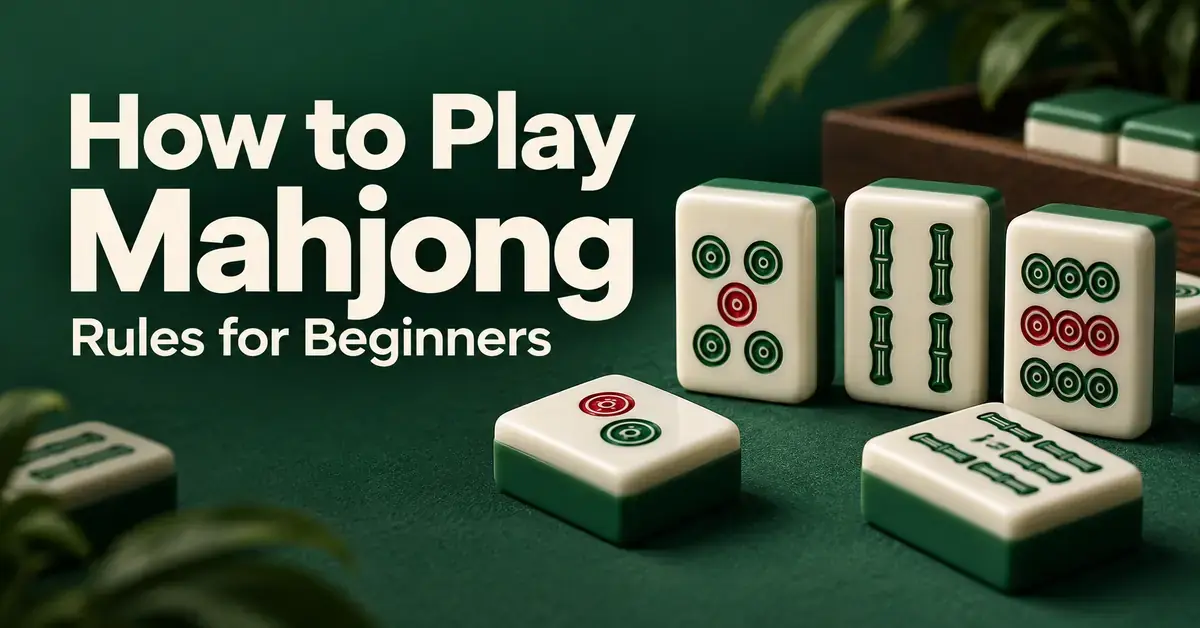
Mahjong is a four-player tile game from 19th-century China in which you repeatedly draw and discard tiles to build a complete hand of four sets plus a matching pair. It mixes luck, pattern recognition and reading your opponents, and it has travelled the world in several regional forms. This beginner’s guide explains the tiles, the setup, how a turn works and how to win, using the widely taught Chinese and Hong Kong style as the baseline and flagging where the popular variants differ.
Key Points
- Mahjong is a four-player tile game from 19th-century China; you draw and discard tiles to build a complete hand.
- A standard set has 144 tiles: three number suits (Characters, Bamboo, Circles) plus wind, dragon, flower and season tiles.
- A winning hand is four sets — chows (runs), pungs (triplets) or kongs (four of a kind) — plus one matching pair, 14 tiles in all.
- Rules and scoring vary by region; the best-known versions are Chinese Classical, Hong Kong, Japanese Riichi and American (NMJL). Agree on one before you play.
- “Mahjong solitaire” is a separate one-player matching puzzle, not the four-player game described here.
What is mahjong?
Mahjong is a game of skill, strategy and chance played by four people seated around a table with a set of engraved tiles. On each turn a player draws a tile and discards one, slowly shaping a hidden hand toward a target pattern. The first player to complete a legal hand of four sets and one pair calls “Mahjong” and wins the round. Players then score the hand, and a new round begins.
The game most likely developed in the mid-to-late 1800s, during the late Qing dynasty, growing out of older Chinese card and domino games rather than being invented in a single moment. Its exact origin is disputed, but it spread rapidly in the early 20th century and reached North America in the 1920s, where a distinct American version later took hold. Today it is played socially across China, Japan, Southeast Asia and Western countries, both at the table and online.
Is this the same as “mahjong solitaire”?
No. Mahjong solitaire is a separate one-player puzzle that shares the same tiles but almost none of the rules. In solitaire you clear a pre-arranged layout by matching open pairs of identical tiles; there is no wall, no discarding and no opponents. It is a solo computer and app puzzle popularised in the 1980s. This guide is about traditional four-player mahjong, which is a social game of building a winning hand against three other people.
What you need to play
You need four players, a mahjong tile set, two or three dice, and something to keep score such as counting sticks, chips or a pen and paper. A standard set has 144 tiles, and understanding the tiles is the single most important step for a beginner.
Quick Facts
| Players | 4 (three-player versions exist) |
|---|---|
| Recommended age | About 8 and up |
| Time per hand | Roughly 15–30 minutes |
| Equipment | 144-tile set, 2–3 dice, scoring chips or sticks |
| Game type | Tile-based, draw-and-discard |
| Skill vs. luck | Both — chance in the draw, skill in play |
| Origin | China, mid-to-late 1800s |
The three number suits (108 tiles)
Most of the set is made up of three suits, each numbered 1 to 9 with four identical copies of every number. That is 36 tiles per suit, or 108 in total. The suits are:
- Characters (also called “cracks” or myriads) — marked with a Chinese character for the number and the symbol for ten-thousand.
- Bamboo (also called “bams” or sticks) — shown as stylised bamboo canes; the 1 of Bamboo is usually drawn as a bird.
- Circles (also called “dots” or wheels) — shown as rings or coins.
These suited tiles are the only ones that can form runs of consecutive numbers.
The honour tiles (28 tiles)
Honour tiles carry no number and cannot form runs, but they are valuable for scoring. There are two groups:
- Winds (16 tiles): East, South, West and North, with four copies of each.
- Dragons (12 tiles): Red, Green and White, with four copies of each. The White Dragon is often a blank tile or one with a plain border.
The bonus tiles (8 tiles)
The bonus tiles are four Flowers and four Seasons, one of each. They are not used to build sets. When you draw one you place it face-up to the side and immediately draw a replacement tile, and it can earn you extra points at the end — especially if it matches your seat. Some rule sets leave the bonus tiles out of the game entirely, which is why a basic set is sometimes described as having 136 tiles.
Setting up the game
Setup fixes who sits where, builds the tile “wall” and deals each player a starting hand. The key fact is that one player, East, is the dealer and acts first.
- Choose seats and winds. Players draw or roll to decide seating, and each player is assigned a seat wind: East, South, West and North. East is the dealer for the first hand.
- Shuffle and build the wall. Turn all tiles face-down and mix them thoroughly. Each player stacks a row 18 tiles long and two tiles high (36 tiles). The four rows are pushed together to form a square wall of 144 tiles in the middle of the table.
- Break the wall. The dealer rolls the dice and counts along the wall to choose where to start drawing, which keeps the starting point unpredictable.
- Deal the tiles. Deal around the table (counter-clockwise in the common Chinese style) until each player has 13 tiles and the dealer has 14. A small section of the wall is set aside as a reserve for replacement draws after flowers, seasons and kongs.
How a turn works
Play is a cycle of drawing and discarding that moves around the table until someone wins. Because the dealer holds 14 tiles, the dealer begins by discarding one tile face-up; play then passes to the next seat.
On a normal turn you:
- Draw one tile from the live wall, bringing your hand to 14 tiles.
- Decide whether the new tile helps your hand.
- Discard one tile face-up into the centre, returning to 13 tiles. In many styles you name the tile as you discard it.
If your drawn tile completes your hand, you do not discard — you declare a win by self-draw instead.
Claiming another player’s discard
You do not have to wait for your own draw to complete a set — you can claim the tile someone just discarded, which is what makes mahjong interactive. To claim, you call out, take the discard, reveal the set it completes, and discard a tile of your own. When several players want the same discard, a fixed priority decides who gets it:
- A winning claim (Mahjong) comes first. A player who can complete their whole hand with that tile beats every other claim.
- A pung or kong comes next. A player taking the tile to make three or four of a kind outranks a player who only wants a run.
- A chow (run) comes last, and in common rule sets only the player immediately to the discarder’s right may claim a discard for a chow.
Claiming a discard can skip over the players in between, and play then continues from the seat after whoever took the tile.
Sets and the winning hand
A winning mahjong hand is four sets plus one pair — 14 tiles in total. There are three kinds of set, and a single pair called the “eyes.”
- Chow: three consecutive tiles in the same suit, such as 4-5-6 of Circles. Runs cannot wrap around from 9 back to 1, and honour tiles can never form a chow.
- Pung: three identical tiles, such as three West winds or three 8 of Bamboo.
- Kong: four identical tiles. A kong counts as one set but uses a fourth tile, so whenever you declare one you draw a replacement tile from the reserve to keep your hand the right size.
- The pair: two identical tiles that complete the hand.
So a typical winning hand is any combination of four chows and/or pungs (with kongs counting as sets) plus one pair. When you complete it, you declare “Mahjong,” lay your tiles face-up, and the others confirm the hand is legal before scoring.
How scoring works
Scoring is where mahjong varies the most, so the only universal advice is to agree on one rule set before you deal. In the widely played Hong Kong style, a winning hand is first awarded points called faan based on its pattern, and most tables require a minimum of three faan to win, with an upper limit (often capped at 13 faan) to keep scores in check.
Across most styles, the same ideas push a hand’s value up:
- Hand shape: a hand made entirely of runs, entirely of triplets, or all one suit (a flush) scores more than a mixed hand.
- Honour sets: a pung or kong of dragons, of your seat wind, or of the round’s prevailing wind adds points.
- Concealed hands: completing a hand without claiming discards is worth more.
- How you won: winning on your own draw usually scores more than winning on a discard, and bonus flowers and seasons can add small amounts.
Payment also differs: if you win on a discard, often only the player who threw the tile pays, whereas a self-drawn win is usually paid by everyone. Because the details differ so much, treat the numbers above as the shape of scoring, not fixed values.
The main mahjong variants
“Mahjong” is really a family of games that share tiles and a core loop but differ in tiles used, scoring and special rules. If you want to know the exact rules of classic tabletop games generally, our guide to classic board game rules is a useful companion; for mahjong specifically, the table below shows how the best-known versions compare.
| Variant | Region | Tiles in set | Hand goal | Signature feature |
|---|---|---|---|---|
| Chinese Classical | China | 144 | 4 sets + 1 pair | The earliest documented rules; uses flower and season tiles |
| Hong Kong Old Style | Hong Kong / Cantonese | 144 | 4 sets + 1 pair | Faan scoring, usually a 3-faan minimum to win |
| Japanese Riichi | Japan | 136 (no flowers/seasons) | 4 sets + 1 pair | The “riichi” ready bet, bonus “dora” tiles and the furiten rule |
| American (NMJL) | United States | 152 (adds 8 jokers) | Match a hand on the annual card | Jokers, a yearly hand card and the “Charleston” tile-passing ritual |
| Taiwanese | Taiwan | 144 | 5 sets + 1 pair (16-tile hands) | Larger hands and generous flower bonuses |
For a complete beginner, the Chinese or Hong Kong style is the most transferable starting point, because most other versions are described as changes to it.
Common mistakes beginners make
Most early frustration comes from a handful of avoidable errors rather than from the core rules.
- Not agreeing a rule set first. Scoring, bonus tiles and even turn direction vary. Settle on one version and confirm the minimum score to win before the first deal.
- Trying to make a run from honour tiles. Winds and dragons only form pairs, pungs and kongs — never chows.
- Breaking a completed set to chase a bigger hand. Dismantling a valid group for an ambitious pattern often leaves you with nothing when someone else wins first.
- Ignoring the discards. The discard pile is public information. If several copies of a tile are already out, you are unlikely to complete a set that needs it.
- Feeding an opponent. Watch what others are collecting; discarding into an obvious flush or collection can hand them the win.
- Forgetting the replacement draw. After declaring a kong or setting aside a flower or season, remember to draw a replacement tile so your hand stays the correct size.
How to get started
Start by learning the tiles cold — being able to recognise the three suits, the four winds and the three dragons at a glance removes most of the early confusion. Deal a few practice hands face-up so everyone can see how chows, pungs and the pair come together, then play open rounds with simple scoring before adding the finer rules. If you cannot gather four people, mahjong apps let you practise the full game solo against the computer, which is a good way to drill turn order and set recognition. Mahjong sits comfortably alongside other skill-and-luck classics; if you are building a games night, our card and dice games guide and the broader beginner’s guide to playing board games cover the basics of setup and turn structure that apply here too.
Once you are comfortable, the game rewards exactly the habits that help in most tile and card games: tracking what has been discarded, keeping your hand flexible, and planning a set a few turns ahead. If you want to sharpen that side of your play, our board game strategy guide explains general principles like risk management and reading opponents, and the board game glossary defines terms such as “meld” and “draw” that appear across many games.
Sources
Frequently Asked Questions (FAQ)
How many players do you need for mahjong?
Traditional mahjong is designed for four players. Three-player versions exist and are common in parts of Asia, usually by removing one suit or some tiles, but the standard game assumes four seats arranged by the four winds, with East as the dealer.
How many tiles are in a mahjong set?
A standard set has 144 tiles: 108 suit tiles (three suits of 1 to 9, four of each), 16 wind tiles, 12 dragon tiles and 8 bonus tiles (four flowers and four seasons). Sets vary by region — Japanese Riichi uses 136 tiles without the bonus tiles, while American mahjong adds eight jokers for 152.
What is the goal of mahjong?
The goal is to be the first to build a complete hand of four sets plus one matching pair — 14 tiles. A set is three tiles in a row of the same suit (a chow), three identical tiles (a pung) or four identical tiles (a kong). When your hand is complete you declare “Mahjong” and win the round.
Is mahjong a game of luck or skill?
It is both. The tiles you draw are down to chance, but which tiles you keep, which you discard, when you claim a discard and how you read your opponents are all skill. Over many hands, stronger players win more often, which is why experienced play focuses heavily on discards and defence.
Is mahjong the same as mahjong solitaire?
No. Mahjong solitaire is a one-player puzzle where you clear a layout by matching open pairs of tiles. Traditional mahjong is a four-player game of drawing, discarding and building a winning hand. They share the tiles and the name but are otherwise different games.
