

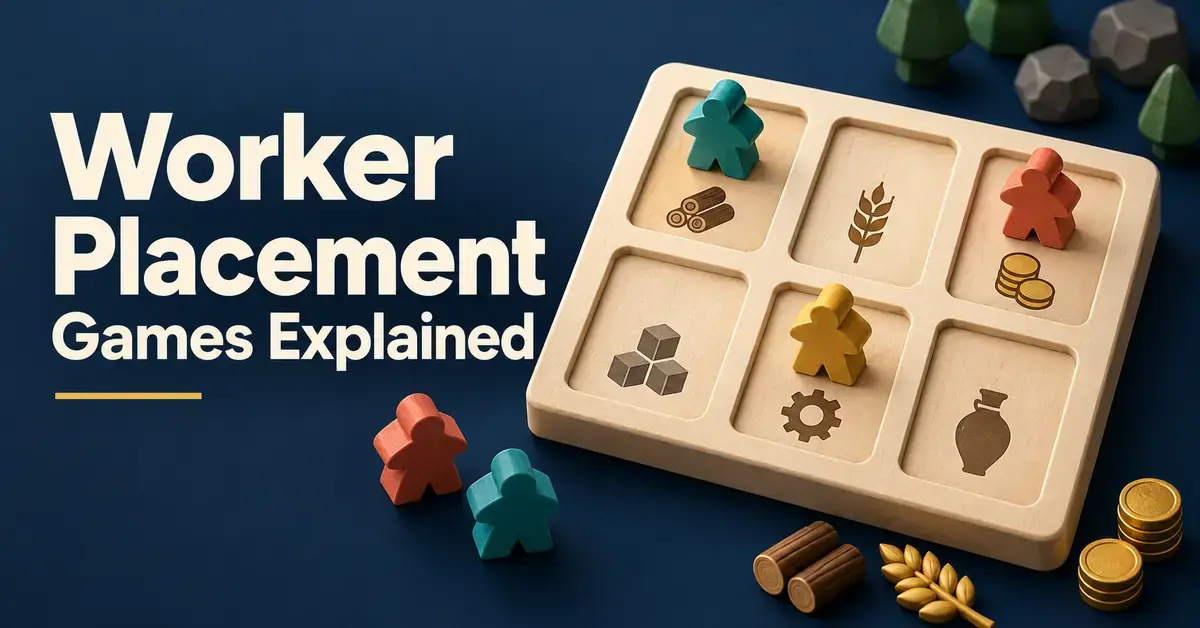
Worker placement is one of the most influential ideas in modern board gaming: each turn you assign a small, limited supply of pawns — your “workers” — to action spaces on a shared board, and once a space is taken it is usually closed to everyone else that round. That single rule turns an ordinary “choose an action” game into a tense contest over scarce opportunities, where grabbing what you need also means denying it to a rival. This guide explains what the mechanic is, where it came from, how a typical turn plays out, why it rewards planning, and which well-known games show it off best — as part of our wider look at board game genres and mechanics.
Key Points
- A worker placement game has you place a limited number of worker pieces on action spaces to take actions.
- Placed workers block the space, so claiming a strong action also denies it to your opponents.
- The mechanic is a form of action selection and is central to many Eurogames.
- It was popularised by Caylus (2005) and brought to a wide audience by Agricola (2007).
- Workers are often meeple-shaped pawns, but can also be discs, cubes or dice.
- The genre rewards forward planning, good timing and reading what your rivals need.
What is a worker placement game?
A worker placement game is a strategy board game in which players take turns placing a limited number of worker tokens onto action spaces to claim resources, actions or other benefits. It belongs to a broader family of mechanics called action selection — the general question of how you choose what to do on your turn. What makes worker placement distinct is that your pieces stay on the board after you place them, physically occupying a space so that no one else can use it until workers are returned.
Most worker placement titles are “Eurogames” — a style of design that favours indirect competition, careful resource management and low randomness, with the winner usually decided by victory points counted at the end. You rarely attack opponents directly. Instead, you compete for the same limited spaces, and the pressure comes from everyone wanting the same useful actions at the same time.
Where the mechanic came from
The mechanic is usually traced to a handful of late-1990s and early-2000s designs. Keydom (1998) is often named as the first game to use the idea, followed by Bus (1999) from the Dutch studio Splotter, designed by Jeroen Doumen and Joris Wiersinga, and Way Out West (2000). The breakthrough came with Caylus (2005) by William Attia, the game widely credited with popularising both the mechanic and the term “worker placement.” Two years later, Uwe Rosenberg’s Agricola (2007) carried the genre into the mainstream and won the 2008 Kennerspiel des Jahres, the German award for more complex “expert” games.
What does “worker placement” mean?
“Worker placement” literally means placing worker pieces to reserve and perform actions. The “workers” are small pawns that represent your available labour for the round: each one you place lets you do one thing, and when you run out of workers, your turn-taking for that round is over. Because the supply is deliberately tight, you can never do everything you want — choosing is the whole game.
The pieces are frequently the little person-shaped tokens called meeples. The word was coined by board-gamer Alison Hansel in November 2000 — reportedly a blend of “my people” said during a game of Carcassonne — and has since become standard gaming vocabulary. For that reason you will sometimes hear the mechanic called “meeple placement.” It is worth knowing, though, that not every worker is a classic meeple: games use discs, cubes, dice, family members, robots or themed figures just as often. The shape does not matter; the placement rule does.
How a turn works in a worker placement game
At its core, a round of worker placement is a simple, repeating loop. A typical turn looks like this:
- Choose a worker and an action space. You pick one of your available workers and the action you want — gather wood, take money, buy a building, score points, and so on.
- Place the worker on that space. The piece sits there, visibly claiming the action.
- Resolve the action. You immediately take whatever the space offers.
- Pass to the next player. Play continues around the table, with each person placing one worker at a time.
- End the round. Once everyone has placed all their workers (or chosen to stop), workers return to their owners and a new round begins, often with a cleanup or income step in between.
Games usually last a fixed number of rounds, and your score grows through the resources, buildings and objectives you gather along the way. Because actions are taken one worker at a time in turn order, the order in which players act can be as important as the actions themselves.
Why blocking is the heart of the genre
Blocking is what separates worker placement from a simple to-do list. Because a placed worker occupies its space, taking an action is also a way of stopping an opponent from taking it — at least this round. If there is only one space that lets you buy the card you both want, whoever reaches it first gets it and the other player must adapt.
This creates a constant double question on every turn: “What do I need most, and what do I most need to stop someone else from getting?” Sometimes the strongest move is not the one that helps you most, but the one that hurts a leading rival. That indirect, non-confrontational tension is exactly why the genre is so popular with players who enjoy strategy but dislike direct conflict or player elimination.
Common structures and variations
Although the core loop is consistent, designers vary worker placement in many ways. Recognising the common patterns helps you learn any new game in the genre faster:
- Single-slot vs. multi-slot spaces. Some spaces hold only one worker (first come, first served), while others let several players stack up, reducing the blocking.
- Growing workforce. Many games, such as Agricola, let you gain extra workers over time, so your options expand as the game progresses.
- Dice as workers. In Stone Age you place workers and then roll dice to see how many resources they gather, adding a measured dose of luck. Other designs use the dice values themselves to decide which spaces a worker can enter.
- Displacement or “bumping.” A few games let you pay to push another player’s worker off a space, loosening the hard blocking rule.
- Timing and movement. The Mayan-themed Tzolk’in famously places workers on interlocking gears that rotate each round, so the longer you leave a worker out, the stronger the reward — turning when you retrieve a worker into a key decision.
- Action strength by order. In several games the earlier you claim a space, the better the payout, pushing players to commit sooner.
Why worker placement rewards planning
Worker placement rewards planning because every choice carries a clear opportunity cost. With only a few workers and many tempting spaces, you cannot react to everything; you have to decide a few turns ahead what engine you are trying to build and spend your limited labour toward it. Players who think in terms of long-term goals — and who read what opponents are collecting — consistently outperform those who grab whatever looks shiny.
Three skills matter most: sequencing (doing actions in an order that sets up later moves), timing (claiming a contested space before someone else needs it), and flexibility (having a backup plan when your first-choice space is blocked). These are transferable ideas that show up across the hobby, which is why the genre pairs so well with general board game strategy. If you are brand new to the hobby, our guide to how to play board games covers the components and turn structure that worker placement builds on.
Well-known worker placement games
The best way to understand the mechanic is to see how different games use it. The titles below are widely recognised examples — this is an illustration of the range, not a ranking. They run from gentle, family-weight introductions to heavier expert games, and they show how the same core idea supports very different themes and levels of complexity.
Worker Placement Games at a Glance
| Game | Year | Designer | Players | Approx. time | Known for |
|---|---|---|---|---|---|
| Caylus | 2005 | William Attia | 2–5 | 60–150 min | Popularised the mechanic and the term |
| Agricola | 2007 | Uwe Rosenberg | 1–5 | 30–150 min | Farming theme; won the 2008 Kennerspiel des Jahres |
| Stone Age | 2008 | Bernd Brunnhofer | 2–4 | 60–90 min | Beginner-friendly; roll dice at resource sites |
| Lords of Waterdeep | 2012 | Peter Lee & Rodney Thompson | 2–5 | 60–120 min | Dungeons & Dragons theme; eight rounds of placement |
| Viticulture | 2013 | Jamey Stegmaier | 1–6 | 45–90 min | Run a Tuscan vineyard across the seasons |
| Everdell | 2018 | James A. Wilson | 1–4 | 40–80 min | Worker placement blended with card tableau building |
Caylus and Agricola are the historical landmarks: the first popularised the mechanic, the second proved it could reach a huge audience. Stone Age is often recommended as a first worker placement game because its theme and rules are easy to grasp. Lords of Waterdeep wraps the mechanic in a Dungeons & Dragons setting that many newcomers find approachable, while Viticulture and Everdell show how modern designs blend worker placement with other systems, such as seasonal rounds or card tableau building.
Common mistakes beginners make
New players tend to lose worker placement games for a small set of predictable reasons. Watching for these is the fastest way to improve:
- Playing only for yourself. Ignoring what opponents need means you miss cheap chances to block them and let them run unopposed.
- Spreading too thin. Dabbling in every strategy usually scores less than committing to one efficient engine and building it well.
- Hoarding resources. Unspent resources rarely score. Convert them into points, buildings or progress before the game ends.
- Ignoring turn order. In many games, going later means the space you wanted is already gone. Factor in where you sit in the order.
- Forgetting the clock. These games last a fixed number of rounds. Plans that would pay off “eventually” are worthless if the game ends first.
Who worker placement games are for
Worker placement suits players who enjoy thoughtful, planning-heavy games with competition that stays civil. If you like puzzles, efficiency and quietly outmanoeuvring opponents — rather than dice-driven luck or direct attacks — the genre is a natural fit. It works well for couples, families with older children and game groups that want depth without aggression.
To get started, pick a lighter title such as Stone Age or Lords of Waterdeep, read the short rulebook once, and accept that your first game is for learning rather than winning. If you prefer to warm up on simpler, familiar games first, the rules of the classic board games are a gentle on-ramp before you tackle a full Eurogame.
Sources
Frequently Asked Questions (FAQ)
What does worker placement mean in board games?
Worker placement means assigning a limited number of worker pieces to action spaces on the board to perform actions or collect resources. Each placed worker claims its space, so you both take an action and prevent opponents from using that same space until workers are returned at the end of the round.
What was the first worker placement game?
Keydom (1998) is frequently cited as the first game to use the mechanic, with Bus (1999) as another early example. However, Caylus (2005) is usually credited with popularising worker placement and the term itself, and Agricola (2007) brought it to a mass audience.
Are worker placement games good for beginners?
Yes. Lighter titles such as Stone Age or Lords of Waterdeep have simple rules and a clear core loop, making them good entry points. Heavier games like Agricola add more decisions and can wait until you are comfortable with the basic idea of placing workers and resolving actions.
What is a meeple?
A meeple is a small person-shaped wooden or plastic token used as a player piece. The word was coined by Alison Hansel in November 2000 during a game of Carcassonne. In worker placement games the workers are often meeples, which is why the mechanic is sometimes informally called meeple placement.
How is worker placement different from other mechanics?
Worker placement is a form of action selection, but unlike simply choosing an action, your pieces remain on the board and block the space for others. That blocking element distinguishes it from mechanics such as deck-building, where you draw actions from cards, or roll-and-move, where dice decide your options.
