

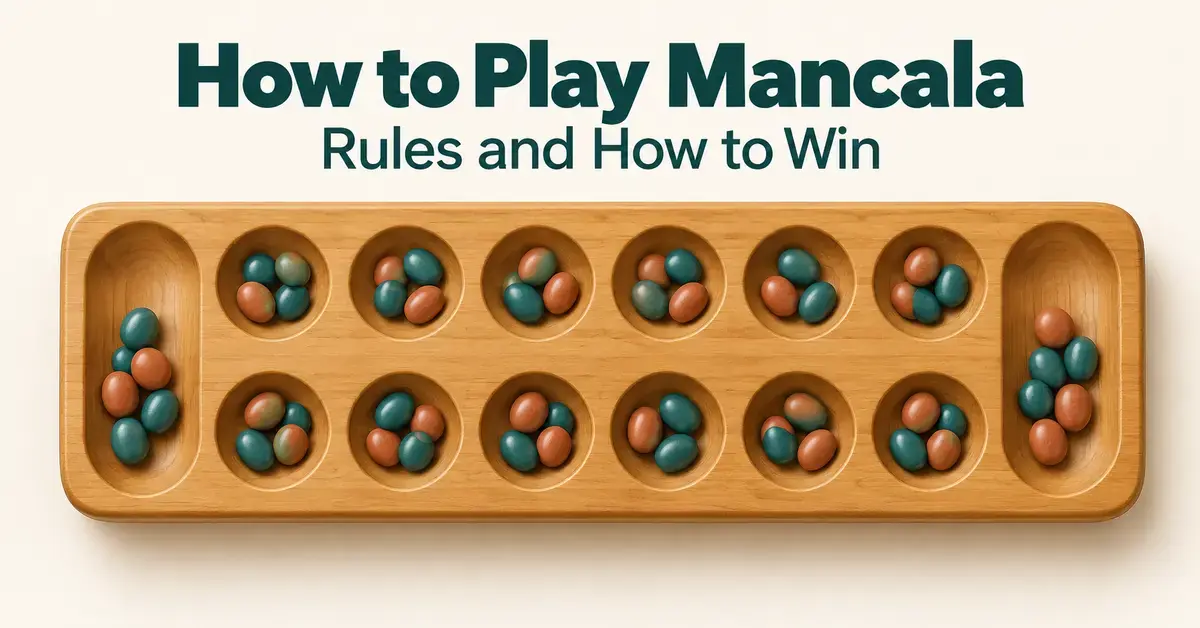
Mancala is one of the oldest and most widely played board game families in the world, and the version most people in North America own is quick to learn: two players take turns scooping up small stones and “sowing” them one pit at a time around the board, trying to collect more stones in their own store than their opponent. This guide explains how to set up the board, how a turn works, how to earn extra turns and capture stones, and how to actually win — then it covers the main variants (Kalah, Oware and Bao) so you know which rules your set is using.
Quick Facts
| Players | 2 |
|---|---|
| Age | 6 and up |
| Playing time | About 10–30 minutes |
| Equipment | Board with 2 rows of 6 pits and 2 stores; 48 stones |
| Type | Abstract strategy, sow-and-capture (count-and-capture) |
| Goal | Collect more stones in your store than your opponent |
| Origin | Ancient family of games, most likely African; Western “Mancala” set is the game Kalah (United States, 1950s) |
What is mancala?
Mancala is not a single game but a whole family of “sow-and-capture” (also called “count-and-capture”) games played on a board of small pits. The word comes from the Arabic naqala, meaning “to move,” which describes the core action: you move stones from one pit to the next. Across the family there are hundreds of named versions, but they share the same idea — pick up all the pieces from one pit and drop them one by one into the pits that follow.
The family is ancient and most likely African in origin. Because the games were often played in holes scratched in the ground rather than on a saved board, hard evidence is thin, but some of the oldest excavated boards come from Ethiopia and are estimated to be at least around 1,300 years old. Today mancala games are played across Africa, the Middle East, the Caribbean and Asia, and have spread worldwide through mass-produced wooden sets.
The version sold in most Western toy aisles simply as “Mancala” is a specific game called Kalah, developed by the American William Julius Champion Jr. and patented and sold in the United States in the 1950s. Because that is the set most readers have at home, the rules below describe Kalah first, then the better-known traditional variants.
What you need to play
Mancala is a two-player game that needs very little equipment:
- A board with two rows of six small pits (often called “holes” or “houses”) and a larger pit, called a store, at each end. Your store is the one on your right.
- 48 playing pieces — stones, seeds, beads or glass beads. The pieces are interchangeable; no player “owns” a colour.
No dice, cards or timer are required, which is part of why mancala travels so well. If you do not own a board, you can play with an empty egg carton (the twelve cups are the pits) and two bowls for the stores.
How do you set up a mancala board?
Setup is identical every game. Place the board between the two players so each controls the six pits on their own side and the store to their right. Put four stones in each of the twelve pits, leaving both stores empty. That is 48 stones in total. Decide who goes first — many players roll for it or simply alternate who starts each game.
How do you take a turn?
On your turn you “sow” the stones from one of your own six pits. The key point: you empty a pit and redistribute its stones one at a time, moving counter-clockwise around the board.
- Pick up all the stones from any one pit on your side.
- Drop one stone into each pit that follows, moving counter-clockwise (to the right along your row, then around the far end and back along your opponent’s row).
- When you pass your own store, drop a stone in it. Never put a stone in your opponent’s store — skip it.
- Your turn ends where your last stone lands, unless that spot triggers an extra turn or a capture (below).
You must always move if you can, and you can only start a sow from a pit that actually has stones in it.
How do you earn an extra turn?
You earn an extra turn whenever your last sown stone lands in your own store. When that happens, you immediately take another turn — and there is no limit on how many extra turns you can chain together in a row if each one keeps ending in your store. Linking several moves together like this is one of the most powerful things you can do in mancala, because it lets you keep scoring and rearranging the board while your opponent waits.
How do you capture stones?
You capture stones when your last sown stone lands in an empty pit on your own side and the pit directly opposite (on your opponent’s side) contains stones. You then take both that last stone and all the stones from the opposite pit and move them into your store. A capture ends your turn.
If the pit opposite is empty, nothing is captured in the standard rules. Note a very common variant, often printed on commercial boards: the empty-capture rule, where landing your last stone in any empty pit on your side captures that single stone into your store even if the opposite pit is empty. Agree with your opponent before the game which version you are using, because it changes the maths.
How does the game end and who wins?
The game ends as soon as one player no longer has any stones in their six pits. At that point the other player moves all the stones remaining on their own side into their own store. Both players then count the stones in their stores.
The player with the most stones in their store wins. Because there are 48 stones in total, a final score of 24–24 is a draw — a genuinely possible result in mancala. There is no bonus for emptying your side first; the running stone count in your store is the only score that matters.
How to win at mancala: strategy and tips
Winning at mancala comes down to banking stones efficiently, chaining extra turns and setting up captures while denying them to your opponent. The strongest habits are simple to state and take practice to execute.
Use the opening extra turn
On a standard Kalah board, a pit that sits exactly as many steps from your store as it has stones will drop its last stone into the store. At the very start every pit holds four stones, so the pit four steps from your store sends its last stone home and earns you an immediate second move. Taking that free extra turn first is a reliable opening for the starting player.
Build toward your store
Favour moves that end in your store so you keep the turn and keep scoring. Stringing several store-ending moves together in one turn is the single biggest swing in the game. Before you commit, glance along the row and look for a sequence that keeps feeding your store.
Set up captures
Keep an eye on which of your pits are empty and whether the opposite pit is loaded. Timing your last stone into an empty pit opposite a full one can sweep a large pile of your opponent’s stones into your store in a single move — captures are where big leads are built.
Watch your opponent’s threats
Captures work both ways. Avoid leaving your own pits with just one or two stones sitting opposite an empty enemy pit, because that is exactly what your opponent needs to capture them. Count the stones your opponent could reach before you make a move that exposes a pile.
Manage your stockpile
Spreading stones across several pits gives you more legal moves and more flexibility each turn, while hoarding everything in one pit leaves you predictable and short of options. That said, a deliberately large pit on the far left can be useful late, as it is hard for an opponent to empty before the game ends. Keep counting, and change plans when the position changes.
Common mistakes beginners make
Most early losses come from a handful of avoidable errors rather than deep strategy:
- Missing free extra turns. Beginners often sow from the first pit that catches their eye instead of checking which move ends in the store.
- Leaving easy captures. Pits holding one or two stones opposite an empty enemy pit are prime targets — don’t hand them over.
- Dropping stones in the wrong store. Remember you sow into your own store and always skip your opponent’s.
- Not counting ahead. Failing to count where a sow will land means missed captures and accidental gifts to the other player.
- Ignoring the endgame. When one side is nearly empty, the player left with stones scoops the remainder; plan for who will be caught holding the board.
- Mixing up rule versions. Starting without agreeing on the empty-capture rule leads to mid-game arguments.
Mancala variants: Kalah, Oware and Bao
Because mancala is a family, “the rules” depend on which game you mean. The three most widely referenced are Kalah, Oware and Bao, and they differ most in how captures and sowing work.
Variant Comparison
| Variant | Board | Sowing | Capture rule | Extra turn | Win condition |
|---|---|---|---|---|---|
| Kalah (Western “Mancala”) | 2 rows of 6 pits, 48 stones | Counter-clockwise, into your own store only | Last stone in an empty pit on your side captures the opposite pit | Yes — if the last stone lands in your store | Most stones in your store (24–24 is a draw) |
| Oware (awari / awalé) | 2 rows of 6 houses, 48 seeds | Counter-clockwise, skipping the start house on long sows | Last seed that makes an opponent’s house total 2 or 3; captures can extend backward | No | First to 25 or more seeds (24–24 is a draw) |
| Bao | 4 rows of pits | Relay sowing (continues from where the last seed lands) | Complex, direction-dependent captures | Via relay sowing rather than a store | Depends on the ruleset; the most complex mancala game |
Kalah is the commercial Western game described above, with its store (the “kalah”) at each end, the land-in-your-store extra turn, and capture by landing in an empty pit on your own side. It is the simplest to teach.
Oware (also spelled awari, and known as awalé, ayo, warri and many other names) is widely associated with the Ashanti people and is the national game of Ghana. It also uses two rows of six houses and 48 seeds, but there is no extra-turn rule, and capturing is different: you capture when your last sown seed brings an opponent’s house to exactly two or three seeds, and the capture can extend backward along a run of qualifying houses. A player needs 25 or more seeds to win, so 24–24 is a draw.
Bao is an East African game, most prominent in Tanzania and Kenya, and is usually considered the most complex member of the family. It is played on four rows of pits rather than two, with relay sowing and intricate capture rules, and is taken seriously as a competitive game with organised tournaments.
Common rule differences and house rules
Even within Kalah, sets and families play slightly differently, so confirm these points before you start:
- Empty-capture: whether landing in any empty pit on your side captures, or only when the opposite pit has stones.
- End-of-game leftovers: the standard rule gives the remaining stones to the player who still has stones on their side; some house rules split or ignore them.
- The pie rule: to offset the starting player’s known advantage, some groups let the second player choose to swap sides after the first move. Kalah is a solved first-player win under several standard settings, so balancing options like this are popular among serious players.
- Sowing direction: the usual direction is counter-clockwise; a few variants sow clockwise.
If you enjoy learning rules sets like this, see our wider guide to classic board game rules and the overview of two-player board games, since mancala shares its head-to-head, perfect-information feel with games like checkers and backgammon. For general sharpening, our board game strategy guide covers principles such as tempo and risk that apply directly to mancala.
Sources
Frequently Asked Questions (FAQ)
Is mancala a game of luck or skill?
Mancala is a game of skill with no hidden information and no dice. Both players can see every stone, and the outcome is decided by counting, planning captures and chaining extra turns. Under standard rules Kalah is even known to be a forced win for the first player with perfect play.
How many stones do you start with in mancala?
In the standard Kalah version you place four stones in each of the twelve pits, for 48 stones in total. Both stores start empty. Traditional Oware uses the same 48-seed setup.
Can you win mancala on the first move?
No. You cannot win on a single turn, but the starting player can gain an early edge by choosing the pit four steps from their store, which lands the last stone in the store and grants an immediate extra turn.
What happens to leftover stones at the end?
When one player’s six pits are all empty, the other player moves every stone still on their own side into their own store. Both players then count their stores, and the higher total wins; a 24–24 tie is a draw.
Is mancala the same as Kalah?
Not exactly. Mancala is the name of the whole family of sow-and-capture games, while Kalah is one specific member of it — the one most commonly sold in the West simply labelled “Mancala.” Oware and Bao are other well-known variants with different capture and sowing rules.
