

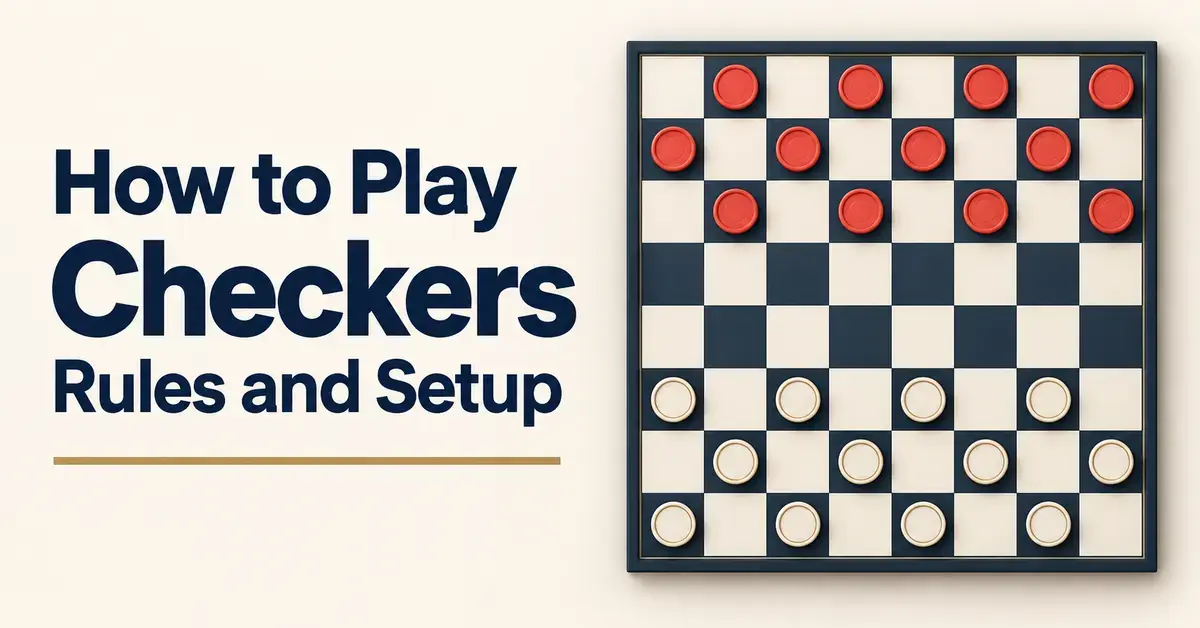
Checkers — called draughts in much of the world — is a two-player strategy game played on the dark squares of a chequered board, where each side tries to capture or trap every one of the opponent’s pieces. It is easy to set up in under a minute and quick to learn, yet it rewards careful planning, which is why it has stayed a kitchen-table favourite for generations. This guide walks through the standard American (English) rules step by step: how to set up the board, how the pieces move, why captures are forced, how to turn a piece into a king, and how to win. At the end we explain how the official international version differs, so you know what is a house convention and what is a tournament rule.
Quick Facts
| Players | 2 |
|---|---|
| Typical age | 6 and up |
| Playing time | About 10–30 minutes (casual) |
| Equipment | 8×8 board (64 squares) and 24 pieces — 12 per player |
| Squares used | Only the 32 dark squares |
| Objective | Capture or block all of the opponent’s pieces |
| Also known as | English draughts (the 8×8 game) |
| Governing bodies | American Checker Federation and World Checkers Draughts Federation (8×8); FMJD for 10×10 international draughts |
What is checkers?
Checkers is an abstract strategy game for exactly two players in which each side commands a row of identical disc-shaped pieces and wins by removing or immobilising the opponent’s pieces. There is no luck or hidden information: both players see the whole board, so every result comes down to choices rather than dice or cards. The 8×8 version described here is the one most people in North America and the UK simply call “checkers” or “draughts”; the two names refer to the same family of games.
Because the rules are short and the equipment is cheap, checkers is a common first strategy game for children and a good entry point into deeper abstract games. If you are completely new to tabletop gaming, it also pairs well with our broader guide on how to play board games, which explains components and turn order from scratch.
What you need to set up a checkers board
You need one standard 8×8 board of 64 squares and 24 pieces — 12 of one colour and 12 of another, traditionally described as “red” (or white) versus “black”. Setup takes about a minute once you know the two rules below: orient the board correctly, then fill the near three rows of dark squares.
Board size and orientation
Place the board so that each player has a light-coloured square in their bottom-right corner (which also means a dark square sits in the bottom-left). This is the same orientation used for chess, and getting it right matters because checkers is played entirely on the 32 dark squares — the light squares are never used. A quick way to check you are set up correctly is that the long unbroken diagonal of dark squares, called the “double corner”, should be on your right.
Placing the 12 pieces
Each player puts their 12 pieces on the dark squares of the three rows closest to them. That fills 12 of your 16 nearest dark squares and leaves the two middle rows of the board empty, creating a four-square gap between the two armies. Uncrowned pieces are called men; a man that is later promoted becomes a king (explained below). Double-check that no piece is sitting on a light square before you begin.
How do the pieces move?
A plain man moves one square diagonally forward to an empty dark square — never sideways, never straight ahead onto a light square, and never backward. Because play is confined to dark squares, every legal move is diagonal by definition. Players alternate turns, making exactly one move (or one capturing sequence) each turn.
Moving men
On a normal, non-capturing turn you slide one of your men diagonally forward by a single square into an adjacent empty dark square. “Forward” means toward the opponent’s side of the board. A man can never move onto a square that is already occupied, and it cannot jump its own pieces. Until a man is crowned, backward movement is not allowed.
Who goes first
In the standard English/American rules the player with the darker pieces moves first, after which turns alternate. Many casual groups simply flip for first move instead, which is a harmless house convention; the important thing is that both players agree before the game starts.
How do captures work?
You capture an opponent’s piece by jumping over it diagonally into the empty square immediately beyond it, then removing the jumped piece from the board. A capture is the heart of checkers, and — crucially — it is not optional.
Jumping a piece
To jump, your piece must be diagonally next to an opponent’s piece, and the square directly beyond that piece (continuing in the same diagonal direction) must be empty. You hop over the enemy piece, land on the empty square, and take the jumped piece off the board. A plain man can only jump diagonally forward; it cannot jump backward until it becomes a king.
Why captures are forced
If a jump is available at the start of your turn, you must take it — jumping is mandatory, not a choice. When more than one capture is available, you may choose which one to make. This is an important detail for beginners: in standard English draughts you are not required to pick the sequence that captures the most pieces, only to make some legal capture. (That “take the maximum” rule belongs to international draughts, covered later.) A historical rule called “huffing”, where an opponent removed a piece that failed to capture, is no longer part of the official rules.
Multiple jumps in one turn
If, after landing from a jump, the same piece can immediately jump another enemy piece, it must continue jumping, chaining captures together in a single turn. A well-placed multi-jump can clear several of your opponent’s pieces at once, which is how most decisive swings happen. The chain ends only when the piece has no further legal jump — or when it reaches the far row and is crowned, which stops the turn at once.
How do you king a piece in checkers?
A man becomes a king the moment it reaches the farthest row from its owner — the opponent’s back row, known as the king row or crownhead. Kinging is the main way to increase your power on the board, because a king can do everything a man can and more.
Reaching the king row
When one of your men lands on any square of the opponent’s back row, it is immediately promoted. You mark this by stacking a second captured piece of the same colour on top of it (that is why spare pieces are useful). If a man reaches the king row as the result of a jump, the turn ends there — you may not keep jumping with it that turn, even if another capture looks available. The newly crowned king can use its extra powers starting on your next turn.
How kings move and capture
A king moves one square diagonally in any direction — forward or backward — and it captures the same way, jumping an adjacent enemy piece into the empty square beyond, forward or backward. Like a man, a king moves only a single square per step in the standard game; the advantage is purely that it is no longer restricted to going forward. That backward reach makes kings far better at chasing down stray pieces and defending your own back rank.
How do you win at checkers?
You win by making it impossible for your opponent to move — either by capturing all of their pieces or by blocking the pieces they have left so that none can make a legal move. A game can also end in a draw when neither side can force a win.
Winning the game
There are two routes to victory. The obvious one is to capture every enemy piece. The second, often overlooked by beginners, is to trap the opponent: if it is their turn and they cannot legally move any piece — all are blocked or captured — they lose immediately, even if pieces remain on the board. Because of this, cornering and immobilising an opponent is just as valid a plan as grinding down their material.
When is it a draw?
If neither player can force a win — for example, when only a few kings remain and nobody can make progress — the game is a draw. Players can agree to a draw, and tournaments add objective limits to stop endless shuffling: a common one declares a draw after a set number of moves (often cited as 40) pass with no capture and no new king. For a casual game at home, agreeing to a draw when progress stalls is perfectly normal.
American checkers vs. international draughts: house vs. official
Everything above describes American (English) checkers, the 8×8 game governed by bodies such as the American Checker Federation and the World Checkers Draughts Federation. The word “draughts”, however, also refers to international draughts, a larger and officially distinct game run by the Fédération Mondiale du Jeu de Dames (FMJD). Knowing the difference stops arguments about which rules are “right”: both are correct, just for different games.
International draughts uses a 10×10 board with 20 pieces per side. Its men may capture backward as well as forward; it enforces a “majority” rule, meaning you must make the capture that takes the most pieces; and a crowned piece becomes a flying king that can slide any number of empty squares along a diagonal, rather than one square at a time. In short, treat the 8×8 single-square-king rules as your default house game, and reach for the 10×10 flying-king rules only when you specifically mean to play international draughts. The table below sums up the split.
Comparison
| Rule | American checkers (English draughts) | International draughts |
|---|---|---|
| Board | 8×8 (64 squares) | 10×10 (100 squares) |
| Pieces per side | 12 | 20 |
| Man capture direction | Forward only | Forward and backward |
| Maximum-capture rule | No — any legal jump is allowed | Yes — you must take the largest capture |
| King type | Single-square king | Flying king (slides along the diagonal) |
| King movement | One square, any diagonal direction | Any number of empty squares on a diagonal |
| First move | Darker pieces | Lighter pieces |
| Governing body | ACF / WCDF | FMJD |
Common mistakes beginners make
Most early losses come from a handful of avoidable errors rather than deep strategy. Watch for these:
- Setting the board up wrong. Forgetting the light-square-on-the-right rule, or placing pieces on light squares, is the most common setup slip — fix it before the first move.
- Forgetting that captures are forced. You cannot “decline” an available jump to keep a piece safe; if you overlook a mandatory capture, you have made an illegal move.
- Giving away free multi-jumps. Advancing a piece next to an enemy without support often hands your opponent a chain capture. Always check what a move exposes.
- Rushing pieces forward. Pushing men too fast creates holes and weak, unprotected pieces; a loose front line is easy to pick apart.
- Abandoning the back row too early. Your own back rank blocks the opponent from crowning kings — breaking it up prematurely lets them promote.
- Treating a king like a man. New players forget their kings can retreat; the backward move is often the one that wins a piece.
Simple strategy to get started
You do not need deep theory to improve quickly. Control the centre of the board, because central pieces have more squares to move to and are harder to trap. Try to advance in connected groups so each piece guards the one ahead of it, rather than sending lone pieces into enemy territory. Aim to crown a king, then use its backward movement to harass your opponent and defend. Finally, think one move ahead: before you move, ask what jumps you would be offering the other player. For more general principles that carry across games, see our guide to board game strategy, and if you enjoy checkers you will find the rest of the classic board game rules worth a look. When you are ready to go beyond the basics, our checkers strategy guide covers opening ideas, midgame traps and endgame technique.
Sources
- Fédération Mondiale du Jeu de Dames (FMJD) — World Draughts Federation
- FMJD Annexes 2024 — official rules of international draughts (PDF)
- Checkers.online — How to play American checkers: rules & tips
- Rarepike — International draughts: the 10×10 version of checkers
- World Mind Games — Draughts vs checkers: the differences
Frequently Asked Questions (FAQ)
How many pieces do you start with in checkers?
Each player starts with 12 pieces in standard American checkers, placed on the dark squares of the three rows nearest to them. International draughts, played on a bigger 10×10 board, uses 20 pieces per side instead.
Can checkers pieces move backward?
Ordinary pieces, called men, can only move and capture diagonally forward. A man gains the ability to move and capture backward only after it is promoted to a king by reaching the opponent’s back row.
Are captures mandatory in checkers?
Yes. If a jump is available at the start of your turn you must take it. When several captures are possible you may choose which one to make, and in standard English checkers you are not forced to pick the one that captures the most pieces.
How do you get a king in checkers?
Move one of your men all the way to the farthest row from you — the opponent’s back row, called the king row. It is crowned immediately, usually by stacking a second piece on top, and from then on can move and capture in any diagonal direction.
How do you win a game of checkers?
You win by capturing all of your opponent’s pieces or by blocking them so that they have no legal move on their turn. If neither side can force a win, the game is a draw, either by agreement or by the tournament move limit.
