

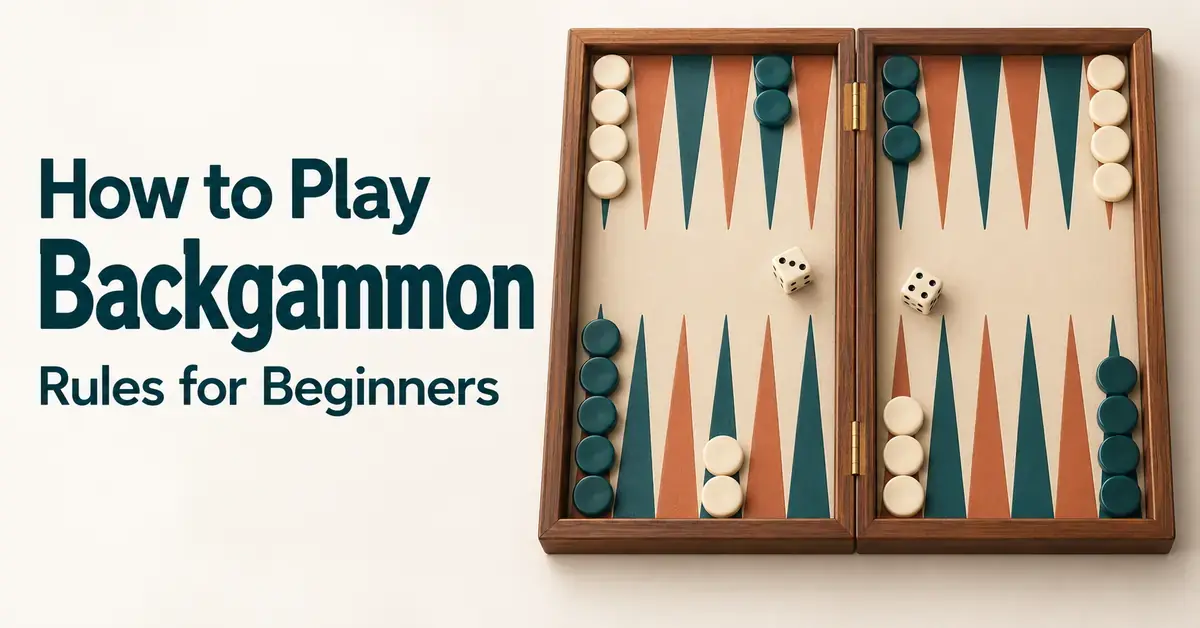
Backgammon is a two-player board game of dice and movement in which each player races 15 checkers around a board of 24 points and off the other side. The first player to remove all of their checkers wins. It is one of the oldest games still played today, and while the basic goal is simple, the mix of luck and decision-making keeps it interesting for a lifetime. This guide walks you through the board, the starting position, how the dice work, hitting and re-entering, bearing off, scoring and the doubling cube — everything a beginner needs to play a full game correctly.
Quick Facts
| Players | Exactly 2 |
|---|---|
| Playing time | About 10–30 minutes per game |
| Recommended age | 8 and up |
| Equipment | Board, 30 checkers (15 each), two dice, optional doubling cube and dice cups |
| Objective | Be first to move all 15 checkers into your home board and bear them off |
| Game type | Race game combining dice luck and strategy |
What is backgammon?
Backgammon is a racing game for exactly two players. Each player controls 15 checkers (also called stones or men) and moves them in opposite directions around the board according to the roll of two dice. Your checkers travel toward your own home board, and once they are all there you begin removing them. The winner is whoever takes all 15 of their checkers off the board first.
The game has roots stretching back thousands of years to ancient race games of the Near East, and the modern version with the doubling cube took shape in the 1920s. Today it is played casually at home and competitively in clubs and tournaments worldwide. Because every turn blends a random dice roll with a genuine choice of how to use it, backgammon rewards both careful planning and good judgement under uncertainty — the same balance you will find across many card and dice games.
What you need to play
A standard backgammon set contains everything required for one game. You do not need to buy anything extra to start.
- The board: a folding board marked with 24 narrow triangles called points.
- Checkers: 30 in total — 15 of one colour for each player.
- Dice: two six-sided dice per player (four in total), though two shared dice also work.
- Dice cups: optional shakers used to roll the dice fairly; common in competitive play.
- The doubling cube: a larger six-sided die marked 2, 4, 8, 16, 32 and 64, used to raise the value of the game (explained later).
The backgammon board layout
The board is divided into four quadrants of six points each, so there are 24 points in total. The points alternate in colour and are the lanes your checkers travel along. A raised ridge down the middle, called the bar, separates the two halves of the board.
Each player has a home board (also called the inner board) and an outer board. Your home board is one quadrant of six points; your outer board sits next to it, on the same side of the bar. Your opponent’s home and outer boards fill the other half. Players number the points 1 to 24 from their own point of view, starting at 1 in their home board and counting up to 24 in the far corner.
The two players move in opposite directions. Each player moves their checkers from the 24-point down toward the 1-point, always heading into their own home board. Because the players sit across from each other, one player’s 1-point is the other player’s 24-point.
How to set up the board (starting position)
The starting position is fixed and the same in every standard game. From your own perspective, place your 15 checkers as follows, with your opponent mirroring the arrangement on the matching points.
- Two checkers on your 24-point (the far corner, in your opponent’s home board).
- Five checkers on your 13-point (in your opponent’s outer board).
- Three checkers on your 8-point (in your own outer board).
- Five checkers on your 6-point (in your own home board).
That adds up to 15 checkers (2 + 5 + 3 + 5). Your opponent’s checkers sit directly opposite on the equivalent points, so the board looks symmetrical at the start. The table below shows the full standard setup at a glance.
Starting Position
| Point (your view) | Your checkers | Location |
|---|---|---|
| 24-point | 2 | Opponent’s home board (far corner) |
| 13-point | 5 | Opponent’s outer board |
| 8-point | 3 | Your outer board |
| 6-point | 5 | Your home board |
| Total | 15 | Opponent mirrors this setup |
Starting the game: the opening roll
To decide who goes first, each player throws a single die. The higher number wins and that player goes first. Importantly, the opening player does not re-roll — they play the two numbers just thrown, using their own die and their opponent’s die as the first move. If both players roll the same number, they throw again until the numbers differ.
After the opening move, players alternate turns. On your turn you roll both dice and move your checkers accordingly.
How to move your checkers
Each turn you roll two dice, and the two numbers are two separate moves. A roll of 5 and 3, for example, lets you move one checker five points and another checker three points, or move a single checker eight points in total (five then three, or three then five). You may only move to an open point — one that is not occupied by two or more of your opponent’s checkers.
Here are the core movement rules every beginner must know:
- Move toward your home board. Checkers always travel from higher-numbered points to lower-numbered points, never backward.
- A point is blocked if your opponent has two or more checkers on it. You cannot land there, though you may jump over it.
- Doubles are played twice. If you roll the same number on both dice — say double 4 — you have four moves of that number to use, not two.
- You must use both numbers if you legally can. If only one number can be played, you must play it. If either could be played but not both, you must play the higher number. If neither number can be played, you forfeit the turn.
- Making a point: landing two or more of your own checkers on the same point gives you control of it, blocking your opponent from landing there.
Building several blocked points in a row forms a prime, a wall that can trap an opponent’s checkers behind it. Deciding when to race ahead and when to build blocks is where the game turns into a contest of judgement — the kind of thinking covered in our guide to board game strategy.
Hitting and entering from the bar
A point occupied by a single checker is called a blot. If your checker lands on a point holding a single enemy blot, you hit it: the opponent’s checker is removed from the point and placed on the bar in the middle of the board.
A checker on the bar cannot make any other move until it re-enters the board. At the start of their turn, the player with a checker on the bar must bring it back in before doing anything else. The checker re-enters in the opponent’s home board, on the point matching one of the dice numbers. For example, if you roll a 3, you may enter on the point counted three in from the edge of your opponent’s home board, provided that point is open.
If both numbers correspond to points blocked by the opponent, the checker cannot enter and the whole turn is lost. If you have more than one checker on the bar, you must enter them all before you may move any other checker. Being hit is a real setback, because the checker has to start its journey around the board again.
Bearing off: removing your checkers
Bearing off is the final phase — removing your checkers from the board to win. You may only begin once all 15 of your checkers are in your home board (points 1 to 6).
To bear off, roll the dice and remove checkers from the points matching the numbers. A roll of 5 bears off a checker from your 5-point; a roll of 2 bears off a checker from your 2-point. If you roll a number higher than any occupied point, you may bear off a checker from the highest occupied point instead — so a 6 can bear off a checker from your 5-point if nothing sits on the 6-point. You can also choose to move a checker inside your home board rather than bear one off, if that is legal and sensible.
One crucial rule: if your opponent hits one of your checkers during the bear-off — because you left a blot — that checker goes to the bar, and you must bring it all the way back around and into your home board again before you can resume bearing off. The first player to bear off all 15 checkers wins the game.
Winning and scoring
Backgammon is scored in points, and there are three levels of win depending on how far behind the loser is at the end. This matters because a single game can be worth one, two or three points.
- Single game (1 point): you bear off all your checkers while your opponent has already borne off at least one of theirs.
- Gammon (2 points): you bear off all your checkers before your opponent has borne off any of theirs.
- Backgammon (3 points): you bear off all your checkers while your opponent has borne off none and still has at least one checker on the bar or in your home board.
A “backgammon” is therefore both the name of the game and its biggest single result. These base values (1, 2 or 3) are then multiplied by the doubling cube, described next.
The doubling cube explained
The doubling cube is a marked die used to raise the value of the current game. It is not a playing piece and never moves around the board — it simply records how many points the game is now worth. At the start of a game the cube sits in the middle showing 64, which here means the game is worth its normal 1 point and belongs to neither player.
At any point before rolling, a player who feels they are ahead may offer a double, proposing to play for twice the current value. The opponent then chooses:
- Take (accept): the game continues at double the value, and the cube is turned to the new number and placed on the accepting player’s side. Only that player may offer the next double — this is called owning the cube.
- Drop (decline): the game ends immediately and the player who declined concedes, losing the game at its value before the double was offered.
A game can be redoubled several times (2, then 4, then 8, and so on), with ownership passing back and forth each time an offer is accepted. The final result combines the win type and the cube: a gammon (2) with the cube at 4 is worth 8 points, for instance. In short, the cube multiplies the one, two or three points a game is worth — it is a scoring mechanism, not a required part of the basic rules, and beginners can safely ignore it until the rest of the game feels comfortable.
Common mistakes beginners make
Knowing the rules is only half the battle; a few errors trip up almost every new player. Watching for these will make your early games much smoother.
- Leaving unnecessary blots. A lone checker can be hit and sent to the bar. Try to keep checkers paired on points, especially near your opponent’s checkers.
- Forgetting the “must play both dice” rule. You cannot skip a number just because the other move is more convenient — if both numbers are legal, both must be played.
- Moving the wrong way. Each player moves toward their own home board. It is easy to drift in the wrong direction when you first learn; always confirm which home board is yours.
- Bearing off too early. Every one of your 15 checkers must be in your home board before you remove any. A checker still on its way back does not count.
- Breaking your home board during the bear-off. If an opponent checker is still trapped behind you, clearing your home points can give it a safe place to land and set up a hit.
Backgammon variants worth knowing
Once you are confident with the standard game, several popular variants change the setup or the dice rules for variety. They all use the same board and checkers.
- Acey-deucey: checkers start off the board and enter from the bar; a roll of 1-2 is special, letting the player choose a doubles roll and move again.
- Nackgammon: a slight change to the starting position that spreads the back checkers out, producing longer, more complex games.
- Hypergammon: each player uses only three checkers, making for very fast, hit-heavy games.
- Dutch backgammon: all checkers begin on the bar and must be entered before any can be hit.
Backgammon fits neatly alongside the other timeless titles in our overview of classic board game rules, and if you are brand new to tabletop gaming in general, start with our wider beginner’s guide to board games before diving in.
Sources
How to start getting better
Once the rules feel natural, a few simple principles improve your results quickly. Make points in your home board to build a wall the opponent must enter past; hit blots when doing so gains you ground rather than just for the sake of it; and keep your checkers connected so they support one another. Thinking about the race — roughly counting how many pips each side needs to get home — helps you decide whether to play an attacking or a running game.
Backgammon rewards practice far more than memorisation, so the fastest route to improvement is simply to play often and review your tighter games. If you enjoy the race-and-block tension here, you may also like the other classic board game rules in the same family, and you can sharpen your decision-making with general board game strategy that applies well beyond a single title. Backgammon also sits comfortably alongside other two-player board games for head-to-head play, and if you want a purely skill-based classic to try next, chess is a natural companion. Any unfamiliar words such as blot, bar or pip are explained in our board game glossary.
Frequently asked questions (FAQ)
How many checkers does each player have in backgammon?
Each player has 15 checkers of a single colour, for 30 in total. They begin in the fixed starting position — two on the 24-point, five on the 13-point, three on the 8-point and five on the 6-point — and the goal is to move all 15 into your home board and then bear them off.
What happens when you roll doubles?
Rolling the same number on both dice lets you play that number four times instead of twice. For example, double 5 gives you four moves of five points each, which you may spread across different checkers or use to move fewer checkers farther. If you cannot use all four moves legally, you play as many as you can.
What does it mean to hit a checker?
Hitting means landing on a point occupied by a single opposing checker, called a blot. The hit checker is removed and placed on the bar, and its owner must re-enter it in your home board on their next turn before making any other move. Being hit forces that checker to travel the whole board again.
When can you start bearing off?
You can begin bearing off only when all 15 of your checkers are inside your home board, the quadrant covering your points 1 to 6. You then remove checkers using the dice numbers. If a checker is hit after you start, it must come all the way back and re-enter your home board before you can continue.
Do you have to use the doubling cube?
No. The doubling cube is optional and only affects how many points a game is worth, not how checkers move. Casual players often leave it out entirely while learning. When used, it multiplies the game’s value — 1 for a single win, 2 for a gammon or 3 for a backgammon — by whatever number the cube shows.
