

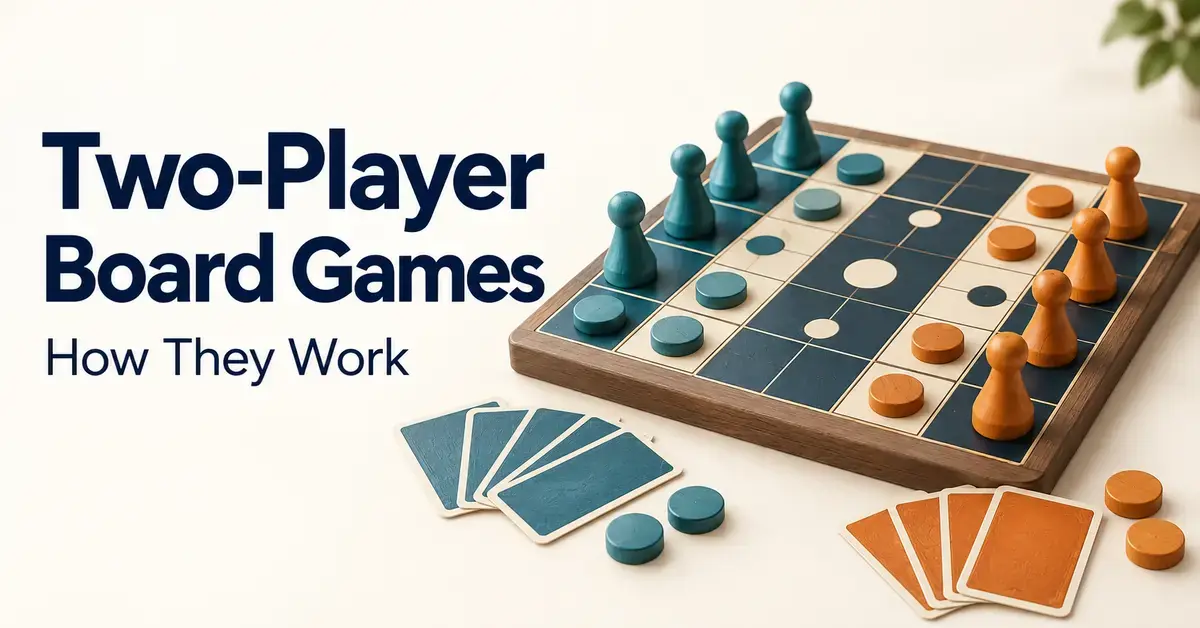
A two-player board game is any tabletop game built to give a satisfying contest, or sometimes a partnership, between exactly two people. Some are designed only for a pair; others simply include two among a wider range of player counts printed on the box. The distinction matters, because the same rules can feel completely different with two players than with four. This guide explains what actually makes a game work head-to-head: how designers handle balance, interaction and pacing, why a two-player count removes some problems and creates others, and how a single player can even face a simulated opponent when no second person is available.
Key Points
- Two groups: games designed only for two, and games that support two within a wider player-count range — the first usually plays better head-to-head.
- Symmetry gives both players identical starting positions, the simplest way to make a two-player game fair.
- Direct interaction (attacking, blocking, area control) creates confrontational, often zero-sum play; drafting and parallel building offer gentler, indirect competition.
- First-player advantage can matter in close games and is handled with compensation rules or the “pie rule.”
- An automa is a card-driven simulated opponent that lets one person play a two-player game solo.
What counts as a two-player board game?
Two broad groups fall under the label “two player board games,” and telling them apart is the first useful step. The first group is games designed exclusively for two, where every rule, card and component is tuned for a single opponent. The second group is games that support a range of counts, such as two to four or two to six, and include a two-player configuration among their options.
You can check which kind you are holding on the box itself: the player-count figure (for example “2” or “2–4”) states the supported range, and dedicated two-player titles list only “2.” If you are new to reading that information and the rest of a game’s components, our beginner’s guide to how to play board games walks through the box, the rulebook and turn structure in plain language.
Why two players changes the whole game
At two players, every decision lands directly on the one person across the table, and that reshapes how a game feels. There is no third party to absorb an attack, no alliance to form or break, and no “kingmaking” — the situation in larger games where a losing player gets to decide which of the leaders wins. With only two, the contest is a straight line between you and your opponent.
Two players also changes pacing. Downtime — the time you spend waiting between your own turns — is at its minimum, because the table comes back to you after a single other turn. That makes two-player sessions feel fast and focused, which is one reason the format is popular for couples, roommates and regular gaming partners who want a quick, repeatable game. It also raises the stakes on balance: with no one else to even things out, any built-in advantage for one side shows up clearly in the result.
Symmetry: starting on equal footing
Symmetry means both players begin with identical positions, pieces and options, so the game is fair by construction. Classic abstract strategy games — games of pure skill with no hidden information and no luck, such as chess, checkers and Go — are the clearest examples: each side has the same army or stones and the same rules, and only the moves differ. A symmetric setup is the simplest way to make a two-player game feel fair, because neither side can blame the starting conditions.
Not every game is symmetric. In an asymmetric two-player game, each side is deliberately different — different powers, goals or pieces — which adds variety but forces the designer to balance the two sides carefully through testing. A related issue is first-player advantage: in many turn-based games the player who moves first has a small edge. Designers handle this in several ways, such as giving the second player a compensating bonus, or using the “pie rule,” where one player sets up the position and the other chooses which side to take. You can read how symmetry and other mechanics fit into the wider picture in our overview of board game genres and mechanics.
Direct interaction and head-to-head conflict
Direct interaction is when your moves visibly affect your opponent’s position — attacking pieces, blocking routes, taking territory or forcing a response. Head-to-head board games lean heavily on this: the tension comes from reading what the other player intends and countering it. Chess is the archetype, but many modern games use direct interaction through combat, area control (competing to dominate regions of the board) or card play that removes an opponent’s options.
Games built on heavy direct interaction are often effectively zero-sum: ground you gain is ground your opponent loses. That produces a sharp, confrontational experience that some players love and others find stressful. It is worth knowing your own preference before you commit an evening to a long, cutthroat duel. For readers who enjoy the thinking side of this, principles like tempo and reading opponents are covered in our guide to board game strategy.
Drafting and other low-conflict systems
Not all two-player games are confrontational. Drafting is a gentler form of interaction in which players pick from a shared pool of cards or tiles, so choosing what you want also denies it to the other player. The pressure is indirect: you are competing for the same limited resources rather than attacking each other directly. 7 Wonders Duel (2015, designed by Antoine Bauza and Bruno Cathala) is a well-known two-player game built around drafting cards from a shared layout, where taking a card both helps you and keeps it from your opponent.
Other low-conflict approaches include parallel building, where each player develops their own engine or display and the winner is simply whoever builds more effectively, and “tug-of-war” tracks, where a shared marker slides toward one side or the other. These systems suit players who want a thoughtful race rather than a fight, and they are a common choice for board games for couples who prefer building together in friendly competition over direct combat. Many classic two-player experiences also live in the card and tile world; see our rundown of card and dice games for staples like cribbage that play beautifully with two.
Comparison
| Approach | How it works | Interaction level | Example type |
|---|---|---|---|
| Symmetric abstract | Both sides start identical; pure skill, no luck or hidden information | High, direct | Chess, checkers, Go |
| Head-to-head confrontation | Attacking, blocking or area control; gains for one are losses for the other | High, direct | War and combat games |
| Drafting / parallel build | Pick from a shared pool; choosing denies the other player | Medium, indirect | 7 Wonders Duel |
| Multiplayer game scaled to two | Two-player variant or a neutral “dummy” player fills the gap | Varies | Many 2–4 player titles |
| Solo vs. automa | A card-driven simulated opponent replaces a human | Simulated | Games with built-in solo modes |
Games built for two versus games that scale down
Whether a game was designed for two or merely supports two is the single biggest predictor of how good the two-player experience will be.
Dedicated two-player games
Dedicated games tune everything around a single opponent. Because the designer never had to make the rules work at three, four or five players, they can focus entirely on the back-and-forth between two people. These games tend to have tight balance, strong interaction and little wasted structure, which is why the “2 player board games” category contains so many purpose-built titles.
Multiplayer games played at two
Many games that support three or more players also offer a two-player mode, but the quality varies. Some add special two-player rules — adjusted setups, extra restrictions, or a removed element — so the game still works. Others introduce a neutral “dummy” player or token that blocks spaces or takes cards to recreate the pressure a missing player would have provided. A game that merely lets two people play without adjusting anything can feel loose, because mechanisms meant to create competition between several players lose their bite with only two. Always check whether a game has a genuine two-player variant before assuming it plays well at that count.
Solo modes and the “automa”: facing a simulated opponent
An “automa” is a simulated opponent run by a set of cards or rules rather than by a second person, letting one player enjoy a game built for two or more. The automa does not think; it follows a scripted deck that tells the player what the fake opponent does each turn. Crucially, an automa usually does not gather and spend resources the way a human would — instead its cards instruct you to award it points or block spaces at a rate tuned, through heavy testing, to mimic the pressure of a real rival.
The modern automa concept was popularised by designer Morten Monrad Pedersen, who created the official solo mode for Stonemaier Games’ vineyard game Viticulture and went on to found Automa Factory, a studio that builds solo modes for other publishers. For two-player fans, automa systems matter because they let a two-player game stay playable when a partner is not around, and they let one person practise a game’s rhythm before teaching it. An automa is a clever substitute, not a true replacement: it reproduces the pacing of a second player without the bluffing, adaptation and surprise a human brings.
Common mistakes with two-player board games
A few avoidable errors spoil more two-player sessions than any rules question.
- Assuming every game plays well at two. A box that says “2–4” supports two, but that does not mean two is the best experience. Check for a dedicated two-player variant first.
- Ignoring first-player advantage. In close, skill-heavy games the first move can matter. Agree in advance how you will decide who starts, and consider alternating or using a compensation rule over a series.
- Mismatching the game to the mood. A long, cutthroat confrontation is a poor fit for a relaxed evening, and a gentle building game can feel flat if both players wanted a fight. Match the interaction level to what you both want.
- Skipping the two-player setup rules. Many games hide important adjustments — a smaller board, fewer rounds, a neutral token — in a short section of the rulebook. Missing them unbalances the game.
- Expecting a solo automa to feel human. An automa recreates pressure and pacing, not personality. Judge it as a practice tool or a stand-in, not as an equal to a live opponent.
Who two-player board games suit
Two-player board games suit anyone who most often plays with exactly one other person: couples, roommates, two friends who meet regularly, and parents playing with a child. The low downtime and direct contest make them easy to set up on a weeknight and quick to replay, and the format rewards learning a single game deeply rather than juggling many. Because this is a broad, neutral category rather than a shopping list, the right choice depends on how much direct conflict you enjoy, how long you want a session to run, and whether you also want a solo option for evenings on your own. If you are still building your general footing, start with the fundamentals in our classic board game rules hub and work up from there.
Sources
Frequently Asked Questions (FAQ)
What makes a board game good for two players?
A good two-player game balances both sides fairly — often through symmetry — and gives players meaningful ways to affect each other, whether through direct conflict or shared-resource drafting. Low downtime and a clear, repeatable contest also help, since with only two people every turn comes back quickly and every decision matters.
What is the difference between a two-player game and a game that supports two?
A dedicated two-player game is designed only for a pair, so every rule is tuned for one opponent. A game that supports two includes a two-player option within a wider range; it may add special rules or a neutral “dummy” player to work well, or it may feel looser if it does not adjust for the lower count.
Do two-player board games have a first-player advantage?
Many turn-based games give the first player a small edge, which is most noticeable in close games of pure skill. Designers offset it with compensation bonuses or the “pie rule,” where one player sets up and the other chooses a side. Players can also simply alternate who starts across a series of games.
What is an automa in a board game?
An automa is a simulated opponent controlled by a deck of cards or a short rule set rather than by a second person. It does not strategise; it follows scripted instructions that award it points or block spaces at a rate tuned to feel like a real rival, letting one player enjoy a game built for two or more.
Are two-player board games only for couples?
No. While they are popular for couples, two-player board games suit any pair who play together often — roommates, friends, or a parent and child. The category is defined by the player count and the design ideas behind it, not by who is sitting at the table.
