

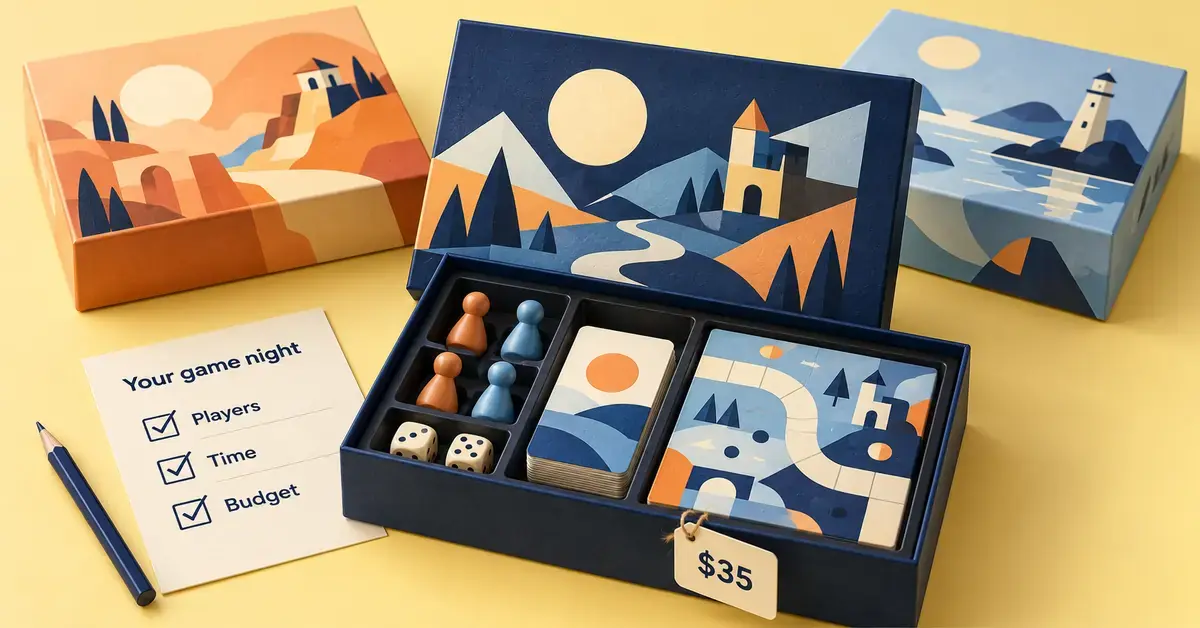
Choosing a board game is less about finding the “best” game and more about finding the right one for the people, time and budget you actually have. A brilliant game that your group never finishes is a worse purchase than a simple one everyone replays. This beginner’s buyer’s guide walks through every decision that matters — who is playing, how complex a game should be, how long it runs, what it costs and how to read the box — so you can buy with confidence the first time.
Key Points
- Choose for your group first: player count, ages and taste matter more than a game’s online reputation.
- Buy for your usual player count, not the largest group you could ever gather.
- Match complexity using BoardGameGeek “weight” (1.0 light to 5.0 heavy); beginners should start at about 1.0–2.5.
- Set a time and price budget — family and gateway games typically run under an hour and cost about $25–45.
- Trust independent signals: Spiel des Jahres award seals and BoardGameGeek player-count polls beat box marketing.
- Start with a gateway game and a base game (never an expansion) for your first purchase.
What “choosing the right board game” really means
The right board game is the one your specific group will actually play again. That depends on a handful of practical factors rather than a game’s reputation: the number of players, their ages and patience, how complex the rules are, how long a session lasts and how much you want to spend. A heavy strategy game can be a masterpiece and still be the wrong choice for a casual family evening. Throughout this guide, treat “best” as “best fit for you,” not “highest rated online.”
Start with your group: who is actually playing?
Begin with the people, not the game. The most common reason a new game disappoints is a mismatch between the game and the players, so pin down your typical group before you look at anything on a shelf.
How many players will you usually have?
Buy for the player count you have most often, not the biggest group you can imagine. A box that says “2–5 players” is not equally good at every number. Many games shine at a specific count and feel flat at the extremes — some drag with two, others get chaotic with five. If your game nights are usually three people, prioritise games that are strong at three. If you are mostly a pair, a dedicated two-player design will almost always beat a big-group game squeezed down to two. Our guides to two-player board games and three-player board games explain which designs hold up at those counts.
Ages and reading level
The age printed on the box is a guideline, not a rule. It usually reflects reading level, rules complexity and small-part safety rather than whether a child will enjoy or stay engaged with the game. A curious eight-year-old may happily play a game labelled 10+, while a younger child may lose interest in a “6+” game that involves a lot of reading. If you are shopping for children, match the game to the child in front of you; our breakdown of board games for kids by age gives stage-by-stage suggestions.
What does your group actually enjoy?
Think about the kind of experience the group likes before you think about mechanics. Some people love direct conflict and bluffing; others hate being attacked and prefer building something of their own. Some want quick laughs; others want a tense hour of planning. A quick, honest read of your group’s taste prevents the classic mistake of buying a cut-throat war game for people who just wanted a relaxed evening.
Match the complexity to your group
Complexity is the single biggest predictor of whether a new game gets a second play. Too simple and experienced players get bored; too heavy and newcomers bounce off the rulebook. The hobby has a shared shorthand for this called “weight.”
What is BoardGameGeek “weight”?
Weight is a community complexity score on BoardGameGeek, running from 1.0 (lightest) to 5.0 (heaviest). Users vote on each game, so the number is a crowd-sourced average rather than an official rating, and BoardGameGeek itself notes the term is loosely defined and subjective. Voters weigh things like how long the rulebook is, how much the outcome depends on planning versus luck, how many decisions you juggle and how many plays it takes before the game “clicks.” The commonly used bands are:
- Light (about 1.0–2.0): easy to teach in a few minutes, forgiving, great for mixed groups and newcomers.
- Medium (about 2.1–3.0): more decisions and a longer teach, but still approachable — the sweet spot for most game nights.
- Heavy (about 3.1–5.0): long rulebooks, deep strategy and a real time investment; rewarding for enthusiasts, intimidating for beginners.
Weight is not the same as quality. A light game can be superb and a heavy game can be a slog. Use the number only to gauge how hard a game is to learn and run, not whether it is “good.”
Which weight should a beginner pick?
If you or your group are new, start in the light-to-medium range (roughly 1.0–2.5). These games teach quickly, survive rules mistakes and leave people wanting another round rather than a lie-down. You can always graduate to heavier games once the group enjoys the hobby; working up is far easier than recovering from a disastrous first night with a four-hour monster.
How long do you want to play?
Decide your time budget before you buy, because play time shapes the whole evening. The time on the box is an estimate for players who already know the rules — your first game or two will usually run longer while everyone learns. As a rough map: fillers and party games run about 15–30 minutes, family and gateway games about 30–60 minutes, and heavier strategy games 90 minutes to several hours. If your group’s attention fades after an hour, a 20-minute game you finish beats a two-hour game you abandon. If you want to shorten the learning time on any game, our tips on how to learn a new board game fast help.
Understand the main types of game
Knowing a few broad categories makes the shelf far less overwhelming and helps you match a game to your group’s taste. You do not need to memorise every mechanic — our overview of board game genres and mechanics goes deeper — but these distinctions matter most when choosing.
Cooperative or competitive?
This is the first fork for most groups. In competitive games, players compete to win individually; in cooperative board games, everyone works together against the game itself, winning or losing as a team. Cooperative games are gentle on groups who dislike conflict or have a wide skill gap, because stronger players can help newer ones. Competitive games create more tension and replay rivalry. If you play by yourself, note that some games support a single player — see our guide to solo board games.
Eurogame or American-style?
Two broad design traditions help predict how a game feels. Eurogames tend to minimise luck and direct conflict, keep everyone in the game until the end and reward efficient planning — our explainer on what a eurogame is covers the hallmarks. American-style (or “Ameritrash”) games lean into theme, dice, player conflict and dramatic swings. Neither is better; they simply suit different tastes. Groups that hate being eliminated or attacked usually prefer eurogames.
Set a budget: what board games cost
Set a price range early, because board game costs vary widely by type. Figures below are approximate and shift with retailer, edition and currency, but the tiers are consistent:
- Card and filler games: roughly $10–25 — small boxes, quick to play.
- Family, party and gateway games: roughly $25–45 — where most beginners should start.
- Hobby strategy games: roughly $45–100 — bigger boxes, more components, longer play.
- Deluxe and collector editions: $100 and well beyond — premium components and miniatures.
A higher price does not mean a better fit. Many of the most-loved beginner games sit in the mid-range. Watch for “expansions,” which are add-ons that require the base game; never buy an expansion as a first purchase.
How to read a board game box
The box is a quick-reference spec sheet once you know what to look for. Before buying, check these in order:
- Player count: the supported range — confirm it covers your usual group size.
- Play time: the estimate for experienced players; add time for your first games.
- Recommended age: a guide to reading level and complexity, not a hard limit.
- “Base game” vs “expansion”: an expansion needs the original game to play.
- Award seals: a red, blue or anthracite-grey pawn signals a Spiel des Jahres family award (explained below).
If you can, look up the game’s weight and player-count polls online before buying — those two numbers tell you more than the marketing on the front of the box.
Where to find trustworthy recommendations
Independent awards and community data are the most reliable signals for a beginner, because they are not marketing. Two sources do most of the work.
Spiel des Jahres and its siblings
The Spiel des Jahres (“Game of the Year”) is the most influential board game award, running annually in Germany since 1979, and its red pawn seal is a strong sign of an accessible, well-designed game. It is deliberately aimed at mainstream players, so its winners make excellent gateway picks — past winners include Catan (1995), Carcassonne (2001), Ticket to Ride (2004), Codenames (2016) and Azul (2018). The award later grew a family: the blue-pawn Kinderspiel des Jahres (added 2001) recognises children’s games, and the anthracite-grey-pawn Kennerspiel des Jahres (added 2011) honours slightly more involved games for players ready to go a step beyond the gateway. Spotting any of these pawns on a box is a dependable shortcut to quality.
BoardGameGeek ratings
BoardGameGeek (BGG) is the hobby’s largest database and a useful sanity check before you buy. Alongside the weight score, each game page shows an average community rating out of 10, the recommended and “best” player counts voted by players, and discussion of how the game plays. Use it to confirm that a game is good at your specific player count and complexity level — just remember the ratings skew toward dedicated hobbyists, so a modest rating does not mean a game is a poor family choice.
Gateway games: reliable first picks
Gateway games are light-to-medium titles designed to welcome newcomers into the hobby, and they are the safest category for a first purchase. They teach in minutes, play in under an hour and keep everyone involved. The table below compares a few widely recommended, award-winning examples across the specs that matter when choosing. For a broader look at easy-going picks, see our guide to family and party board games.
Gateway Games Compared
| Game | Players | Play time | Age | Complexity | Why it’s a good starter |
|---|---|---|---|---|---|
| Ticket to Ride | 2–5 | 30–60 min | 8+ | Light | Collect cards, claim train routes; simple rules, Spiel des Jahres 2004 winner |
| Carcassonne | 2–5 | ~35 min | 7+ | Light | Draw-and-place tiles to build a landscape; quick teach, Spiel des Jahres 2001 |
| Azul | 2–4 | 30–45 min | 8+ | Light | Draft tiles to complete patterns; elegant and calm, Spiel des Jahres 2018 |
| Codenames | 2–8+ | ~15 min | 14+ | Light (party) | Team word-guessing party game; big groups, Spiel des Jahres 2016 |
| Catan | 3–4 | 60–120 min | 10+ | Light–medium | Trade and build settlements; the classic hobby entry point, Spiel des Jahres 1995 |
A simple step-by-step way to choose
Put the pieces together with a short checklist and the decision gets easy. Work through these in order and you will narrow hundreds of options down to a handful:
- Count your usual players and note the most common number.
- Set a time budget for a typical session (say, under an hour).
- Pick a complexity ceiling — start light-to-medium if anyone is new.
- Choose a vibe: cooperative or competitive, relaxed or tense.
- Set a price range and stick to a base game, not an expansion.
- Shortlist and verify: check the weight, player-count polls and an award seal before buying.
Follow those six steps and almost any game that survives the filter will be a reasonable fit for your group.
Common mistakes when choosing a board game
Most buying regrets come from a few repeatable errors. Avoiding them matters as much as picking the right title:
- Buying for the biggest possible group: choose for the count you play most, not the party you host twice a year.
- Starting too heavy: a four-hour strategy game as a first purchase often kills a group’s enthusiasm before it starts.
- Trusting the age label as a rule: it reflects reading level and complexity, not enjoyment — judge the actual child or group.
- Ignoring play time: a game nobody has time to finish will not get replayed.
- Chasing online rankings: top-rated hobby games are often heavy and poorly suited to casual play.
- Buying an expansion first: expansions need the base game and assume you already know the rules.
- Overspending for a first try: a mid-range gateway game teaches you what your group likes before you invest more.
Dodge these and your hit rate improves dramatically. When the game arrives, a clear, confident teach helps it land — see our guide on how to teach a board game.
Sources
Frequently Asked Questions (FAQ)
What is the best board game for complete beginners?
There is no single best game, but light-to-medium “gateway” games are the safest starting point. Titles like Ticket to Ride, Carcassonne and Azul teach in minutes, play in under an hour and work for mixed groups, which is why they are so often recommended to newcomers.
How do I know if a board game is too complicated?
Check its weight on BoardGameGeek, a community complexity score from 1.0 (lightest) to 5.0 (heaviest). For beginners, aim for roughly 1.0–2.5. Anything above about 3.0 has a long rulebook and a real learning curve that can overwhelm a first-time group.
Does the age on the box really matter?
Treat it as a guideline, not a rule. The printed age mainly reflects reading level, rules complexity and small-part safety rather than whether a particular player will enjoy the game. Judge the actual child or group, and do not rule out a game that is only a year or two above a keen player.
How much should I spend on my first board game?
Most beginner-friendly family and gateway games fall in roughly the $25–45 range, which is a sensible budget for a first purchase. A higher price does not guarantee a better fit, and a mid-range game lets you learn your group’s tastes before investing in larger, pricier titles.
What does the Spiel des Jahres award mean?
It is the main “Game of the Year” award, given annually in Germany since 1979 and marked by a red pawn seal on the box. It targets accessible, mainstream games, so a winner is a reliable choice for casual players and families. Related seals include the blue pawn for children’s games and the anthracite-grey pawn for slightly more involved titles.
