

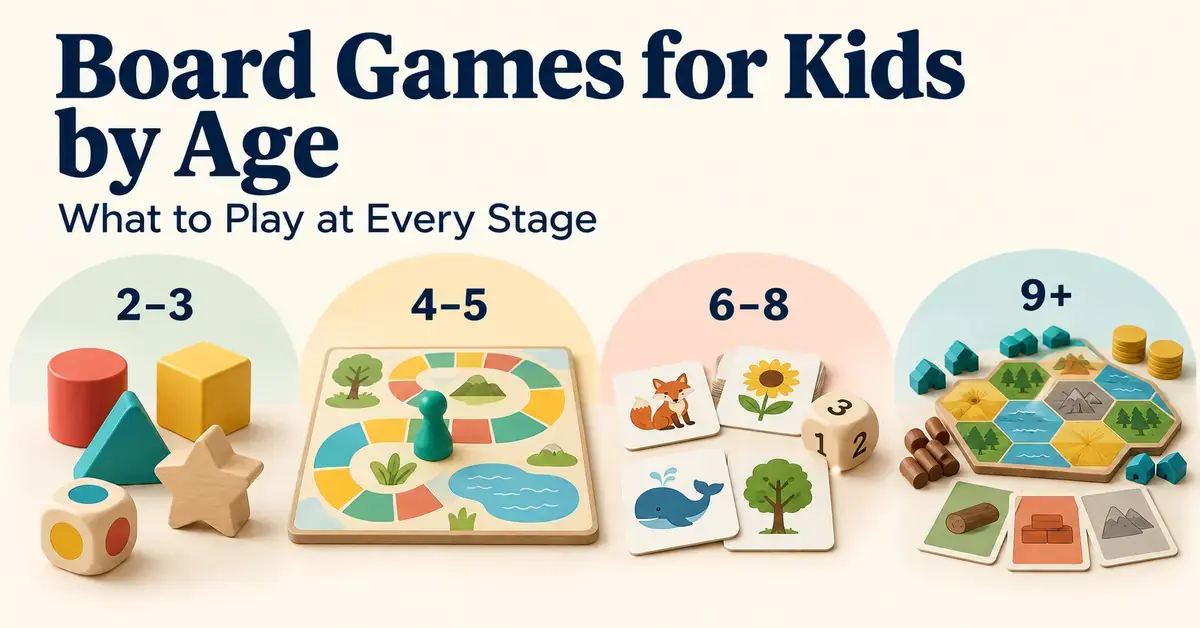
Choosing a board game for a child is mostly a question of age — not because younger children cannot enjoy games, but because the right game meets a child where they are. A toddler needs chunky pieces and a single simple action; a ten-year-old can handle resource trading and reading an opponent. This guide groups games by age band, explains what the age number printed on the box actually means, names widely played examples for each stage with their publisher age ratings, and describes the skills a game tends to build. It is an informational guide, not a shopping list: the goal is to help you judge whether any game fits the child in front of you.
What age can a child start playing board games?
Most children can play their first, very simple board game at around 2 to 3 years old, with an adult sitting alongside. At that age a “game” means rolling a die, naming a colour and moving one piece — there is no strategy and often no winner. Purpose-built toddler games such as HABA’s My First Orchard are rated from 2 years and up and use large wooden pieces that are safe for small hands.
True turn-based play, where a child waits for their turn and follows a rule, usually settles in between ages 3 and 4. Games that involve counting, light choices or simple reading tend to land well from about age 5 or 6. By 8 to 10, many children enjoy the same modern strategy games adults play, and by the tween years they can take on the classics like chess or standard Monopoly. The bands below reflect that progression.
Age Guide
| Age band | Example games (publisher age) | What it builds | Typical play time |
|---|---|---|---|
| Toddlers (2–3) | My First Orchard (2+) | Colours, shapes, first turn-taking | 5–10 min |
| Preschool (3–5) | Candy Land (3+), Chutes and Ladders (3+), My First Carcassonne (4+), Outfoxed! (5+), Monopoly Junior (5+) | Counting, rules, winning and losing | 10–20 min |
| Early school (5–7) | Connect 4 (6+), Qwirkle (6+), Catan Junior (6+), Ticket to Ride: First Journey (6+) | Light strategy, planning one step ahead | 15–30 min |
| Ages 8–10 | Blokus (7+), Ticket to Ride (8+), Azul (8+), Sushi Go! (8+) | Multi-step strategy, reading opponents | 20–45 min |
| Tweens (10–12) | Catan (10+), chess, Scrabble, standard Monopoly | Negotiation, probability, long-term planning | 45–90 min |
How to choose a board game for a child
The single most useful rule is to match the game to the child’s current skills, then check the age label as a safety and complexity backstop. A child who cannot yet read will be frustrated by a word game no matter how fun it looks; a child who already plays Checkers will be bored by a pure roll-and-move. Think about three things: what the child can already do (count, read, take turns, lose gracefully), how long they can stay focused, and whether you want cooperation or competition at the table.
Key Points
- Match the skill, not just the number: check whether the game needs reading, counting or addition before anything else.
- Mind the play time: keep the length within the child’s attention span — minutes for toddlers, up to an hour for tweens.
- Start cooperative, add competition later: team games suit the youngest; light competition fits most children from 4–5.
- The age label is an average: a supported child can often play a year or two above it.
- Check for small parts before handing any game to a child under 3.
What does the age number on the box actually mean?
The age printed on a box is the publisher’s guidance, and it reflects two different things at once: how complex the rules are, and safety. On the safety side, under United States rules a toy or game intended for children under 3 cannot contain “small parts” that pose a choking hazard, while games for ages 3 and up that do contain small parts must carry a choking-hazard warning (16 C.F.R. part 1501, enforced by the U.S. Consumer Product Safety Commission). That is a large part of why so many mainstream games start at “3+” — it is often about small pieces, not about difficulty.
On the complexity side, the number is a rough average, not a rule. Plenty of 5-year-olds happily play games labelled 8+ with an adult helping, and some 7-year-olds find a “6+” game dull. Treat the label as a starting point and adjust to the specific child.
Match the game to the skill, not just the number
Ask what a game demands before you buy or teach it. Does it require reading? Counting past ten? Addition? Keeping a secret? Handling defeat? A game that asks for a skill a child is just beginning to develop is ideal — challenging but reachable. A game that assumes a skill the child does not have yet simply will not work, however age-appropriate the box claims to be. If you are new to picking games apart this way, our beginner’s guide to how board games work breaks down the common components and turn structures.
Board games for toddlers (ages 2 to 3)
For toddlers, the best games are cooperative, physically chunky and over in a few minutes. At this stage children are learning to take turns at all, to name colours and shapes, and to follow one instruction. They are not ready to win or lose, so games that have everyone work together — or simply explore the pieces — suit them best.
- My First Orchard (HABA), 2+: a cooperative game where players roll a colour die and collect large wooden fruit before a raven reaches the orchard. Everyone wins or loses together, which avoids tears.
- Colour- and shape-matching games, 2 to 3: simple matching and memory games build vocabulary and visual recognition with no reading or counting required.
Keep sessions short, expect the rules to be ignored, and let the child handle the pieces as toys — that is part of how they learn the game exists.
Board games for preschoolers (ages 3 to 5)
Preschoolers are ready for simple turn-based games with a clear goal, and most still cannot read, so good games for this age avoid text. This is the classic “roll and move” era, and it is also where counting and colour recognition get real practice.
- Candy Land (Hasbro), 3+: a pure colour-matching race with no reading and no decisions — ideal for the youngest players learning to take turns. The game was invented in 1948 by schoolteacher Eleanor Abbott while she was recovering from polio, and published by Milton Bradley in 1949.
- Chutes and Ladders (Hasbro), 3+: spin, count spaces and climb or slide. It quietly teaches number recognition and counting from 1 to 100.
- My First Carcassonne (Z-Man Games), 4+: a gentler version of the tile-laying classic, with no reading required.
- Outfoxed! (Gamewright), 5+: a cooperative whodunit where the table works together to catch the culprit; it introduces simple deduction with no reading.
- Monopoly Junior (Hasbro), 5+: a stripped-down Monopoly with small numbers and short play, a stepping stone toward the full game later.
These games introduce the idea of winning and losing. Expect some frustration, and model losing gracefully yourself — it is a skill the games are quietly teaching.
Board games for ages 5 to 7 (early school age)
From about 5 to 7, children can handle light strategy, simple choices and a bit of reading, which opens up far more interesting games. This is where a child starts making decisions rather than just obeying a die.
- Ticket to Ride: First Journey (Days of Wonder), 6+: a kid-sized version of the famous train game, with a smaller map and simpler goals that still teach route planning.
- Catan Junior (Catan Studio), 6+: an introduction to the trading-and-building ideas of Catan, scaled down for younger players.
- Connect 4 (Hasbro), 6+: a fast two-player game of lining up four discs — pure spatial thinking with instant feedback.
- Qwirkle (MindWare), 6+: matching tiles by colour and shape to score; simple to learn, with genuine tactical depth.
Games at this age reward a child for thinking one step ahead. Two-player games are especially good here because the child is always involved and never waiting long — our explainer on how two-player board games work covers why head-to-head designs hold attention.
Board games for ages 8 to 10
By 8 to 10, most children can play full modern strategy and family games, including many designed for adults. They can read fluently, add and subtract, plan several turns ahead and cope with losing. This is the sweet spot where the whole family can play the same game on roughly equal terms.
- Ticket to Ride (Days of Wonder), 8+: collect cards and claim train routes across a map; easy to teach, with real decisions every turn.
- Azul (Next Move/Asmodee), 8+: a tile-drafting game about building a pattern — tactile, visual and quick to grasp.
- Sushi Go! (Gamewright), 8+: a fast card-drafting game; children learn to read what opponents are collecting.
- Blokus (Mattel), 7+: a spatial game of fitting shapes onto a grid, blocking opponents as you go.
At this age a child can also learn the enduring classics. If they enjoyed Monopoly Junior, the official rules of Monopoly are within reach — and worth learning properly, because many families play with invented “house rules” that are not in the box.
Board games for tweens (ages 10 to 12)
Tweens can handle longer games with deeper strategy, negotiation and hidden information — essentially the adult hobby. Attention spans stretch to 45 minutes or more, and abstract reasoning is well developed.
- Catan (Catan Studio), 10+: the flagship modern game of trading, building and probability; its official age on catan.com is 10 and up. A full walkthrough lives in our guide to how to play Catan.
- Chess and the classics: by this age many children are ready for chess, Scrabble and standard Monopoly played by the full rules rather than a junior edition.
Tweens also enjoy games with bluffing and alliances, where reading other players matters as much as the board. This is a natural moment to move from “family games” into the wider world of strategy; our rules library for the classics is a good next stop.
What skills do board games build at each age?
Board games exercise different skills as a child grows, and at least one benefit is backed by a controlled study rather than assumption. In a randomized trial published in Child Development in 2008, researchers Geetha Ramani and Robert Siegler found that preschoolers who played a simple numbered board game — roughly an hour of play over two weeks — made measurable gains in number knowledge, while a control group that played the same game with coloured instead of numbered squares did not. The U.S. Department of Education’s What Works Clearinghouse rates that study as meeting its standards without reservations.
Beyond counting, the skills tend to layer up by age:
- Toddlers (2 to 3): colour and shape recognition, naming, and the very first taste of taking turns.
- Preschoolers (3 to 5): counting, number recognition, following rules and coping with winning and losing.
- Ages 5 to 7: simple planning, cause and effect, reading, and patience while others take their turn.
- Ages 8 to 10: multi-step strategy, arithmetic, reading opponents and handling setbacks.
- Tweens (10 to 12): negotiation, risk management, probability and longer-term planning.
Many of these games also quietly build vocabulary and social skills. If a term in a rulebook trips you up, our glossary of board game terms explains the jargon in plain English.
Cooperative or competitive: which suits a child?
For younger and more sensitive children, cooperative games — where everyone works together against the game — are often the gentler starting point. Games like My First Orchard and Outfoxed! remove the sting of losing, which matters a great deal for a 3- or 5-year-old who is still learning emotional regulation. Everyone wins or loses as a team, so the table stays positive.
Competitive games teach a different and equally important set of skills: losing gracefully, winning without gloating, and trying again. Most children are ready for light competition by 4 or 5, provided an adult models good sportsmanship. A sensible path is to start cooperative, add simple competitive games around age 5, and let the mix follow the child’s temperament rather than a fixed rule.
Common mistakes when choosing board games for kids
The most common mistake is buying a game that is too complex and assuming the child will “grow into it” soon — a game two or three years ahead usually ends up in the cupboard. A few others to avoid:
- Ignoring reading level. A game full of text cards is a non-starter for a pre-reader, regardless of the age on the box.
- Overlooking play time. A 60-minute game will lose a 5-year-old long before the end; match length to attention span.
- Forcing competition too early. Pushing a toddler to “win” creates stress; cooperative play is more age-appropriate.
- Treating the age label as a hard cutoff. It is an average. A keen, well-supported child can often play a year or two above it, and a reluctant one may prefer something simpler.
- Doing all the thinking for them. Guiding is good; making every decision defeats the point. Let the child make — and learn from — their own choices.
When you bring a new game to the table, teach it in small steps rather than reading the whole rulebook aloud. Our guide to learning a new board game quickly lays out a method that works well with children.
A note on safety and small parts
Always check a game for small parts before giving it to a child under 3, because small pieces are a genuine choking hazard. This is the reason behind many age labels: under U.S. rules, toys and games intended for children under 3 may not contain small parts that pose a choking risk, and games for ages 3 and up that do contain small parts must carry a choking-hazard warning on the box. If a game is rated 3+ and your child is younger, the label is flagging a safety issue, not just difficulty — supervise closely or choose a toddler-specific game with large pieces instead.
This age-based approach complements the way games are often grouped by setting; for the related view of accessible games built for mixed groups, see our explainer on family and party board games.
Sources
- U.S. Consumer Product Safety Commission — Small Parts for Toys and Children’s Products (16 C.F.R. part 1501)
- Catan Studio — CATAN official game page (age 10+)
- Days of Wonder — Ticket to Ride official site
- What Works Clearinghouse (U.S. Dept. of Education) — review of Ramani & Siegler (2008)
- Ramani, G. B., & Siegler, R. S. (2008), Child Development, 79(2), 375–394
- Hasbro Gaming — official game instructions (Candy Land, Chutes and Ladders, Monopoly Junior, Connect 4)
- HABA USA — My First Orchard and early-years games
Frequently Asked Questions (FAQ)
At what age can a child start playing board games?
Most children can play a very simple, adult-assisted board game from around 2 to 3 years old, using games with large pieces and a single action like rolling a die and moving one token. Genuine turn-taking with rules usually settles in between ages 3 and 4.
What do the age numbers on board game boxes mean?
They combine rules complexity with safety. Part of the reason so many games are labelled “3+” is that, under U.S. rules, toys for children under 3 cannot contain small parts that pose a choking hazard. Treat the number as guidance, not a strict cutoff.
Are cooperative or competitive games better for young children?
Cooperative games, where everyone works together against the game, are usually the gentler start for toddlers and sensitive children because no one loses alone. Light competitive games suit most children from about age 4 or 5, especially when an adult models good sportsmanship.
Do board games actually help children learn?
At least some benefits are supported by research. A 2008 randomized trial in Child Development found that preschoolers who played a simple numbered board game made measurable gains in number knowledge compared with a control group. Games also exercise turn-taking, patience, reading and planning as a child grows.
Can a child play a game rated above their age?
Often yes, with help. The age on the box is an average, and many children play a year or two above it when an adult guides them, provided they have the needed skills such as reading or counting. Check that first, and watch for small parts with the youngest players.
