

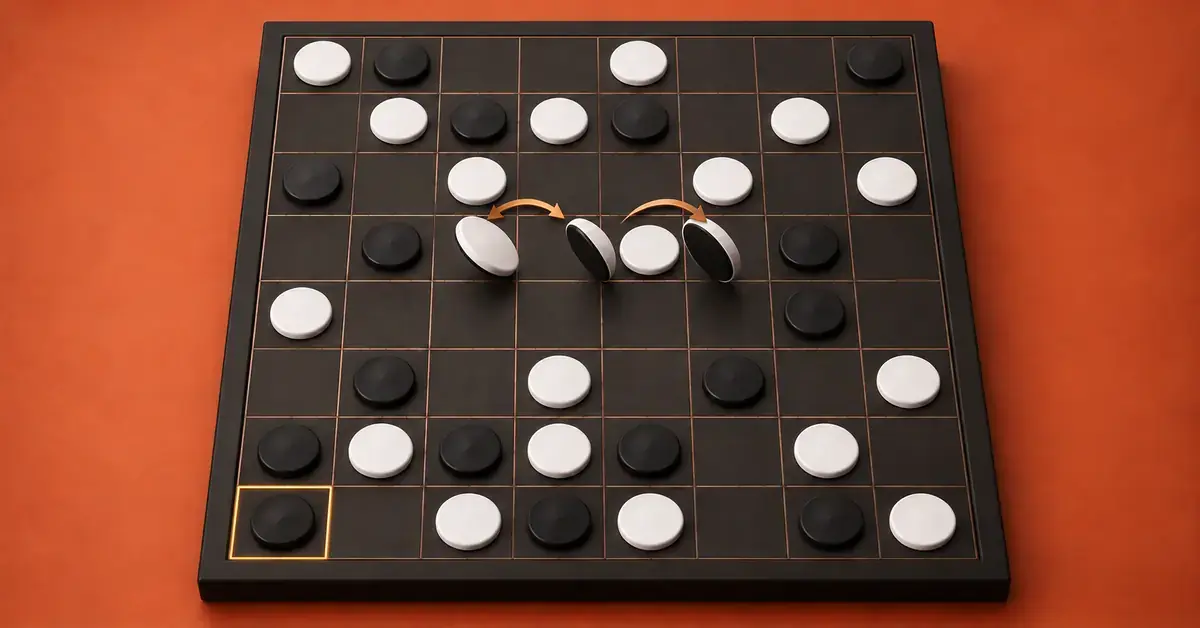
Othello is a two-player strategy game played on an 8×8 board with 64 double-sided discs that are dark on one side and light on the other. The idea is simple to grasp and hard to master: on your turn you trap a line of your opponent’s discs between two of your own, and every trapped disc flips to your colour. When neither player can move, whoever shows more discs wins. This guide covers the setup, the full rules, the strategy that actually wins games, the mistakes beginners make, and how Othello relates to the older game of Reversi.
Key Points
- Players: exactly two — one dark, one light; dark moves first.
- Goal: show more of your colour than your opponent when neither side can move.
- Core move: place a disc so it traps a line of opponent discs between two of yours, then flip every trapped disc.
- Must move: you only pass when you have no legal move; otherwise you must play.
- Win the corners: corner discs can never be flipped and usually decide the game.
- Position over count: a big disc lead early is often a weakness, not an advantage.
What is Othello?
Othello is a modern, standardised version of a Victorian game called Reversi. It is an abstract strategy game — there is no luck, no dice and no hidden information, so both players see everything and the outcome depends entirely on decisions. Dark and light take turns placing one disc at a time, and the board state can swing dramatically because a single move can flip many discs at once.
The game was shaped into its current form by Japanese salesman Goro Hasegawa, who patented it in Japan in 1971 and named it after Shakespeare’s play Othello. It is one of the most accessible entry points into the world of abstract strategy games, alongside classics such as Go and Checkers.
Is Othello the same as Reversi?
Othello and Reversi are almost the same game, and the rules for play are identical. The one meaningful difference is the opening. Modern Othello always begins with a fixed starting position: four discs already placed in the centre of the board. In the older form of Reversi, the board starts completely empty and each player places their first two discs freely on the four central squares before normal capturing begins. Today most people play the Othello setup, so that is the version this guide uses.
What you need to play
You need very little: the board, the discs and a second player. Othello is a strict two-player game, and because it is purely tactical it works well as a quick, repeatable duel — the kind of head-to-head contest covered in our guide to two-player board games.
- The board: an 8×8 grid of 64 squares, usually green and unmarked.
- The discs: 64 identical discs, each dark on one face and light on the other. Players do not own separate sets; any disc can belong to either side depending on which way up it sits.
- Two players: one takes dark, one takes light. Dark always moves first.
Quick Facts
| Players | 2 |
|---|---|
| Typical age | 8 and up |
| Playing time | About 15–30 minutes |
| Board | 8×8 grid (64 squares) |
| Equipment | 64 double-sided discs (dark/light) |
| Type | Two-player abstract strategy; no luck |
| Also known as | Reversi (older variant) |
| Modern designer | Goro Hasegawa (patented 1971) |
| First released | Japan, 1973 |
How to set up the board
Place four discs in the four central squares to form a 2×2 square in the middle of the board. The two discs on one diagonal show light, and the two discs on the other diagonal show dark, so that matching colours sit diagonally opposite each other and the two colours sit side by side.
On a lettered-and-numbered board (columns a–h, rows 1–8), the standard starting position is light discs on d4 and e5, and dark discs on e4 and d5. Give the remaining 60 discs to the side of the board where both players can reach them. Dark takes the first turn.
The rules of Othello
The core rule is the outflank: you capture by trapping a straight line of your opponent’s discs between the disc you are placing and another disc of your own colour. Everything else follows from that single idea.
How to make a legal move
On your turn you place one disc of your colour onto an empty square. The move is only legal if it outflanks at least one of your opponent’s discs. Outflanking means that, starting from the square you just played, there is an unbroken straight line of one or more opponent discs that ends with one of your own discs, with no gaps and no empty squares in between.
- The line can run in any of the eight directions: horizontally, vertically or diagonally.
- A single move can outflank lines in several directions at the same time.
- If a placement does not flip at least one disc, it is not a legal move and you may not play there.
How flipping works
After you place your disc, every opponent disc you outflanked is flipped to your colour. You flip all trapped discs in all the directions your move captured — not just one line. Flipped discs are turned over in place; they are never removed or moved to another square. Only discs that lie in a straight line directly between your new disc and an existing disc of yours are flipped, so discs further along that are not bracketed stay as they are.
When you have to pass
If you have no legal move — meaning there is nowhere you can place a disc that flips at least one opponent disc — you forfeit your turn and your opponent moves again. Passing is not optional and it is not a choice: you must pass if and only if you cannot move. Equally, if a legal move does exist, you are not allowed to pass; you must play one of your available moves.
How the game ends and who wins
The game ends when neither player can make a legal move. Usually this happens when all 64 squares are filled, but it can happen earlier if both sides are stuck. At that point you count the discs: the player showing more of their own colour wins. If both colours show the same number of discs, the game is a tie. In tournament play, any empty squares at the end are conventionally credited to the winner’s score, but the winner is still decided by who has more discs on the board.
Basic Othello strategy
Good Othello play is about position, not quantity. The number of discs you have in the middle of the game barely matters, because any disc can be flipped at any time — except in a few key squares. Beginners who chase a big lead early almost always lose it. These principles will raise your level quickly, and they pair well with the general advice in our board game strategy tips.
Take and hold the corners
Corners are the single most valuable squares on the board because a disc in a corner can never be outflanked and therefore can never be flipped. Once you own a corner it is yours for the rest of the game, and it anchors long lines of discs along the two edges leading away from it. Winning Othello usually comes down to who controls more corners, so steer your moves toward claiming them and deny them to your opponent.
Avoid the X-squares and C-squares early
The X-squares are the four squares that sit diagonally next to a corner. Playing on an X-square in the opening or middlegame is dangerous, because it almost always hands your opponent the adjacent corner on their next move. The C-squares — the edge squares immediately beside a corner — are less risky but should still be treated with caution in the first half of the game. Both become safe to play only late in the game, or when you already control the neighbouring corner.
Think about mobility, not disc count
Mobility means how many legal moves you have available. Keeping your own mobility high while shrinking your opponent’s is one of the strongest ideas in the game. When you run low on moves, you get forced into bad squares that give up corners or edges. A reliable way to protect mobility is to flip as few discs as possible on each move: moves that turn over just one or two discs keep your “frontier” (the discs touching empty squares) small and your options open.
Build stable discs along the edges
Edges are safer than the open middle because discs on an edge can only be attacked from fewer directions, and a disc anchored to a corner you own becomes permanently stable — it can never flip. Aim to build solid, connected lines of your discs out from corners you control. Avoid placing isolated discs on an edge in the opening, though, because a lone edge disc can hand your opponent an easy capture or a route to a corner.
Use parity in the endgame
Parity is about who makes the last move in each separate pocket of empty squares as the board fills up. If an isolated empty region has an even number of squares, you generally want to be the player who places the final disc there, because the last move in a region often lets you flip back whatever your opponent just gained. Parity matters most in the closing moves, when the board splits into small independent regions.
Common mistakes beginners make
The most common beginner error is treating Othello like a race to flip the most discs as fast as possible. A big disc lead in the opening and middlegame is usually a weakness, not a strength, because it means you are filling the board and reducing your own mobility. Watch out for these traps:
- Grabbing discs greedily. Flipping a huge stack in one move feels great but often exposes you to a damaging reply. Fewer flips are frequently better.
- Playing next to empty corners. Moving onto an X-square or C-square beside an unclaimed corner typically gives that corner away.
- Ignoring your opponent’s mobility. Always ask what moves you are giving your opponent, not just what you gain.
- Rushing the edges. Early, unsupported edge discs can create weaknesses that lead straight to lost corners.
- Forgetting that you must move when you can. You cannot pass to avoid a bad move; plan so you are not forced into a square you do not want.
How Othello compares to other classic games
Othello sits in the same family as other two-player abstract games, but it has its own character. Unlike Checkers, where pieces are captured and removed, Othello pieces are never taken off the board — they only change colour, so the balance of power can reverse in a single move. Compared with the territory-building of Go, Othello has far simpler rules and much shorter games, which makes it a gentle first step into deep strategy. It shares with all of them the hallmark of a true abstract game: no luck, complete information and a result that rests entirely on your choices. If you come across unfamiliar terms while reading strategy articles, our board game glossary explains the vocabulary.
A short history of Othello and Reversi
Reversi, the ancestor of Othello, appeared in England in the 1880s. Two Englishmen, Lewis Waterman and John W. Mollett, each claimed to have invented it around 1883, and each accused the other of copying. The game was mentioned in print in The Saturday Review in 1886, and the German publisher Ravensburger began producing it in 1893.
The modern game was developed in Japan by Goro Hasegawa, who patented it in 1971. He founded the Japan Othello Association in March 1973 and held the first national championship on 4 April 1973, with the publisher Tsukuda Original releasing the game commercially later that month. Othello reached the United States in 1975 through Gabriel Industries and went on to sell tens of millions of sets in more than 100 countries. Today the rights to Othello outside Japan are held by the Japanese company MegaHouse.
Who Othello is for
Othello suits anyone who enjoys a short, purely skill-based duel with rules you can learn in a couple of minutes. It is excellent for children and adults alike, works as a quiet two-player game at home, and is a natural choice if you are curious about strategy games but find chess or Go intimidating. Because games are fast, it rewards playing many rounds and learning from each one — which is also the best way to internalise the strategy above.
Sources
Frequently asked questions (FAQ)
Who goes first in Othello?
Dark always moves first. After that, players alternate turns, except that a player who has no legal move must pass and the other player moves again.
Can you ever skip a turn on purpose?
No. You pass only when you have no legal move that flips at least one opponent disc. If any legal move exists, you must play one of them — you cannot choose to pass.
What happens if the board is not full when the game ends?
The game ends as soon as neither player can move, even if some squares are still empty. You then count the discs on the board, and the player showing more of their colour wins.
Why are the corners so important?
A disc placed in a corner can never be outflanked, so it can never be flipped. Corners are permanent anchors that secure long lines of discs along the edges, which is why controlling them usually decides the game.
Is Othello a game of luck?
No. Othello has no dice, no cards and no hidden information. Both players see the whole board at all times, so the result depends entirely on the moves you choose.
