

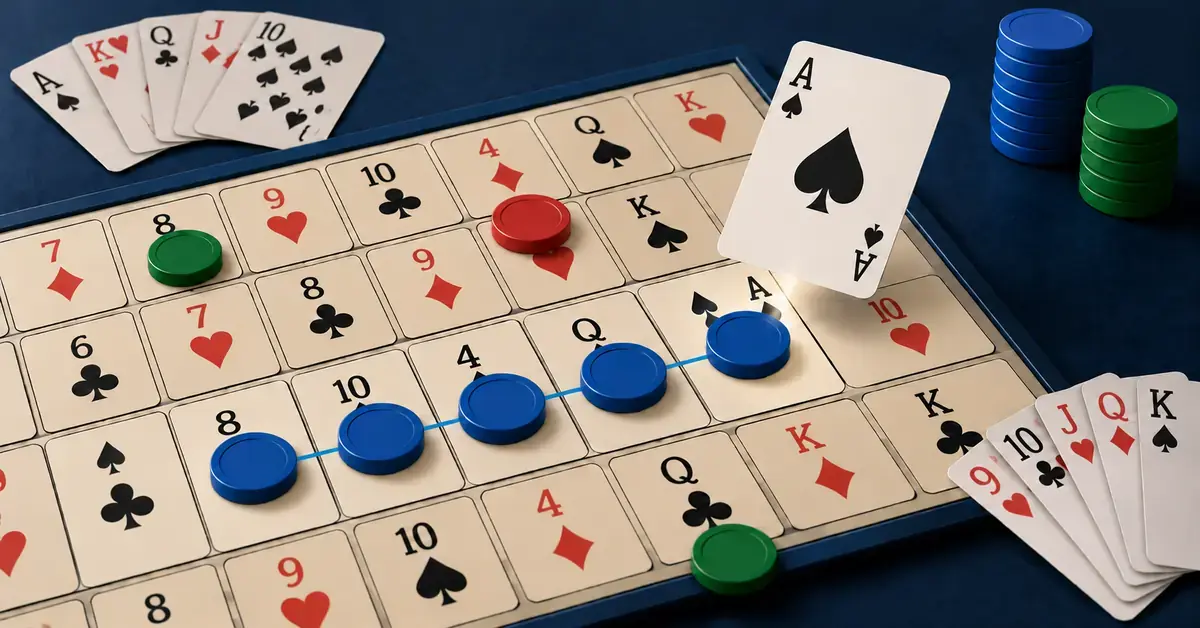
Sequence is a board-and-card game for 2 to 12 players in which you play cards from your hand to place chips on a matching board space, racing to line up five chips in a row. It mixes a little luck from the cards with real tactics, and it works just as well head-to-head as it does in teams, which is why it has stayed a family-night favourite since the early 1980s.
This guide explains everything a new player needs: what comes in the box, how to set up, how a turn works, what the two kinds of Jacks do, how to win, and how team games are arranged. Every rule below has been checked against published rules and the game’s publisher.
Quick Facts
| Players | 2–12 |
| Recommended age | 7 and up |
| Playing time | About 10–30 minutes |
| Board | 10×10 grid (96 card spaces + 4 free corners) |
| Components | 104 cards (two decks, no Jokers); 50 blue, 50 green and 35 red chips |
| Goal | Line up five of your chips in a row (a “sequence”) |
| Type | Board-and-card connection game |
| Designer | Douglas Reuter |
| First published | 1982 |
| Publisher | Jax Ltd. (part of Goliath Games) |
What is Sequence?
Sequence is a connection game that combines a game board with a standard deck of playing cards. Each space on the board (except the corners) shows the face of a specific playing card. On your turn you play a card from your hand and drop one of your coloured chips onto the matching board space. The goal is to build a sequence — five of your own chips in an unbroken line, running horizontally, vertically or diagonally.
The game was designed by Douglas Reuter, who originally called it “Sequence Five.” Jax Ltd. licensed it in 1981 and brought it to stores in 1982. It is still in print today and is produced by Jax Ltd., now part of Goliath Games. Because the rules are simple to teach but reward planning, Sequence sits comfortably between a light party game and a tactical one — a good pick if you want something deeper than snakes-and-ladders but lighter than a full strategy game. If you are brand new to tabletop gaming, it also pairs well with our beginner’s guide to board games.
What you need to set up Sequence
Everything you need comes in the box. A standard copy of Sequence contains:
- The game board — a 10×10 grid of 100 spaces. 96 spaces show the face of a playing card, and the four corners are free “bonus” spaces.
- 104 cards — two full decks of standard playing cards with the Jokers removed. Because there are two decks, every non-Jack card appears twice on the board.
- Chips (markers) — 50 blue, 50 green and 35 red. Each player or team uses one colour. Red chips are only brought out when there is a third player or a third team.
The Jacks are not printed anywhere on the board — they are special action cards, explained below.
Key Points
- On your turn you play a card, place a matching chip, then draw a new card — in that order.
- Two-eyed Jacks (Diamonds, Clubs) are wild; one-eyed Jacks (Hearts, Spades) remove an opponent’s chip.
- The four corners are free spaces everyone can use, so a corner line needs only four chips.
- Two players or teams need two sequences to win; three players or teams need one.
- In team games, teammates sit apart and may not talk strategy.
How to set up
Place the board where everyone can reach it. Give each player (or team) a single colour of chips. Shuffle the 104 cards into one deck. To choose a dealer, each player cuts the deck; the lowest card deals (aces are high). The dealer then deals each player a face-down hand, with the number of cards depending on how many people are playing:
| Number of players | Cards dealt to each |
|---|---|
| 2 players | 7 cards |
| 3 or 4 players | 6 cards |
| 6 players | 5 cards |
| 8 or 9 players | 4 cards |
| 10 or 12 players | 3 cards |
The rest of the cards become a face-down draw pile. The player to the dealer’s left goes first, and play passes clockwise.
How to play Sequence step by step
A turn in Sequence has three simple actions in a fixed order: play a card, place a chip, then draw a card. Missing the final draw is the single most common slip, so make it a habit from the first turn.
What is the objective?
The objective is to make the required number of sequences before your opponents. A sequence is five of your chips in an unbroken straight line — across, down or on a diagonal. How many sequences you need depends on the player count, which is covered in the winning section below.
How do you take a turn?
On your turn you:
- Play a card from your hand, face up, onto your own discard pile where everyone can see it.
- Place one of your chips on an open board space that matches the card you played. Because each card appears twice on the board, you choose which of the two matching spaces to take if both are still open.
- Draw one card from the draw pile to refill your hand back to its starting size.
Chips that are placed on the board are never moved for the rest of the game, with one exception: a one-eyed Jack can remove a chip (see below).
What do the two-eyed Jacks do?
Two-eyed Jacks — the Jack of Diamonds and the Jack of Clubs — are wild cards. Play one and you may place a chip on any open space on the board, regardless of what card that space shows. They are the most flexible cards in the game and are usually best saved for the spot you most need.
What do the one-eyed Jacks do?
One-eyed Jacks — the Jack of Hearts and the Jack of Spades — are the opposite: instead of placing a chip, you use them to remove one of an opponent’s chips from the board. There is one firm limit: you cannot remove a chip that is already part of a completed sequence. Once your turn with a one-eyed Jack ends you do not place a chip, and the space you cleared is open again for everyone.
How do the corner spaces work?
The four corner spaces are free spaces that belong to everyone. Any player can count a corner as if it were one of their own chips when building a sequence. That means a line running into a corner only needs four of your actual chips to make five. Several players can use the same corner in their own separate sequences at the same time.
What is a dead card?
A card is “dead” when both of its matching board spaces are already covered, so you could never use it to place a chip. If you hold a dead card, you may exchange it once per turn: announce that it is dead, place it on your discard pile, and draw a replacement. Do this before you play your normal card for the turn.
What happens when the draw pile runs out?
When the draw pile is used up, shuffle all of the players’ discard piles together to form a fresh draw pile and keep playing. The game does not end just because the cards run low.
How do you win at Sequence?
The winner is the first player or team to complete the required number of sequences. The target changes with the number of sides in the game:
- Two players or two teams: you must complete two sequences to win.
- Three players or three teams: you only need to complete one sequence.
When you need two sequences, the two lines may share at most one chip — a single chip can act as the overlapping point between them, but no more than one. As soon as the required sequences are finished, that player or team wins immediately and the game ends.
How does team play work in Sequence?
Team play is where Sequence really opens up, and it is the mode most families use once there are more than three people. With four or more players you split into equal teams, and there can be no more than three teams in a game. Two teams use the blue and green chips; a third team adds the red chips.
The one rule that trips people up is seating: teammates must be spread out so that turn order alternates between the teams — you may not sit next to your own teammate. This keeps the turns fair and stops one team from taking several placements in a row.
The number of players therefore has to divide evenly into teams. Workable counts are 2, 3, 4, 6, 8, 9, 10 and 12 players; counts like 5, 7 and 11 do not split into equal teams and are not used.
Can teammates talk strategy?
No. Teammates are not allowed to coach each other, hint at which card to play, or tell a partner to hold back. If a team breaks this “no table talk” rule, the penalty is that every player on that team must discard one card as a one-off cost. Part of the skill of team Sequence is reading your partner’s placements rather than their words — the same read-the-table instinct we cover in our board game strategy tips.
Sequence strategy tips
Sequence rewards planning more than luck over a full game. A handful of habits make a clear difference.
Build toward the corners
Lines that run into a free corner space only need four of your chips instead of five. Starting sequences that aim at a corner is one of the most efficient plays in the game.
Hold your Jacks for the right moment
A two-eyed (wild) Jack can finish a sequence from almost anywhere, and a one-eyed Jack can wreck an opponent’s near-complete line. Spending them early on ordinary spaces wastes their power; keep at least one in reserve when you can.
Block before you build
Watch for an opponent who has three or four chips in a line. Dropping a single chip into the gap, or removing one with a one-eyed Jack, is often worth more than advancing your own line by one.
Work two threats at once
If you develop two possible sequences at the same time, opponents cannot block both. This double-threat idea is the same tactic that wins games like Connect Four, where creating two ways to make a line forces a losing choice on your opponent.
Common mistakes to avoid
- Forgetting to draw a card. If you skip the draw at the end of your turn, the standard penalty is that you play short a card for the rest of the game. Make the draw automatic.
- Trying to remove a chip from a completed sequence. One-eyed Jacks cannot touch chips that are already locked into a finished sequence.
- Sitting next to your teammate. Teams must be seated so turns alternate; this is easy to get wrong during setup.
- Coaching your partner. Any table talk about strategy costs your whole team a discarded card.
- Hoarding dead cards. If both spaces for a card are taken, swap it out on your turn instead of clogging your hand with an unplayable card.
- Burning your wild Jacks too soon. Using a two-eyed Jack for an ordinary placement throws away your most valuable card.
Sequence variants and editions
The classic game has spun off several editions aimed at different ages and interests. They share the five-in-a-row idea but change the cards, board or components. The table below compares the main versions.
| Edition | Typical players | What changes | Best for |
|---|---|---|---|
| Sequence (classic) | 2–12 | Standard playing-card faces on a 10×10 board | Families and groups, ages 7+ |
| Sequence Numbers | 2–12 | Addition and subtraction equations instead of card faces | Practising basic maths |
| Sequence Letters | 2–4 | Letters and phonics on the board and cards | Early readers |
| Sequence for Kids | 2–4 | Animal pictures, no reading needed, dragon/unicorn action cards | Younger children, roughly ages 3–6 |
| Sequence Dice | 2–4 | Dice rolls drive placement instead of cards | Players who like a push-your-luck feel |
| Sequence States & Capitals | 2–12 | U.S. states and capitals replace the card faces | Geography-themed play |
Who is Sequence for?
Sequence suits mixed-age groups and casual game nights better than almost anything else in its class. The rules can be taught in a couple of minutes, yet the chip-and-line tactics give older players plenty to think about, so a child and an adult can genuinely enjoy the same game. It scales from two players up to a full table of twelve, which makes it a reliable choice for larger gatherings where you want everyone involved. For more options in that space, see our overview of family and party board games.
It is less suited to players who want a deep, long strategy session — games are short and there is a card-draw luck element — and the team seating rules mean it is at its best with an even, team-friendly player count.
A short history of Sequence
Sequence was invented by Douglas Reuter, who spent years developing a five-in-a-row game he first called “Sequence Five.” In June 1981 he licensed the design to Jax Ltd., a Minnesota company, and the game reached retail shelves in 1982. Reuter is credited as the inventor on the box and in the rules of current copies.
The game has stayed continuously in print for more than four decades and has grown into a small family of editions. In September 2017, Jax Ltd. was acquired by Goliath Games, which continues to publish Sequence alongside Jax’s other titles. If you are teaching it to a group for the first time, our guide on how to teach a board game pairs well with these rules.
Sources
Frequently Asked Questions (FAQ)
How many players can play Sequence?
Sequence is for 2 to 12 players. With four or more people you play in teams, and the player count must divide into equal teams, so 2, 3, 4, 6, 8, 9, 10 and 12 players all work.
How many sequences do you need to win?
Two players or two teams must complete two sequences to win. Three players or three teams only need to complete one sequence. A sequence is five of your chips in an unbroken line.
What do the Jacks do in Sequence?
Two-eyed Jacks (Diamonds and Clubs) are wild and let you place a chip on any open space. One-eyed Jacks (Hearts and Spades) let you remove one of an opponent’s chips instead of placing one.
Can you remove a chip that is part of a completed sequence?
No. A one-eyed Jack can remove a loose opponent chip, but any chip that is already locked into a finished sequence is safe for the rest of the game.
Are the corner spaces free for everyone?
Yes. The four corners are free bonus spaces that every player can count as their own, so a line running into a corner needs only four of your real chips to make five.
