

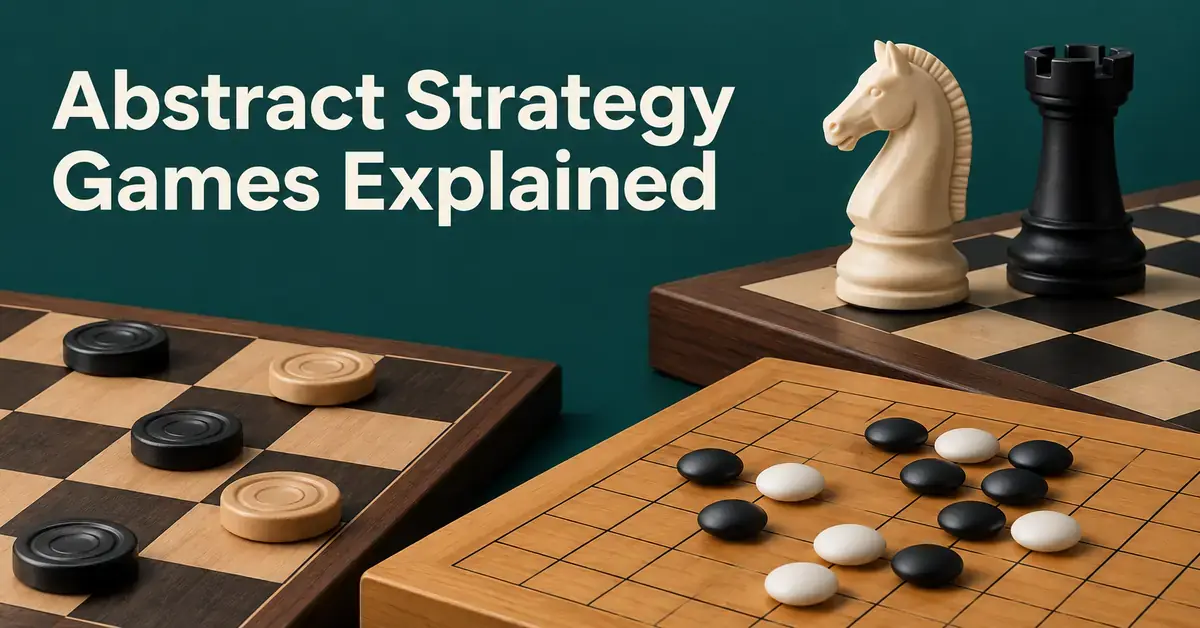
Abstract strategy games are board games stripped down to pure decision-making: there is usually little or no story, nothing is hidden from either player, and the outcome is decided by skill rather than dice or shuffled cards. Chess, checkers and Go are the classic examples, but the family runs from ancient games played for thousands of years to clever modern designs. This guide explains what makes a game “abstract”, what terms like perfect information actually mean, and how to start playing.
What are abstract strategy games?
An abstract strategy game is a game whose outcome depends almost entirely on player decisions rather than luck or hidden information, and which carries little or no theme. In practice that means two players (occasionally more) take turns on a board or with a set of pieces, both can see the entire position at all times, and there are few or no random elements such as dice or face-down cards.
The word “abstract” points to the lack of a story. A themed game might dress its rules up as building a city or fighting a war; an abstract game is usually just shapes, lines and pieces, with rules that stand on their own. Because nothing is hidden and nothing is random, you can never blame a bad roll — every result traces back to the moves the players chose. Abstracts sit alongside other families you can explore on our guide to board game genres and mechanics.
Key Points
- What they are: board games decided by skill, not luck, with little or no story.
- Little or no theme: the pieces represent themselves, not knights, cities or armies.
- Perfect information: both players see the whole position; nothing is hidden.
- Minimal or no luck: no dice or shuffled cards drive the outcome.
- Players: usually two, taking alternating turns.
- Classic examples: chess, checkers (draughts) and Go.
What does “perfect information” mean?
Perfect information means every player can see the complete state of the game at all times, with nothing hidden and nothing left to chance. In chess, both players look at the same board and the same pieces; there is no hand of cards you keep secret and no dice to roll. Each player knows everything there is to know before deciding a move.
This is a term borrowed from mathematics. In combinatorial game theory — the branch of maths that studies two-player games — a combinatorial game is defined as one with two players moving in turn, no chance devices, and perfect information for both sides. Chess, checkers, Go and tic-tac-toe are the textbook examples. Contrast that with poker, where you cannot see your opponent’s cards (hidden information), or Monopoly, where dice decide how far you move (chance). Those are not abstract strategy games.
Three traits that define an abstract strategy game
Most abstracts share three features. A game does not have to hit all three perfectly to count — the hobby genuinely argues about edge cases — but the more boxes it ticks, the more “abstract” it feels.
Little or no theme
The defining trait is the absence of a story. The pieces represent themselves rather than knights, farmers or spaceships. When a theme does appear, it is usually decorative and could be swapped out without changing how the game plays. This is why some gamers prefer the clearer label “themeless” or “weakly themed” over “abstract”.
Perfect information
Everything is on the table. There are no secret hands, no hidden roles and no face-down tiles waiting to surprise you. Both players reason from exactly the same information, which is what makes abstracts such a pure test of planning and reading ahead.
Minimal or no luck
Abstracts lean on skill rather than randomness. Many have no luck at all; others allow a small random element, such as the starting layout, while keeping play itself deterministic. Because luck is squeezed out, the stronger player wins far more consistently than in a dice-driven game — part of why abstracts are popular in competitive and tournament settings.
Classic examples: chess, checkers and Go
Three games define the category for most people. All three are centuries old, played by two players, and decided purely by skill. If you want the full rules for these classics, see our pillar on board game rules for the classics.
Chess
Chess is played on an 8×8 board of 64 squares, with each player commanding 16 pieces — a king, a queen, two rooks, two bishops, two knights and eight pawns. The goal is checkmate: trapping the opponent’s king so it cannot escape capture. The modern game took shape in Europe around the 15th century, evolving from older games with roots in India more than a thousand years ago. It is the archetypal abstract: no theme beyond the names of the pieces, total visibility, and no luck.
Checkers (draughts)
Checkers, known as draughts in British English, is a game of diagonal moves and jumping captures. The most common form — American checkers or English draughts — uses an 8×8 board, with each player starting with 12 pieces placed on the 32 dark squares. International draughts scales this up to a 10×10 board with 20 pieces per side and more powerful “flying” kings. Pieces capture by jumping over an opponent’s piece into an empty square beyond it, and reaching the far side promotes a piece to a king.
Go
Go is widely considered the oldest board game still played in its original form, invented in China more than 2,500 years ago. Two players place black and white stones on the intersections of a grid — 19×19 lines in the standard game — aiming to surround and control more territory than the opponent. Stones that are completely surrounded are captured and removed. Go’s rules are famously simple, yet the number of possible positions dwarfs chess, which is why it resisted computer mastery far longer.
Older abstracts beyond the big three
The family is older and broader than chess and checkers. Mancala, a group of “sowing” games played by moving seeds or stones around a row of pits, is ancient, spread across Africa and Asia, and is also a perfect-information game with no luck. Nine Men’s Morris and backgammon’s distant cousins round out a long tradition of pure strategy games played long before modern publishing.
Comparison
| Game | Players | Board / equipment | Luck | Origin |
|---|---|---|---|---|
| Chess | 2 | 8×8 board, 16 pieces each | None | Modern form ~15th-century Europe |
| Checkers (English draughts) | 2 | 8×8 board, 12 pieces each on dark squares | None | Medieval Europe |
| Go | 2 | 19×19 grid, black and white stones | None | China, 2,500+ years ago |
| Mancala | 2 | Pits and seeds/stones | None | Ancient Africa and Asia |
| Hive | 2 | Interlocking insect tiles, no board | None | Published 2001 |
| Onitama | 2 | 5×5 grid with movement cards | Random starting cards only | Published 2014 |
Modern abstract strategy games
Abstract design is alive and well, and modern titles often add small twists while keeping the core purity. A few widely praised examples:
- Hive (John Yianni, 2001) — a board-less game where players build an interlocking cluster of insect tiles on the table, trying to surround the opponent’s Queen Bee. No board, no luck, perfect information.
- Onitama (Shimpei Sato, 2014) — a two-player duel on a 5×5 grid where shared movement cards determine how pieces can move. The starting cards are dealt randomly, but once play begins everything is open and skill-based.
- The GIPF Project — an acclaimed series of connected abstracts by Belgian designer Kris Burm, including GIPF, DVONN, YINSH and TZAAR, all played on hexagonal boards.
- Santorini — a building game that layers a light theme over tight, chess-like movement and construction rules.
You will also hear tile-laying and drafting games such as Azul called “near-abstract”, because their themes are so thin they barely affect play. Where to draw the line is exactly the kind of friendly argument the hobby enjoys.
Abstract games vs themed games
The practical difference is where the challenge comes from. In an abstract, the challenge is the pure puzzle of the position in front of you; in a themed game, part of the appeal is the story, the role-play and the swing of luck. Abstracts reward deep thinking and replay the same way every time; themed games trade some of that purity for atmosphere, surprise and variety.
Neither is better — they suit different moods. If you want a clean contest of skill with no excuses, an abstract delivers. If you want a dramatic night where an underdog can get lucky, a themed game with dice and cards may be the better call. Understanding the trade-off also helps your wider play; see our guide to general board game strategy for principles that carry across both.
How to get started with abstract strategy games
Start small and build up. You do not need an expensive collection to enjoy the best the category offers.
- Pick one game and learn it well. Abstracts reward depth, so playing one game many times beats owning ten you barely know.
- Begin with a simple-rules game. Checkers, Connect Four or Nine Men’s Morris teach the mindset with rules you can learn in minutes.
- Play against a person when you can. Reading an opponent is half the skill, and it is hard to learn against an app set to easy.
- Use free online versions to practise. Chess, Go and many modern abstracts have free apps and websites, so you can play dozens of games before buying anything.
- Review your losses. Because there is no luck, every loss is a lesson — ask which move actually cost you the game.
If you are completely new to tabletop gaming, our beginner’s guide to how to play board games covers components, turns and reading a rulebook first.
Common mistakes beginners make
A few habits trip up newcomers more than anything else:
- Assuming “abstract” means “simple” or “dry”. Simple rules often hide enormous depth — Go has a handful of rules and a lifetime of strategy.
- Playing too fast. With perfect information, the position already contains the answer; rushing means leaving value on the board.
- Only attacking. Many abstracts are won by shaping position and restricting the opponent, not by chasing captures.
- Blaming luck. In a pure abstract there is no luck to blame — accepting that every result is earned is the fastest way to improve.
- Thinking abstracts are two-player only. Most are, but some modern designs seat three or more; check the box before assuming.
Who are abstract strategy games for?
Abstract strategy games suit players who enjoy a fair, skill-based contest and do not mind the lack of a story. They are ideal for two people who want a quick, deep game; for competitive players who want their skill to decide the result; and for anyone who likes puzzles and planning. They are a weaker fit for groups that crave theme, drama and the chance for an underdog to win on luck — those players may prefer card and dice games or themed adventures. Many households keep a few of each, reaching for an abstract for a focused head-to-head and a themed game for a lively group night.
Sources
Frequently Asked Questions (FAQ)
What is an abstract strategy game in simple terms?
It is a board game decided almost entirely by player skill, with little or no theme, no hidden information and little or no luck. Chess, checkers and Go are the classic examples.
Is chess an abstract strategy game?
Yes. Chess has no hidden information, no random elements and only a decorative theme, which makes it the textbook abstract strategy game.
What does perfect information mean?
Perfect information means both players can see the entire game state at all times, with nothing hidden and nothing left to chance. Every decision is made with full knowledge of the position.
Are abstract strategy games always for two players?
Most are two-player, because a pure skill duel is easiest to balance for two. However, some modern abstracts support three or more players, so it is worth checking each game.
Do abstract strategy games involve any luck?
Usually very little or none. Many have no luck at all; some allow a small random element, such as a shuffled starting setup, while keeping the play itself fully deterministic.
