

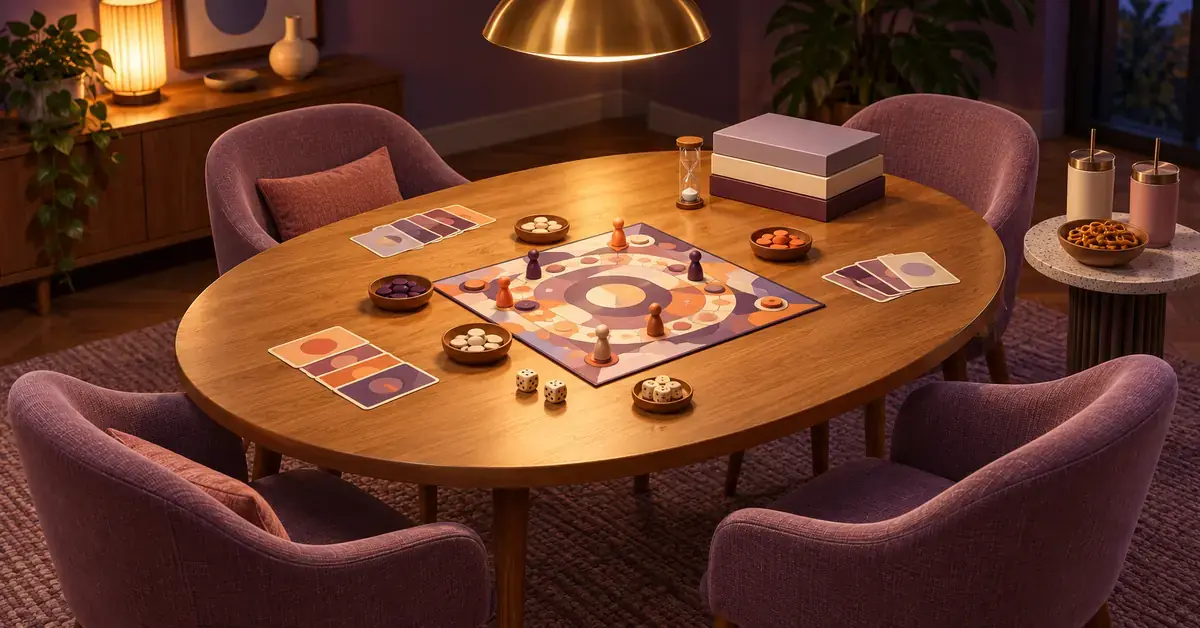
A board game night succeeds or fails before anyone rolls a die. The difference between a lively evening and an awkward one usually comes down to a handful of choices made in advance: who you invite, which games you line up, and how you run the table once everyone sits down. This guide covers both halves of the job — the planning you do beforehand and the hosting you do on the night — with concrete ideas for groups of every size, plus the mistakes that quietly ruin otherwise good evenings.
Key Points
- Confirm your headcount first — four to six players is the most flexible range and opens up the widest game selection.
- Shortlist three to five games and pace them: a light opener, one or two main games, and a short closer.
- Learn each rulebook in advance so you can teach fast and play a demonstration turn.
- Keep food dry and one-handed and drinks lidded to protect cards and boards.
- Set a rough end time and keep a short backup game in reserve.
What makes a board game night work?
A game night works when the games fit the people in the room and nobody is left sitting out for long. Most evenings that fall flat share one of two causes: a game that is too complicated for the group, so the rules explanation eats half the night, or a single long game that keeps four people waiting while two play. Your real job as host is not to own the best collection — it is to match the games to the group and keep the evening moving. If you are brand new to this, it is worth getting the fundamentals down before you take on hosting.
How to plan a board game night, step by step
Plan a game night by settling four things in order: the guest count, the games that suit them, the running order of those games, and the rules you need to know in advance. Sorting these out ahead of time is what lets the night itself feel relaxed.
Decide who’s coming — and how many
Confirm your numbers before you choose a single game, because player count drives everything else. Four to six people is the most flexible range: it opens up the widest selection of games and still fits around one table. Smaller and larger groups both work, they just steer you toward different titles:
- Two or three players: lean on head-to-head games and quick card games built for small counts. See our guide to two-player board games for what scales down well.
- Four to six players: the sweet spot — most modern games are designed with this range in mind.
- Seven or more: switch to party games that absorb big groups, or split into two tables.
Get a firm headcount a day or two ahead rather than guessing. If you want team-based games, aim for an even number so nobody is the odd one out.
Match the games to your group
Choose games around the experience level in the room, not around the heaviest game you own. A mixed group of newcomers and veterans does best with titles that are quick to teach but still have enough depth to stay interesting — word, drawing and cooperative games are reliable here because everyone starts on roughly equal footing. If you are unsure how to weigh complexity, player count and play time against your crowd, our walkthrough on how to choose a board game breaks down what to look for on the box. When a group has no shared vocabulary yet, a quick primer on common terms can save a lot of mid-game confusion.
Build a line-up: opener, main event, closer
Shortlist three to five games and arrange them like a meal rather than picking one and hoping it lasts. A dependable running order is a light opener while people arrive and settle, one or two main games once everyone is present, and a short, low-stakes closer to end on a high note. This keeps early arrivals occupied, gives the evening a clear peak, and avoids the trap of starting a ninety-minute game at the exact moment energy is fading.
Learn the rules before guests arrive
Read the rulebook of anything new before the night so you can teach it in your own words instead of reading aloud. A good teach leads with the goal of the game, then the structure of a turn, then the handful of exceptions — ideally with a demonstration turn that players can watch. Our guide on how to teach a board game covers the method in detail. Knowing the rules cold is also what lets you referee calmly when a question comes up mid-game.
Game Night Picks Compared
| Game | Players | Approx. time | Type | Best for |
|---|---|---|---|---|
| Just One | 3–7 | ~20 min | Cooperative word game | Easy opener, mixed groups |
| Codenames | 4–8+ | ~15 min | Team word game | Bigger tables, two teams |
| Telestrations | 4–8 (up to 12 with party pack) | ~30 min | Draw and guess | Laughs, all-ages crowds |
| Dixit | 3–6 (8 in the 2021 edition) | ~30 min | Storytelling with pictures | Gentle, creative groups |
| Ticket to Ride | 2–5 | ~30–60 min | Route building | A main game for the night |
| Azul | 2–4 | ~30–45 min | Tile drafting | Light strategy, small tables |
| Carcassonne | 2–5 | ~35–45 min | Tile-laying | Easy-to-teach main game |
| Catan | 3–4 (5–6 with extension) | ~60–90 min | Trading and strategy | Experienced tables |
Player counts and play times are approximate and vary by edition — always check the box.
Board game night ideas by group size
The best games for a night depend heavily on how many people are at the table, so it helps to think in terms of group size rather than a single “best games” list.
Two players or a couple
For two, pick games built for head-to-head play or cooperation, where there is little or no downtime between turns. Many two-player games are tense, quick and highly replayable precisely because every decision matters to both of you. Avoid games that need three or more players to function.
Families with kids
Choose simple rules, short rounds and an age rating that suits the youngest player. Games with a strong luck element help level the field so a child can genuinely beat an adult, which keeps everyone engaged. Our guide to board games for kids by age maps what each stage can handle, from toddlers to tweens.
Groups of four to six
This range gives you the run of the shelf — route builders, tile-layers, trading games and team word games all shine here. It is also the easiest size to run a proper opener-main-closer line-up, because you can seat everyone at one table without anyone sitting out.
Large groups and parties
For seven or more, favour party games that scale to big counts or that split the room into teams, and be ready to run two tables if the group is large. Fast, social, forgiving games keep a crowd together far better than a long strategy game ever will. See our overview of family and party board games for the traits that make a game work with a crowd.
Online or long-distance game night
A remote game night works when you pick games that do not need a shared physical board. Pair a video call with titles that run on personal devices, shared screens or simple pen-and-paper so everyone can follow along. Keep the rules light, since troubleshooting a complex game over video is its own kind of chore.
Theme night ideas to try
A theme is entirely optional, but it gives a night focus and makes choosing games easier. Pick one of these and build your shortlist around it:
- Pick-a-category night: restrict the evening to one family — classics, modern designer games, or card and dice games — so every title has something in common.
- Retro or decade night: choose games (and music) from a particular era for an easy nostalgia hook.
- Genre night: lean into mystery, fantasy, sci-fi or horror themes across the games you play.
- Tournament night: run a bracket or a points table across several short games and crown a winner at the end.
- Co-op night: play games where everyone works together against the game itself, which lowers the temperature for competitive friends or new players.
- Canadian classics night: build the evening around home-grown favourites such as crokinole, euchre and cribbage.
How to host: keeping the night flowing
Good hosting is mostly about pacing — filling dead time, teaching fast, and knowing when to move on. The plan gets people to the table; the hosting keeps them happy once they are there.
Fill the early minutes
Start a short, easy game as soon as two or three people have arrived. It occupies early guests, warms up the group, and means the night has already “started” by the time the last person walks in — far better than everyone staring at a stack of boxes waiting to begin.
Teach, then play a demo turn
Teach each game in layers rather than front-loading every rule. State the goal, explain a normal turn, then flag the exceptions as they come up. A single demonstration turn where everyone watches one real play almost always teaches faster than another five minutes of explanation.
Pace the night and take breaks
Put a short break between longer games so people can refill drinks, stretch and reset. If a game clearly is not landing with the group, it is completely fine to wrap it up early and move to the next one — a game that nobody is enjoying is not worth finishing out of politeness.
End on time and on a high
Agree on a rough end time at the start so nobody is trapped in a game that runs past midnight. When the evening is winding down, close with a quick, light game rather than starting another long one; it is a much better note to finish on than a half-played epic.
Food, drinks and setting up the space
The goal with food and setup is simple: protect the components and keep the table usable. Serve dry, one-handed finger foods — chips, crackers, veggies, popcorn, cookies — and keep greasy or sticky items well away from cards and boards. Put drinks in lidded containers or on a separate side table so a knocked glass does not end the night. A potluck spreads the effort, and a quick check for allergies and dietary needs is always worth doing.
For the space itself, use a table big enough for your largest game plus everyone’s drinks and snacks. Light the area well enough to read cards comfortably, give everyone a seat they can sit in for a couple of hours, and keep background noise and distractions low — a shared “phones face-down during turns” norm does wonders for pace. Comfortable, well-lit and roomy beats fancy every time.
Common mistakes to avoid
Most disappointing game nights come down to a short list of avoidable errors:
- Stacking too many heavy games. One demanding title per night is plenty; back-to-back brain-burners exhaust a casual group.
- Reading the rulebook aloud. Learn it in advance and teach in your own words instead.
- Ignoring player counts. A game that is brilliant at four can be a slog at two or chaos at seven — always check the box.
- Leaving people out. Avoid games that seat fewer players than you have; split tables rather than benching someone.
- No backup game. Keep one short, easy title in reserve for when a plan falls through or a game ends early.
- Messy snacks near components. Greasy fingers and borrowed cards do not mix.
- No end time. Without one, a long game can hijack the whole evening.
Sources
Frequently Asked Questions (FAQ)
How many games do I need for a board game night?
Shortlist three to five titles for a typical evening: one quick opener, one or two main games, and a light closer. That gives you variety and a natural flow without over-planning, and leaves room to drop or swap a game if the mood changes.
What are good games for a mix of beginners and experienced players?
Pick games that are fast to teach but still have some depth — team word games, drawing-and-guessing games and cooperative games all work well because everyone begins on roughly equal footing and no one needs hours of prior experience to compete.
How long should a board game night last?
Most game nights run about two to four hours. Agree on a rough end time at the start so nobody feels trapped, and keep a short game ready to finish on if the evening is running long.
What food is best for a board game night?
Dry, one-handed finger foods such as chips, crackers, veggies and popcorn are ideal because they do not leave residue on cards or boards. Keep drinks in lidded containers or on a separate surface to avoid spills on components.
How do I host a game night for a large group?
For big groups, choose party games that scale to high player counts or that split the room into teams, and be ready to run two tables. Avoid long strategy games, which leave most of a large group waiting between turns.
