

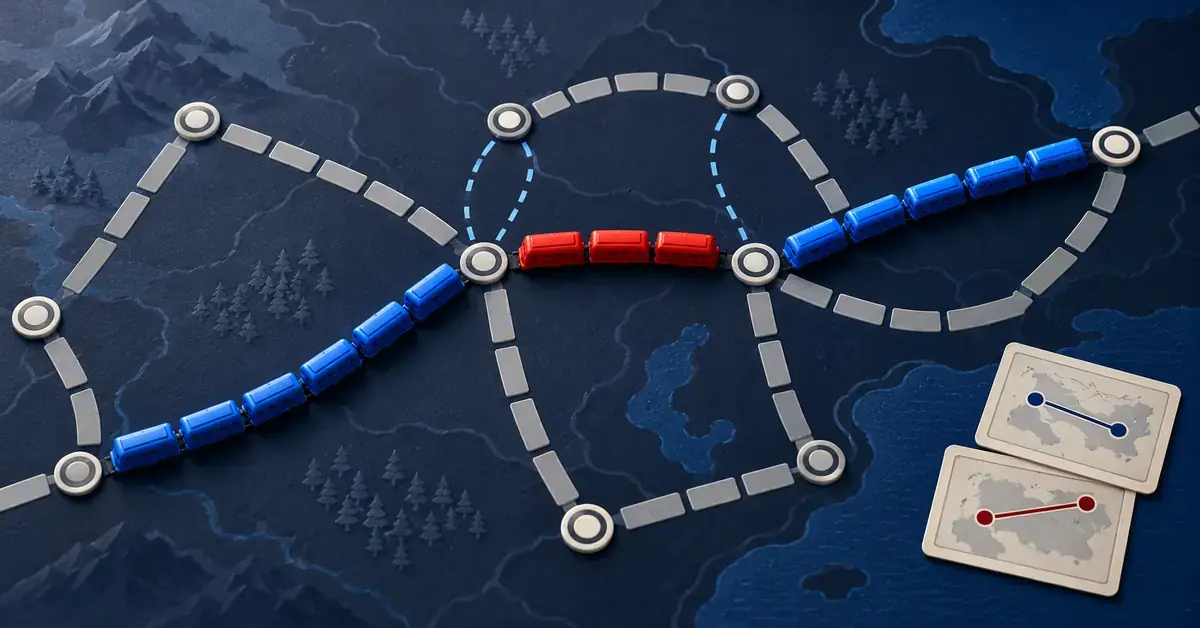
Winning at Ticket to Ride comes down to three things working together: claiming routes efficiently, completing the destination tickets you hold, and quietly building toward the longest-route bonus while keeping opponents off the connections you need. The rules are famously simple — collect coloured train cards, spend them to claim routes between cities, and score the tickets in your hand — but the decisions underneath are not. This guide assumes you already know how a turn works and focuses on the strategy: how to plan routes, manage your cards, read the board and block opponents without wrecking your own plan. If you need a refresher first, start with our guide on how to play Ticket to Ride, then come back here.
Key Takeaways
- Score from three sources at once: routes claimed, destination tickets completed, and the 10-point longest-route bonus.
- Favour longer routes: a six-car route scores 15 points (2.5 per car) versus 1 point for a single car.
- Plan around your tickets: unfinished tickets are subtracted at the end, so build one connected backbone that serves several of them.
- Manage cards in bursts: hold a hand, then claim a long route in one move rather than dribbling out short links.
- Block only when it also helps you — spite blocks usually hand the game to a third player.
- Count trains: the game ends fast once a player is down to two or fewer cars, and everyone takes one last turn.
What makes a winning Ticket to Ride strategy?
A winning strategy maximises points from three sources at once: the routes you claim, the destination tickets you complete, and the single 10-point bonus for the longest continuous path of track. Ticket to Ride, designed by Alan R. Moon and published by Days of Wonder in 2004 (and the 2004 Spiel des Jahres winner), rewards players who turn those three scoring levers into one connected plan rather than chasing them separately.
The core tension is time. On each turn you can do only one thing: draw two train cards, claim one route, or draw new destination tickets. Every route you claim and every card you draw costs a full turn, and the original USA map gives each player just 45 train cars to spend across the whole game. Good strategy is really about spending those turns and those 45 cars for the most points — and denying your opponents the chance to do the same.
How route scoring shapes your strategy
Longer routes score far more points per train car, so efficient players favour them. Claiming a route scores immediately, and the points climb much faster than the length: a one-car route is worth 1 point, but a six-car route is worth 15. That curve is the single most important number in the game to internalise, because it quietly pushes almost every other decision.
Route Scoring and Efficiency
| Route length (train cars) | Points scored | Points per car |
|---|---|---|
| 1 | 1 | 1.0 |
| 2 | 2 | 1.0 |
| 3 | 4 | 1.3 |
| 4 | 7 | 1.75 |
| 5 | 10 | 2.0 |
| 6 | 15 | 2.5 |
The table shows why: a six-car route pays 2.5 points per train, a five-car route 2.0, while one- and two-car routes pay only 1.0. Spending your trains on longer routes earns more raw points for the same number of cars. The catch is that long routes need more matching cards, take longer to assemble, and are easier for an opponent to grab before you. The practical rule: prefer longer routes when you can collect the cards for them, but take the short connecting links you genuinely need to complete a ticket rather than leaving a gap. A completed ticket plus a slightly inefficient short route almost always beats an unfinished ticket.
How to plan your routes around destination tickets
Route planning in Ticket to Ride starts with your destination tickets, because an unfinished ticket is subtracted from your score at the end — it swings your total twice as hard as simply not scoring it. Every route you build should ideally serve a ticket you hold. The aim is to draw one clear map in your head early and then spend the rest of the game filling it in.
Choosing your opening tickets
At setup you are dealt three destination tickets and must keep at least two (the 2024 “Refresh” edition deals four and keeps two). Keep tickets whose endpoints point the same general direction so their paths overlap or run parallel, and be wary of a single ticket that crosses the entire map alone. Two tickets that share a corridor — say, several cities in the same region — let one stretch of track count toward both. Discard a ticket that forces you to build in the opposite direction from the others; the points rarely justify splitting your trains across the board.
Building a connected backbone
Build one long, central “backbone” of track and hang your other tickets off it. Because the longest continuous path earns a 10-point bonus, a single connected spine does double duty: it completes several tickets and competes for the bonus at the same time. Claim the routes that are both on your backbone and most likely to be contested first — the long five- and six-car stretches and any single-link chokepoint a ticket depends on. Leave the safe, out-of-the-way links for later, when fewer cards and trains remain.
When to draw more tickets
Draw more tickets only when you can realistically finish them with the trains and turns you have left. When you take the draw-tickets action you reveal three and must keep at least one, so there is always a risk of being forced to keep a ticket you cannot complete. Early in the game, extra tickets add cheap points if they fit your backbone. In the second half, each new ticket is a gamble: if you cannot connect it before the game ends, its value is deducted. A common winning pattern is to draw a second batch of tickets once your backbone is nearly built, so new tickets you already half-satisfy become near-free points.
How to collect and manage your train cards
Train-card management is the quiet engine of a good strategy: you want to claim routes in bursts, not dribble out short routes as soon as you can afford them. There are 110 train cards — 12 each of eight colours plus 14 multicoloured locomotives, which act as wild cards. Because claiming a route requires a set of one colour (or any colour on grey routes), the skill is collecting the right colours efficiently.
- Draw with purpose. Take face-up cards that match the long routes you are planning. Random draws from the deck are fine early, but once you know your backbone, hunt the colours it needs.
- Respect the locomotive rule. A face-up locomotive is powerful because it substitutes for any colour, but taking one from the display uses your entire turn for that single card. Grab it only when it genuinely unlocks a route you otherwise cannot build.
- Hold, then strike. It often pays to sit on a growing hand for a turn or two and then claim a long route in one move, rather than announcing your plan by taking a short route early. Large hands do carry risk: if the board changes, cards for a blocked route can become dead weight.
- Watch the face-up display. The cards opponents take are public information. A rival hoarding one colour is probably aiming at a specific long route — useful intelligence for the blocking decisions below.
Blocking: how and when to cut off opponents
Blocking means claiming a route specifically to deny it to an opponent, and it is strongest on the board’s narrow points. Ticket to Ride has no direct attacks, so denial is the only way to interfere — but every blocking move spends trains and cards you could have used to score, so it must be chosen carefully.
How blocking works
The most effective blocks sit on chokepoints: single links or narrow corridors that many tickets must pass through, such as the routes in and out of a dense region or across a natural gap in the map. Taking the one route an opponent needs can cost them several points and force a long detour. Double routes (the parallel tracks between two cities) matter here too — see the player-count section below for how they change with fewer players.
When blocking is worth it
Block only when the move also helps you, or when the game is close and the denial is decisive. A good block is usually a route you wanted anyway that happens to hurt a leader. Pure “spite” blocks — spending a turn and a set of cards purely to annoy someone — tend to cost the blocker more than the target, because you fall behind on your own tickets while a third player quietly pulls ahead. Reserve aggressive blocking for the late game, when you can read who is threatening to win and can afford to trade a little efficiency to stop them.
Playing the longest route bonus
The 10-point longest-continuous-path bonus can decide a close game, so plan for it from the start rather than chasing it at the end. The bonus goes to the player whose single unbroken chain of train cars is longest (ties share it). Because 10 points is a large swing — roughly the value of a five-car route — building your tickets along one connected spine rather than several disconnected clusters is often enough to claim it as a by-product. Do not over-commit, though: spending your last trains on a dead-end detour purely to add length can leave a ticket unfinished, which costs you more than the bonus is worth. Treat the bonus as a tie-breaker you steer toward, not a goal that overrides your tickets.
How strategy changes with player count
The biggest strategic shift between game sizes is how double routes behave, which changes how much you can rely on a given connection. The original USA map plays 2 to 5 players, and the board fills up very differently at each end of that range.
- Two or three players: only one side of each double route can ever be claimed — the second track is closed as soon as the first is taken. Routes feel scarcer, blocking is sharper, and you should claim contested links earlier because there is no backup track. With fewer opponents the board is also emptier overall, so you can plan longer, more ambitious backbones.
- Four or five players: both sides of a double route are open, so direct blocking is weaker and the board clogs fast. Here, speed and card efficiency matter more than denial — grab the long routes you need before the map fills, and expect to improvise around other players’ track. Two-player tactics in general carry over well; see our guide to two-player board games for how head-to-head play rewards tighter planning.
Different editions and expansions tweak the maths further. Europe adds stations, tunnels and ferries; the 1910 expansion can replace the longest-route bonus with a 15-point “Globetrotter” bonus for the most completed tickets, which pushes you toward many short tickets instead of one long chain. Always check which bonuses your map uses before committing to a plan.
Common mistakes to avoid
Most losses come from a handful of repeatable errors, and avoiding them lifts your results faster than any clever trick. Watch for these:
- Hoarding too many tickets. Keeping every ticket you draw feels productive but buries you in goals you cannot finish, and each unfinished ticket is subtracted at the end.
- Claiming short routes too early. Spending turns on one- and two-car links before your backbone exists wastes the scoring curve and telegraphs your plan.
- Ignoring the longest-route bonus. Building in disconnected clusters forfeits an easy 10 points you could have earned just by connecting them.
- Blocking out of spite. Denial that does not also advance your own score usually helps a third player win.
- Leaving a critical link for last. If one single route must complete a ticket, claim it before an opponent — or before the board closes it off — rather than saving it for a tidy finish.
- Forgetting the end-game trigger. The game ends abruptly once any player is down to two or fewer trains and everyone takes one final turn, so count trains and make sure your key routes are claimed before the last round.
For principles that apply well beyond this one game — tempo, reading opponents and managing risk — see our broader board game strategy guide and our collection of board game strategy tips. If you enjoy planning a network under pressure, the same instincts transfer to resource and placement games like Catan strategy.
Sources
Frequently Asked Questions (FAQ)
Is Ticket to Ride a game of luck or skill?
It is mostly skill with a layer of luck. The cards you draw and the tickets you are dealt are random, but how you plan your routes, manage your hand and time your claims decides most games. Over several plays, stronger strategic choices win far more often than lucky draws.
Should I focus on long routes or completing many tickets?
Build one connected backbone of longer routes and hang your tickets off it, so the two goals reinforce each other. Long routes score more points per train and compete for the longest-route bonus, while completed tickets add their value and avoid the end-game penalty. Chasing many scattered tickets or long routes alone is usually weaker than combining them.
When is it worth blocking an opponent?
Block when the move also helps your own plan, or late in a close game when denial is decisive. Taking a route you wanted anyway that happens to cut off a leader is efficient. Spending a turn purely to inconvenience someone, with no benefit to you, generally hurts your score more than theirs.
How does the number of players change strategy?
With two or three players, only one side of each double route can be claimed, so routes are scarcer and blocking is sharper — claim contested links early. With four or five players both sides stay open, the board fills quickly, and speed and card efficiency matter more than trying to block.
How important is the longest route bonus?
Very — the 10-point bonus for the longest continuous path can swing a tight game. Because building along one connected spine often earns it as a by-product, plan for it from the start, but never leave a ticket unfinished just to add length, since the penalty can outweigh the bonus.
