

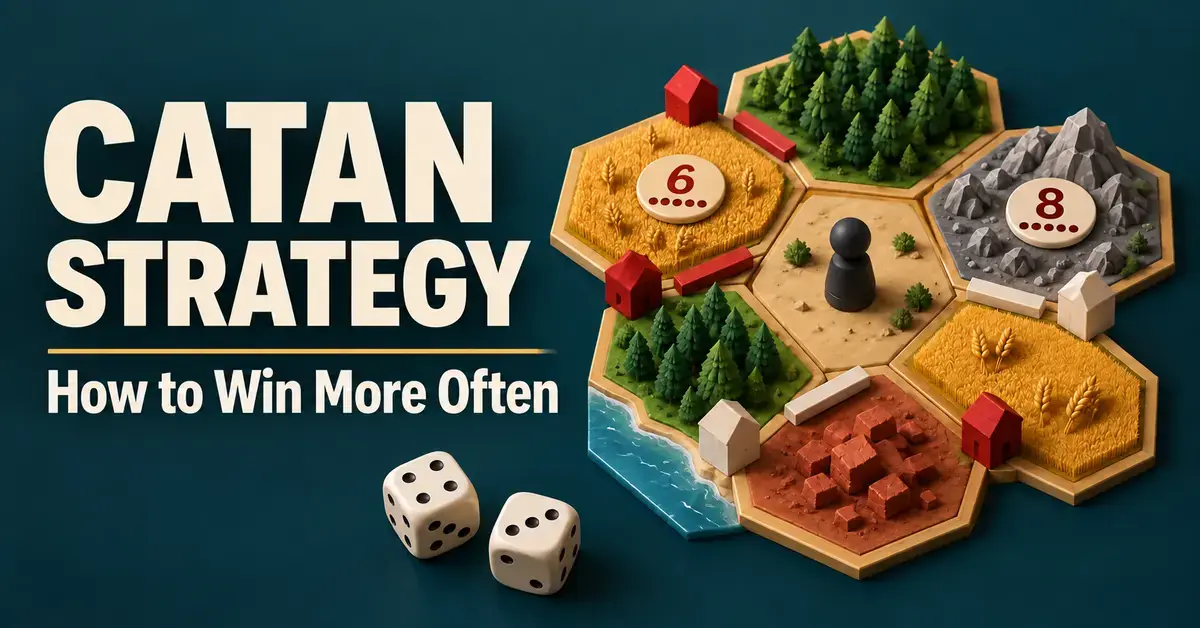
Winning at Catan comes down to a handful of decisions you make long before the final victory point: where you place your first two settlements, which numbers you build on, how you use the robber, and how well you trade. Luck decides individual dice rolls, but strong players consistently finish ahead because they stack the odds in their favour and keep resources flowing almost every turn. This guide breaks Catan strategy into the specific questions that decide most games, with the real probabilities behind each piece of advice. It pairs with the classic Catan rules and sits under the site’s wider board game strategy principles, so if you are brand new, read those first.
Key Points
- Win condition: first to 10 victory points — settlements (1), cities (2), Longest Road (2), Largest Army (2) and hidden Victory Point cards (1 each).
- Placement wins games: count pips, favour 6 and 8, and spread across different numbers and resources.
- Robber: target the leader’s high-pip ore or wheat hex; keep your hand under 8 cards to survive a 7.
- Trade to build, never to hand the leader their winning card.
- Development cards suit an ore-and-wheat engine and quietly build Largest Army and hidden points.
How do you win at Catan?
You win Catan by being the first player to reach 10 victory points. Points come from a mix of permanent buildings and two special bonuses, so there is no single path to victory — you add up several small advantages.
- Settlement: 1 victory point each.
- City (an upgraded settlement): 2 victory points each.
- Longest Road: 2 victory points for the first player with a continuous road of 5 or more segments.
- Largest Army: 2 victory points for the first player to play 3 Knight cards.
- Victory Point development cards: 1 point each, kept hidden until you win.
Because cities double the value of a settlement without taking a new board spot, upgrading is usually more efficient than sprawling. A common winning shape is a few well-placed settlements upgraded to cities, plus one of the two bonus trophies. Keep a running tally of every opponent’s visible points so you know who is close to 10 and can slow them down.
What makes a good opening settlement in Catan?
The best opening settlements sit on high-probability numbers, collect several different resources, and spread your production across as many distinct numbers as possible. Your two starting settlements decide most of your early economy, so this is the most important decision in the game.
Count the pips, not the numbers
Each number token carries dots — “pips” — that show how many of the 36 possible two-dice combinations produce that number. More pips means more frequent resources. The numbers 6 and 8 are the strongest (5 pips each), while 2 and 12 are nearly useless (1 pip each). A quick habit of elite players is to add up the pips on the three hexes touching a corner and compare spots by that total rather than by gut feel.
Catan Number Odds
| Number token | Pips (dots) | Ways to roll (of 36) | Chance per roll |
|---|---|---|---|
| 2 | 1 | 1 | 2.8% |
| 3 | 2 | 2 | 5.6% |
| 4 | 3 | 3 | 8.3% |
| 5 | 4 | 4 | 11.1% |
| 6 | 5 | 5 | 13.9% |
| 7 (robber, no token) | — | 6 | 16.7% |
| 8 | 5 | 5 | 13.9% |
| 9 | 4 | 4 | 11.1% |
| 10 | 3 | 3 | 8.3% |
| 11 | 2 | 2 | 5.6% |
| 12 | 1 | 1 | 2.8% |
Diversify your numbers
Spread your production across different numbers so almost every roll gives you something. If both settlements sit on 6 and 8, you feast when those hit and starve otherwise. A settlement touching an 8, a 5 and a 10, paired with a second on 6, 9 and 4, collects on six different numbers — you will rarely sit through a turn with nothing. Even a 3 or an 11 on an otherwise strong corner is better than doubling up on a number you already own.
Diversify your resources
Aim to touch as many of the five resources as you can across your two settlements. Catan has wood, brick, sheep (wool), wheat (grain) and ore. Missing a resource entirely means you depend on trading or a port for it all game, which is fragile. A balanced opening that reaches four or five resources keeps every build option open.
Which resources matter most in Catan?
No resource is useless, but the two pairs do different jobs, and matching them to a plan is what separates a focused game from a scattered one. Decide early whether you are expanding across the board or building up in place.
- Wood and brick build roads and settlements. They power an expansion game: claim more corners, chase Longest Road, and grab ports.
- Ore and wheat build cities and buy development cards. They power a growth game: fewer spots, each upgraded to a city, backed by Knights and hidden victory points.
- Sheep feeds both settlements and development cards, and is the most common port, so it is easy to trade away when you have a surplus.
A reliable opening secures one working pair at the first settlement and the matching pair at the second, so you can both expand and upgrade. If the board forces a choice, an ore-and-wheat city build is often the most consistent because two cities on 6 and 8 produce a flood of the exact resources that buy more cities and development cards.
How should you use the robber in Catan?
Use the robber to slow the player who is winning and to choke the resource they need most — not to settle personal scores. The robber moves when a 7 is rolled (the single most likely result, at 6 of 36 rolls) or when a Knight card is played, and it blocks a hex from producing and lets you steal one random card from an adjacent player.
Target the leader, not the nearest player
Place the robber on a high-pip hex that the current points leader depends on — ideally their 6 or 8, especially if it carries ore or wheat for cities. Stealing from the leader does double duty: it denies them a card and hands you one.
Keep your hand under eight cards
When a 7 is rolled, every player holding 8 or more resource cards must discard half of them, rounded down. Since a 7 appears roughly once every six rolls, sitting on a big hand is a real risk. Spend down to seven or fewer before your opponents’ turns, or bank the cards into a build or a development card.
Watch the diplomacy
The robber creates grudges. Hitting the same player repeatedly invites retaliation and lost trades, so spread the pressure and weigh whether a small steal is worth the resentment when you still need that player as a trading partner.
How do you use trading as leverage?
Trading is where skill shows most, because every deal should move you toward 10 points faster than it helps your opponent. You can trade with other players on your turn in any amounts both sides agree to, or with the bank at fixed rates.
- Bank trade: 4 of one resource for 1 of any other, always available.
- Generic (3:1) port: trade any 3 identical resources for 1 of your choice.
- Specialized (2:1) port: trade 2 of one specific resource for 1 of any — excellent if a settlement overproduces that resource.
Trade to build, not to hoard
Make a deal only when it lets you complete a build this turn or next. Handing an opponent the one card that finishes their city is a common way to lose, so never trade a resource to the player closest to winning, and avoid giving anyone their scarce resource.
Create urgency and scarcity
Offer your surplus when demand is high — right after someone has been robbed, or when a player visibly needs one card. If you control a 2:1 port, you can refuse lopsided deals and still convert your surplus efficiently, which quietly raises your bargaining power all game.
When should you buy development cards?
Buy development cards when you have surplus ore, wheat and sheep and no better building move, or when you are deliberately chasing Largest Army or hidden points. A development card costs 1 ore, 1 wheat and 1 sheep, and the 25-card deck contains:
- 14 Knight cards — move the robber and count toward Largest Army.
- 5 Victory Point cards — 1 hidden point each.
- 6 Progress cards — 2 Road Building (2 free roads), 2 Year of Plenty (take any 2 resources from the bank), and 2 Monopoly (take every copy of one resource from all opponents).
Because more than half the deck is Knights or points, buying cards is rarely wasted for an ore-and-wheat engine. Knights let you keep the robber off your own hexes and steadily build toward the 3 needed for Largest Army, while the hidden Victory Point cards let you reach 10 without warning opponents. Remember you cannot play a card the turn you buy it (except Victory Point cards at the moment of winning), and you may play only one development card per turn.
How do you win Longest Road and Largest Army?
These two trophies are worth 2 points each and often decide close games, but both can be taken away, so weigh the cost before committing. If you are new to how these bonuses interact with the rest of the board, the broader classic board game rules explainers give useful context.
Longest Road
The first player to build an unbroken road of 5 or more segments takes Longest Road. A rival can steal it by building a longer road — or by dropping a settlement on an open corner in the middle of your path, which breaks the chain. Chase it only when wood and brick are flowing; sinking resources into roads you do not need is a classic way to fall behind on points.
Largest Army
Playing 3 Knight cards earns Largest Army, and control passes to anyone who later plays more Knights than the current holder. Because Knights also move the robber, an ore-and-wheat player buying development cards often picks up Largest Army almost as a by-product of defending their hexes.
What are the most common Catan mistakes?
Most losses trace back to a few avoidable errors, not bad luck. Watch for these.
- Chasing only 6 and 8. Doubling up on the same hot number leaves you with nothing when it goes cold. Spread across different numbers instead.
- Ignoring a missing resource. Skipping a resource at setup forces you into bad trades all game. Cover four or five resources if you can.
- Hoarding cards. Sitting on 8+ cards means losing half the moment a 7 lands. Spend down before opponents’ turns.
- Trading with the leader. Any card you give the front-runner can be the one that finishes their win. Trade down the standings, not up.
- Over-building roads. Long road networks look impressive but cost wood and brick that could have become a city or a development card.
- Announcing your plan. Visible points invite the robber and blocking settlements. Hidden Victory Point cards and quiet city upgrades keep opponents guessing.
Who is this strategy for?
These ideas apply to the Catan base game for 3–4 players and work whether you play on a physical board or online. Beginners should focus first on pip counting and resource diversity at setup — that alone wins more games than any mid-game trick. More experienced players can layer in robber targeting, port leverage and a committed ore-and-wheat engine. If you are still learning general tabletop habits, the site’s guide on how to play board games for beginners explains the components, turn structure and etiquette that underpin all of this.
Sources
Frequently Asked Questions (FAQ)
How many points do you need to win Catan?
You need 10 victory points. Settlements give 1 each, cities 2 each, and Longest Road and Largest Army 2 each, with hidden Victory Point development cards worth 1 each. You win immediately on your turn when you reach 10.
What are the best numbers to build on in Catan?
6 and 8 are the strongest because each comes up on 5 of the 36 dice combinations, followed by 5 and 9. Avoid relying on 2 and 12, which appear on only 1 combination each. Spread across several different numbers rather than stacking the same one.
Should I focus on settlements or cities in Catan?
Upgrading settlements to cities is usually more efficient: a city doubles a spot’s points and resource output without needing a new, often contested, board corner. Expand with new settlements early to claim good numbers, then convert to cities as ore and wheat allow.
When is the best time to use the robber?
Place the robber on a high-probability hex belonging to the player closest to winning, ideally one producing ore or wheat. This slows the leader and lets you steal a card. Avoid repeatedly targeting the same player if you still need them as a trading partner.
Are development cards worth buying in Catan?
Yes, especially with surplus ore, wheat and sheep. Over half the 25-card deck is Knights (toward Largest Army) or hidden victory points, so purchases are rarely wasted. They also let you reach 10 points without revealing your score to opponents.
