

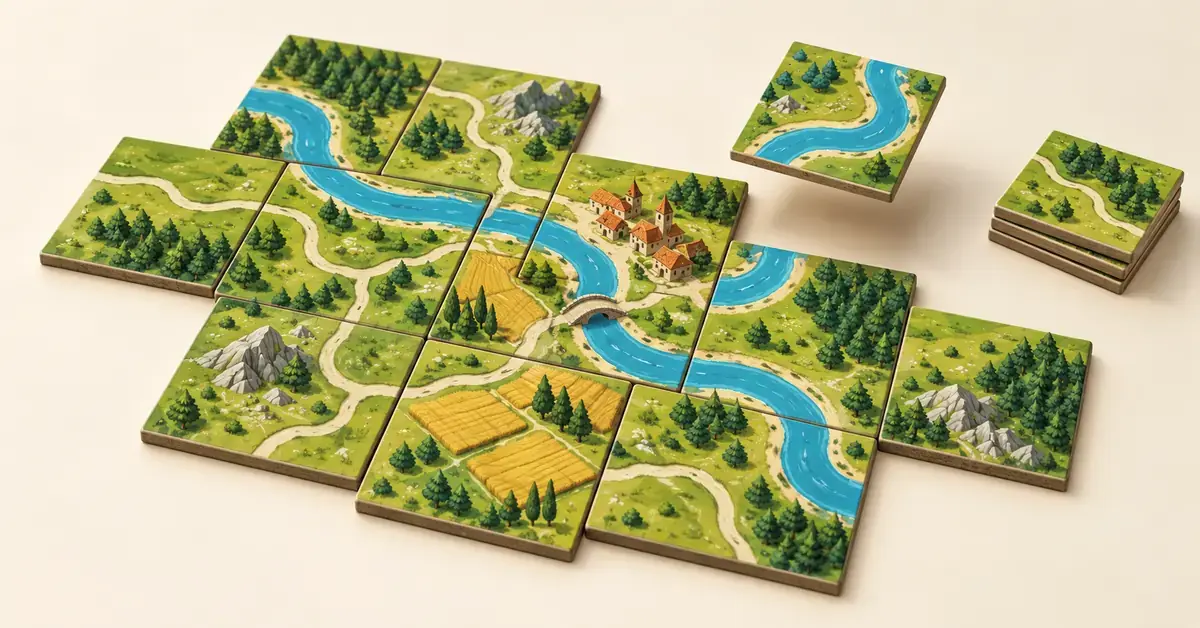
Tile-laying games are board games in which players build a shared or personal layout by adding tiles to it one at a time, usually scoring more points the better each new tile fits with the tiles already down. Instead of moving pieces around a fixed board, you create the board itself as you play. The mechanic powers some of the best-known modern games, from the medieval landscape of Carcassonne to the colourful patterns of Azul, and BoardGameGeek lists thousands of titles that use it. This guide explains what counts as a tile-laying game, how the core loop works, the main styles you will meet and a shortlist of well-known games to try.
Key Points
- What they are: games where you build a layout by placing tiles one at a time, scoring more when each tile fits well with its neighbours.
- The core loop: get a tile (draw or draft), place it by the rules, then score it — repeated until the tiles run out.
- Main styles: open-board landscapes (Carcassonne), grid and pattern builders (Azul, Kingdomino), polyomino shape-fitting (Patchwork), and hex habitats (Cascadia).
- Who they suit: newcomers, families and puzzle lovers; most play in 20–45 minutes and need only the box.
- Pedigree: tile-layers have won the Spiel des Jahres at least five times, including Carcassonne (2001), Alhambra (2003), Qwirkle (2011), Kingdomino (2017), Azul (2018) and Cascadia (2022).
What are tile-laying games?
A tile-laying game is any game whose central action is placing tiles to build up a layout that earns points. A tile is simply a rigid piece — usually cardboard — that shows terrain, a pattern, a shape or an icon. On your turn you take one (or a few) and add it to a growing picture, following placement rules that say where it is allowed to go. The game rewards clever positioning: a tile dropped next to the right neighbours is often worth far more than the same tile placed in isolation.
The mechanic is sometimes called “tile placement”. It overlaps with other families but is not the same as them. A tile-laying game differs from a roll-and-write, where you mark a sheet rather than place a physical piece, and from a pure abstract strategy game like chess, where the board never changes shape. What unites tile-layers is that the playing area is assembled during the game, so no two games ever look quite the same.
How do tile-laying games work?
Almost every tile-laying game runs on the same three-step loop — get a tile, place it, score it — repeated until the tiles run out or a board fills up. Understanding that loop means you can pick up most games in the family quickly, because only the details change from title to title.
Getting a tile
You first acquire a tile, and how you get it is the first big design choice. In the simplest games you draw one at random from a face-down stack or bag, so you must adapt to whatever you pull. In others you draft — you choose from a face-up market or display, which turns tile selection into its own strategic battle because taking a tile also denies it to everyone else. Some games combine the two, letting you draw blind but then choose where among several options to use what you drew.
Placing a tile
You then place the tile according to the game’s rules, and this is where tile-layers earn their name. Common restrictions include matching edges (a road must continue a road, a colour must touch the same colour), building only onto your existing layout, or fitting an odd shape into a tight grid without overlaps. The restriction is what creates the puzzle: you rarely have a perfect spot, so you weigh the points you gain now against the flexibility you keep for later.
Scoring a tile
You finally score, either immediately or at the end of the game. Most tile-layers reward adjacency — points grow when a tile sits beside others that share a feature with it, such as the same colour, a continuous road, or a matching habitat. Many games add bonuses for completing a region, filling a row or collecting sets, and penalties for tiles you could not place well. Because scoring is tied to position, a tile-laying game is really a running optimisation puzzle played out on the table.
A short history of the mechanic
Tile-laying is older than modern hobby gaming, with roots in classic tile games like dominoes and mahjong, where players already matched edges or built sets from physical tiles. The modern design idea — building a scoring landscape from a shuffled stack — arrived in a mainstream form in 2000 with Carcassonne, designed by Klaus-Jürgen Wrede and published by the German company Hans im Glück. Carcassonne won the 2001 Spiel des Jahres (“Game of the Year”), has sold well over ten million copies, and is widely credited with bringing tile placement to a broad audience.
Carcassonne’s success made the mechanic a staple of the eurogame movement, and designers have kept reinventing it. Dirk Henn’s Alhambra took the 2003 Spiel des Jahres by having players build palaces from purchased tiles, Qwirkle won in 2011 with a pattern-matching abstract, Bruno Cathala’s Kingdomino won in 2017, Michael Kiesling’s Azul in 2018 and Randy Flynn’s Cascadia in 2022. Five Game of the Year awards for tile-layers in two decades is a strong sign of how versatile the mechanic is.
What are the main types of tile-laying games?
Tile-laying games split into a few recognisable styles, grouped by what you build and how tightly the placement is constrained. Knowing the styles helps you predict how a new game will feel before you open the box.
Open-board landscape builders
Open-board games grow one shared picture outward in any direction, with Carcassonne as the definitive example. Players draw land tiles showing roads, cities, cloisters and fields, and must place each so its edges line up with tiles already on the table. Followers (the little wooden figures known as meeples) are then placed to claim features and score them. The layout is unpredictable and interactive, because anyone can extend — or block — a region you are counting on.
Grid and pattern builders
Grid builders have each player fill a fixed personal grid, rewarding neat patterns rather than sprawling landscapes. Azul is the standout: players draft sets of coloured Portuguese tiles (azulejos) and arrange them on their own board, scoring for adjacency while avoiding leftover tiles that cost points. Kingdomino sits here too, with players laying domino-style tiles into a five-by-five kingdom and scoring connected terrain multiplied by crowns. These games are usually quick, tense and driven by the draft.
Polyomino (shape-fitting) games
Polyomino games use irregular Tetris-like shapes that you fit into a limited space without gaps or overlaps. A polyomino is simply a tile made of several squares joined together. Uwe Rosenberg’s two-player Patchwork, in which players quilt oddly shaped fabric pieces onto a nine-by-nine board, is a clean example, and The Isle of Cats adds drafting and theme to the same spatial puzzle. The appeal is the satisfying click of a tight fit, and the quiet agony of a hole you cannot cover.
Hex and habitat games
Hex-based games build with six-sided tiles, which connect in more directions and create flowing, organic shapes. Cascadia is the modern benchmark: each turn you take a hexagonal habitat tile paired with a wildlife token, add it to your own growing wilderness, and score both large connected habitats and the patterns formed by the animals. Hex layouts tend to feel softer and more sprawling than square grids, and they open up more placement choices each turn.
What do you need to play, and who are they for?
Most tile-laying games need only their own box — tiles, a few scoring tokens or meeples, and a rulebook — with no dice, apps or batteries required. Table space matters more than in many other genres, especially for open-board builders like Carcassonne that can spread well beyond their starting footprint, so a decent-sized table helps.
Tile-layers suit a wide range of players, which is part of why they sell so well. They are a strong fit for:
- Newcomers and families — rules are usually short, turns are visual and intuitive, and many play well with children.
- Puzzle lovers — the constant “where does this fit best?” question rewards spatial thinking.
- Mixed groups — grid and polyomino games cause little direct conflict, so they rarely upset anyone, while open-board games add interaction for players who want it.
- Players short on time — many tile-layers finish in 20–45 minutes.
If you are completely new to the hobby, a tile-laying game is one of the gentlest on-ramps there is; our guide to board game mechanics shows how the style sits alongside the other major genres.
Popular tile-laying games to try
The table below compares widely played tile-laying games across the main styles, using neutral facts such as designer, player count, playing time and awards rather than opinions. Every game listed is a Spiel des Jahres winner or a long-running bestseller, so any of them is a safe place to start.
Comparison
| Game | Designer / Year | Players | Approx. time | Tile style & what you build | Notable award |
|---|---|---|---|---|---|
| Carcassonne | Klaus-Jürgen Wrede, 2000 | 2–5 | 30–45 min | Square land tiles; a shared medieval landscape of roads, cities and fields | Spiel des Jahres 2001 |
| Alhambra | Dirk Henn, 2003 | 2–6 | 45–60 min | Building tiles bought with money; your own walled palace | Spiel des Jahres 2003 |
| Qwirkle | Susan McKinley Ross, 2006 | 2–4 | ~45 min | Colour-and-shape tiles; shared pattern grid (abstract) | Spiel des Jahres 2011 |
| Patchwork | Uwe Rosenberg, 2014 | 2 | 15–30 min | Polyomino fabric pieces; a 9×9 quilt | Golden Geek Best Abstract 2014 |
| Kingdomino | Bruno Cathala, 2016 | 2–4 | 15–20 min | Domino-style tiles; a 5×5 kingdom scored by crowns | Spiel des Jahres 2017 |
| Azul | Michael Kiesling, 2017 | 2–4 | 30–45 min | Drafted colour tiles; a personal pattern wall | Spiel des Jahres 2018 |
| The Isle of Cats | Frank West, 2019 | 1–4 | 60–90 min | Polyomino cat tiles; filling your boat | — |
| Cascadia | Randy Flynn, 2021 | 1–4 | 30–45 min | Hex habitat tiles plus wildlife tokens; a connected wilderness | Spiel des Jahres 2022 |
If you want a full rules walkthrough of the game that started the modern trend, see our step-by-step guide on how to play Carcassonne.
Common mistakes beginners make
The most common beginner mistake is placing tiles for short-term points while painting yourself into a corner. Because the layout is permanent, a greedy early placement can leave you with no legal or useful spot later. A few recurring errors are worth watching for:
- Ignoring future space. Filling the easy spots first often blocks the big-scoring placements you were saving. Leave yourself room to grow.
- Forgetting the penalties. In games like Azul, tiles you take but cannot place cost you points. Drafting more than you can use is a classic trap.
- Playing only your own board. In open-board and drafting games, what you take denies it to others, and opponents can extend or block shared regions. Watch the whole table, not just your corner.
- Chasing one giant region. A single huge area is vulnerable and easy to disrupt; several solid medium ones are often safer and score comparably.
- Over-committing your pieces. In Carcassonne, meeples are limited and stay put until a feature scores. Tying them all up in slow-scoring regions can leave you unable to claim anything new.
How to get started with tile-laying games
Start with one short, grid-based game to learn the loop, then branch out once the draw-place-score rhythm feels natural. Kingdomino and Azul are common first picks because their rules fit on a page and a game takes well under an hour. From there, open-board games like Carcassonne add interaction and bigger decisions, while polyomino and hex games such as Patchwork or Cascadia lean further into the spatial puzzle.
When you learn any tile-layer, read the scoring rules before your first placement, not after. The whole game bends toward how points are earned, and knowing the scoring up front stops the most common early mistakes. Play an opening turn or two slowly, pay attention to what the highest-scoring tiles need, and you will improve fast. Because the genre shares one underlying loop, your second tile-laying game is almost always easier to learn than your first.
Sources
Vanliga frågor (FAQ)
What is a tile-laying game?
A tile-laying game is a board game whose main action is placing tiles to build a layout that scores points. You usually earn more when a new tile fits well with the tiles already down, so the board — and the puzzle — is created as you play rather than fixed in advance.
Is Carcassonne a tile-laying game?
Yes. Carcassonne, designed by Klaus-Jürgen Wrede and released in 2000, is the best-known modern tile-laying game. Players draw and place land tiles showing roads, cities, cloisters and fields, then place meeples to claim and score those features. It won the 2001 Spiel des Jahres.
What is the difference between tile-laying and polyomino games?
Polyomino games are a sub-type of tile-laying games. All tile-layers involve placing tiles, but polyomino games specifically use irregular, Tetris-like shapes made of joined squares that you fit into a limited space without gaps, as in Patchwork. Other tile-layers use single square or hexagonal tiles instead.
Are tile-laying games good for beginners?
Tile-laying games are among the most beginner-friendly board games. Rules are typically short, turns are visual and intuitive, and many games finish in 20–45 minutes. Kingdomino and Azul are popular first choices because they teach the core draw-place-score loop quickly.
How many players do tile-laying games support?
It varies by title. Patchwork is strictly two players, Carcassonne handles 2–5 (more with expansions), Azul and Kingdomino take 2–4, Cascadia plays 1–4 including a solo mode, and Alhambra supports up to 6. Always check the box for the exact range.
