

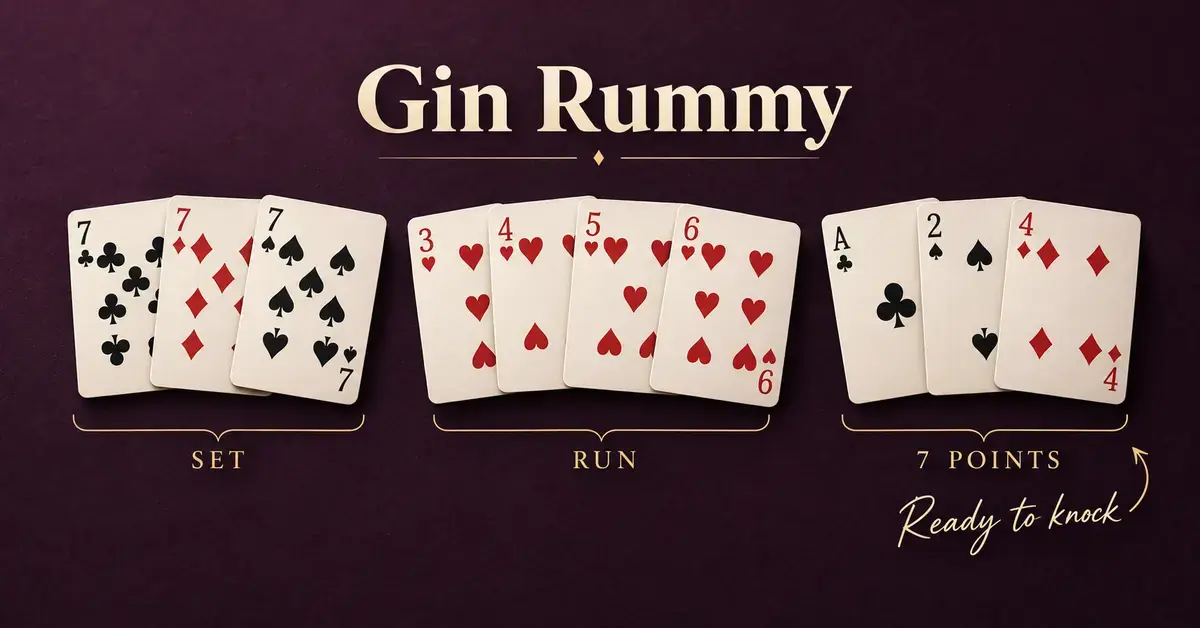
Gin Rummy is a two-player card game in which you build matched sets and runs, then end the round by “knocking” once your leftover cards are worth 10 points or fewer. It is played with a standard 52-card deck and is one of the most popular two-handed games in the Rummy family. This guide explains the deal, how a turn works, how to form melds, the three ways to end a round (knock, gin and undercut) and exactly how the scoring adds up to a 100-point game.
Key Points
- Players: exactly two, using one standard 52-card deck.
- Goal: form melds (sets and runs) and reduce your unmatched cards, called deadwood.
- Knock: end a round when your deadwood is 10 points or fewer.
- Gin: knock with zero deadwood for a bonus (commonly 25) plus the opponent’s deadwood.
- Undercut: if the non-knocker ties or beats the knocker’s deadwood, they score a bonus plus the difference.
- Winning: first to 100 points earns a 100-point game bonus, plus per-hand bonuses.
What is Gin Rummy?
Gin Rummy is the fast, two-player version of Rummy, where the goal is to arrange your hand into melds and get rid of your worthless leftover cards. A meld is a group of cards that scores no penalty: either a set (cards of the same rank) or a run (a sequence in one suit). Any card not part of a meld is called deadwood, and deadwood is what you are trying to reduce.
The game was devised in 1909 in Brooklyn, New York, by whist teacher Elwood T. Baker and his son C. Graham Baker, who wanted a quicker, two-handed alternative to standard Rummy. It stayed a local New York pastime until the early 1940s, when it spread across the United States and became a lasting classic. Unlike standard Rummy, you do not lay your melds on the table as you go — you keep them hidden until someone ends the round, which is what makes Gin Rummy both tense and quick.
What you need to play
You need just two players and one standard 52-card deck — no jokers. A pencil and paper (or a notes app) are handy for keeping score across several rounds, because a full game is played over many short hands rather than one.
Quick Facts
| Players | 2 |
|---|---|
| Equipment | One standard 52-card deck (no jokers) |
| Cards dealt | 10 to each player |
| Objective | Form melds and reduce deadwood to knock or go gin |
| Typical game length | 15–30 minutes (played to 100 points over several hands) |
| Recommended age | 8 and up |
| Designers | Elwood T. Baker and C. Graham Baker |
| First played | 1909 (Brooklyn, New York) |
| Difficulty | Easy to learn, rewards skill and memory |
If you are new to the wider Rummy family or want to compare mechanics, our general guide to the rules of Rummy is a good companion, and you can look up any unfamiliar term in our board game glossary.
How do you set up and deal Gin Rummy?
Deal 10 cards to each player, one at a time, and turn the next card face up to start the game. The remaining cards form the face-down stock pile, placed next to the single face-up card, which begins the discard pile.
- Choose a dealer. Pick a first dealer by any agreed method (for example, each player cuts the deck and the lower card deals). The deal alternates between players each round.
- Deal 10 cards each. Deal one card at a time, starting with your opponent, until you both have 10 cards.
- Turn the upcard. Place the 21st card face up beside the stock to start the discard pile.
Card values matter for scoring: aces count as 1 point, face cards (king, queen, jack) count as 10 each, and every other card counts as its number. Aces are low, so they only form runs at the bottom end (ace-2-3), never king-ace-2.
How does a turn work?
On each turn you draw one card and then discard one card, always keeping exactly 10 cards in hand. The round has a short opening sequence that decides who moves first.
- The first upcard. The non-dealer chooses first: take the face-up card or pass. If they pass, the dealer may take it or pass. If both pass, the non-dealer draws the top card of the stock and play continues normally.
- Drawing. On a normal turn, draw either the top card of the stock (face down, unknown) or the top card of the discard pile (face up, known).
- Discarding. After drawing, place one card face up on the discard pile. You may not take a card from the discard pile and then discard that same card on the same turn.
You keep your melds secret the whole time — nothing is laid on the table until a player ends the round. If the stock runs so low that only two cards remain and no one has ended the hand, the round is a draw: no one scores, and the cards are reshuffled and re-dealt.
What counts as a meld?
A meld is a scoring group of three or more cards, and there are only two kinds. Everything that is not in a meld is deadwood.
Sets
A set is three or four cards of the same rank, such as 7♠ 7♥ 7♣ or Q♠ Q♥ Q♣ Q♦. Suit does not matter for a set, only matching rank.
Runs
A run is three or more consecutive cards of the same suit, such as 4♣ 5♣ 6♣ or 9♦ 10♦ J♦. Because aces are low, the lowest run is ace-2-3 and a run cannot wrap around from king to ace.
The one-meld rule
Each card can belong to only one meld at a time. If you hold 7♣ 8♣ 9♣ and also 9♥ 9♦, the 9♣ can complete either the run or the set, but not both at once — you choose the arrangement that leaves you with the least deadwood.
What does knocking mean in Gin Rummy?
Knocking is how you end a round, and you may knock only when your deadwood adds up to 10 points or fewer. To knock, you physically knock on the table (or simply announce it), then lay down your hand arranged into melds with your deadwood set to one side. You take your normal turn first — draw, then discard — and knock on the discard.
You are never required to knock just because you can. Many players hold on in the hope of reducing their deadwood to zero and “going gin” for the bigger bonus, but waiting also gives your opponent more turns to improve.
Going gin
Going gin means knocking with zero deadwood — all 10 of your cards form valid melds. Gin earns a bonus (commonly 25 points) on top of the opponent’s entire deadwood count, and the defender is not allowed to lay off any cards. Gin is always worth more than an ordinary knock, which is why skilled players often chase it.
Big gin
Big gin happens when you can form a complete gin hand using all 11 cards — the 10 in your hand plus the card you just drew — without discarding. Big gin pays an even larger bonus (commonly 31 points) plus the opponent’s deadwood, and again no laying off is allowed. It is rare, but worth knowing.
The undercut
An undercut occurs when the player who did not knock ends up with equal or less deadwood than the knocker. When a player knocks without going gin, the defender first lays off any deadwood cards that extend the knocker’s melds (for example, adding a 10♣ to the knocker’s 7♣ 8♣ 9♣ run). If the defender’s remaining deadwood is then lower than or equal to the knocker’s, the defender wins the hand and collects a bonus (commonly 25 points) plus the difference between the two counts. This is why knocking with a high deadwood count — say exactly 10 — is risky.
How does scoring work in Gin Rummy?
After a round ends, both players total the point value of their deadwood, and the result decides who scores and how much. Points accumulate across rounds until someone reaches the game target, usually 100.
Scoring a knock
- Ordinary knock: if the knocker has less deadwood after the defender lays off, the knocker scores the difference between the two deadwood totals.
- Gin: the player who went gin scores the gin bonus (commonly 25) plus the opponent’s full deadwood count, with no lay-offs allowed.
- Undercut: if the defender ties or beats the knocker’s count, the defender scores the undercut bonus (commonly 25) plus the difference in the counts.
Bonuses and winning the game
The game ends when a player’s running total reaches the target, normally 100 points, after which the end-of-game bonuses are added.
- Game bonus: the player who first reaches 100 adds a 100-point game bonus.
- Line (box) bonus: each player adds a bonus for every individual hand they won during the game — commonly 25 points per hand (some rule sets use 20).
- Shutout (schneider): if the loser never won a single hand, the winner doubles their score before or after adding bonuses, depending on the house rule.
The player with the higher grand total after all bonuses wins the game. In tournament play, games are often played to 250 points instead of 100.
One honest caveat: Gin Rummy has no single governing rulebook, so bonus values differ by region and by household. The 25-point gin and undercut bonuses, the 25-point box bonus and the 100-point game and game-bonus targets are the most common modern values, but agree on the numbers before you start.
Gin Rummy vs standard Rummy: what is the difference?
The biggest difference is that in Gin Rummy you hide your melds until someone ends the round, whereas in standard Rummy you lay melds down as you build them. A few more contrasts are worth knowing if you already play basic Rummy:
- Players: Gin Rummy is strictly a two-player game, while standard Rummy works for two to six.
- Going out: Gin Rummy lets you end early by knocking at 10-or-fewer deadwood; standard Rummy usually requires melding your whole hand.
- Scoring: Gin Rummy scores the difference in deadwood plus bonuses, rather than simply penalising the loser’s leftover cards.
If you enjoy quick two-handed card games, you may also like our guides to Cribbage and other two-player games, or browse the full list of card and dice games.
Common mistakes beginners make
Most early losses come from a handful of avoidable habits rather than bad luck. Watch for these:
- Knocking too early with high deadwood. Knocking at exactly 10 points invites an undercut. If your deadwood is still high, it is often safer to wait a turn or two.
- Ignoring the opponent’s discards. Every card your opponent takes from the discard pile tells you what they are collecting. Avoid feeding them cards that complete obvious runs or sets.
- Holding high cards too long. Kings, queens, jacks and tens are 10 points of deadwood each. If they are not improving your hand, discard them early to cut your risk.
- Forcing gin every time. Chasing gin can backfire when a simple knock would have safely won the hand. Weigh the bonus against the chance of being undercut.
- Forgetting the one-meld rule. A shared card cannot sit in two melds at once, so count your deadwood using the arrangement that leaves the smallest total.
Simple strategy tips for beginners
Good Gin Rummy play is about managing risk and reading your opponent, not memorising tricks. A few reliable principles:
- Track the discard pile. Knowing which cards are gone helps you judge whether a run or set is still possible.
- Keep flexible cards. Middle cards (like 7s and 8s) can complete more runs than edge cards, so they are often worth holding.
- Shed deadwood steadily. Aim to lower your deadwood total each turn so you can knock the moment a good chance appears.
- Mind the safe discard. Late in a hand, discard cards your opponent is unlikely to want, even if they are slightly higher value.
For broader principles that carry over to many games, see our board game strategy tips.
Who is Gin Rummy for?
Gin Rummy suits anyone who wants a quick, skill-rewarding card game for exactly two people. It is easy to learn in a few minutes, plays in short rounds that fit a coffee break, and travels anywhere a single deck of cards can go. Because decisions about when to knock and what to discard reward attention and memory, it stays interesting long after you know the rules, making it a strong pick for couples, family pairs and travellers.
Sources
Frequently Asked Questions (FAQ)
How many cards do you deal in Gin Rummy?
You deal 10 cards to each of the two players from a standard 52-card deck. The next card is turned face up to start the discard pile, and the rest form the face-down stock.
What is deadwood in Gin Rummy?
Deadwood is any card in your hand that is not part of a meld (a set or a run). You add up the point value of your deadwood cards, and you may knock to end the round only when that total is 10 points or fewer.
What is the difference between knocking and going gin?
Knocking ends the round when your deadwood is 10 points or fewer, and your opponent may lay off cards against your melds. Going gin means knocking with zero deadwood, which pays a bonus and blocks your opponent from laying off.
What is an undercut in Gin Rummy?
An undercut happens when the player who did not knock finishes with equal or less deadwood than the knocker. The defender then wins the hand and scores a bonus plus the difference between the two deadwood counts.
How many points do you need to win Gin Rummy?
Most games are played to 100 points, and the first player to reach that total adds a 100-point game bonus, plus a bonus for each hand won. Tournament games are often played to 250 points instead.
