

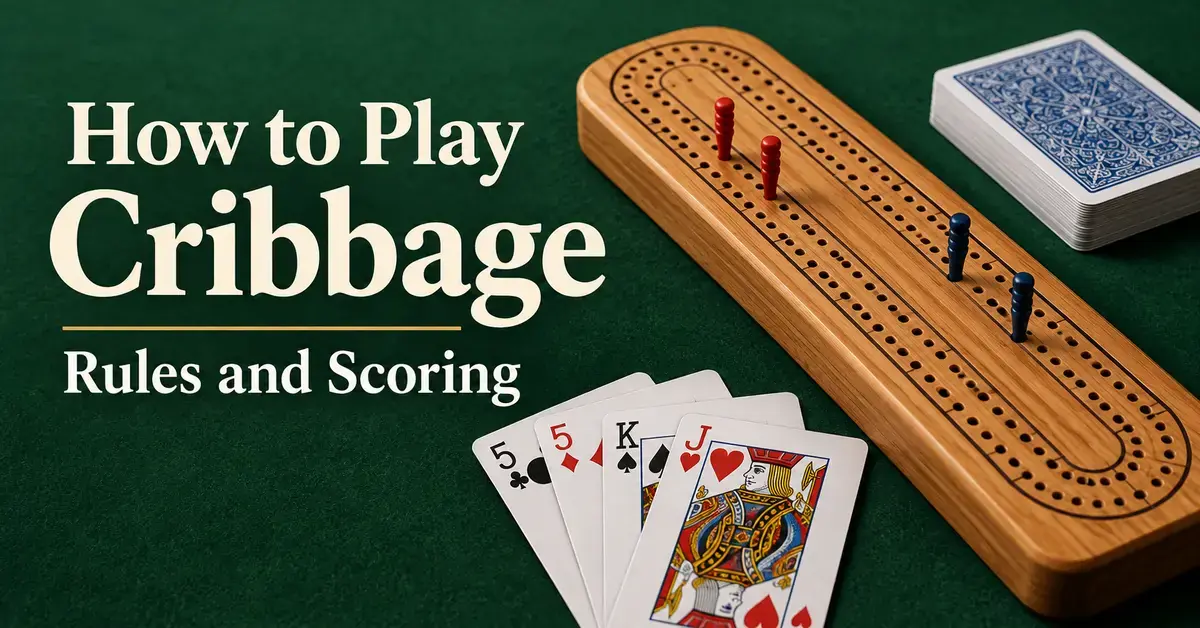
Cribbage is a card game for two players (with three- and four-player versions) in which you score points in two separate phases and track them by moving pegs around a wooden board. Using a standard 52-card deck, the goal is to be the first to reach 121 points. It has been a Canadian kitchen-table favourite for generations, in part because a quick game takes only 15–20 minutes and the distinctive board makes keeping score effortless. This guide walks through everything a beginner needs: the equipment, the deal, the crib, the cut, the play, the show and how to peg your way to the finish.
Key Points
- Players: 2 (also 3- and 4-player versions).
- Equipment: standard 52-card deck, a cribbage board and 4 pegs.
- Goal: be first to 121 points (or 61 in a short game).
- Deal (2 players): 6 cards each; each discards 2 to the crib, leaving 4.
- The crib: an extra hand that belongs to the dealer and is counted last.
- Two scoring phases: the play (pegging) and the show (counting hands).
- Playing time: roughly 15–20 minutes per game.
- Highest possible hand: 29 points.
What is cribbage?
Cribbage is a scoring game in which players build small card combinations worth points and race to a target total, traditionally 121. It is usually played head-to-head by two people, and its defining feature is the crib — an extra, fifth “hand” made from cards both players throw away, which the dealer gets to score. The other hallmark is the cribbage board, a pegged track used to record each player’s running total instead of pencil and paper.
Points come from two places. During the play (also called pegging) you score as cards are laid down one at a time. Then, during the show, you score the combinations hidden in your four-card hand and in the crib. Keeping those two phases separate in your mind is the single biggest step toward understanding the game.
What you need to play
You need three things: a standard deck of cards, a cribbage board, and something to peg with. None of it is expensive, and the board is the only specialised item.
Equipment
- A standard 52-card deck — no jokers.
- A cribbage board — a wooden board with rows of small holes used to track scores.
- Four pegs — two per player, usually two colours.
How cards are valued
Card values in cribbage are simple and stay the same throughout the game. Aces are always low and count as 1. Number cards count at face value (a 7 is worth 7). Jacks, Queens and Kings each count as 10. These values are used both for making fifteens and for the running total in the play. For runs (sequences), the order is A-2-3-4-5-6-7-8-9-10-J-Q-K, so a Jack-Queen-King is a valid run of three.
How to set up and deal
Decide who deals first by each cutting the deck — the player who cuts the lower card deals. The deal then alternates every hand, which matters because the dealer gets the extra points from the crib.
Dealing the cards
In the two-player game the dealer gives six cards face down to each player, dealing one at a time and starting with the opponent. Each player picks up their six cards and keeps them hidden.
Forming the crib
Each player then chooses two cards to lay face down to one side, keeping four cards in hand. Those four discarded cards — two from each player — form the crib, a second hand that belongs to the dealer and is counted only at the end of the show. Deciding which two cards to throw is the heart of cribbage strategy: the non-dealer wants to give the crib as little as possible, while the dealer wants to load it.
The cut and the starter
Once the crib is set, the non-dealer cuts the deck and the dealer turns up the top card of the lower pile. This face-up card is the starter (or turn-up). It is not used during the play but is treated as a fifth card for every hand and the crib during the show. If the starter is a Jack, the dealer immediately pegs 2 points — this is called “his heels” (or his nibs).
The play: fifteen-two, pairs, runs and 31
In the play, the two of you lay cards down one at a time and announce a running total, scoring points for combinations as you go. The non-dealer always lays the first card.
How the play works
Starting with the non-dealer, players alternate laying one card face up in front of themselves and calling out the new running total. The total may never pass 31. You keep your played cards in front of you (you do not mix them together) so that both hands can be re-counted later in the show.
What you score during the play
- Fifteen — if your card makes the running total exactly 15, peg 2 points (“fifteen-two”).
- Pair — play a card of the same rank as the one just played and peg 2. A third of the same rank (“pair royal”) is 6; a fourth (“double pair royal”) is 12.
- Run — complete a sequence of three or more cards played in a row (any order) and peg 1 point per card: a run of three scores 3, a run of four scores 4, and so on.
- Thirty-one — make the running total exactly 31 and peg 2 points.
The “go” and the last card
When a player cannot add a card without passing 31, they say “Go,” and the opponent pegs 1 point — unless that opponent can keep laying cards, in which case they continue until they too must stop. Whoever plays the last card of a sequence before the count resets scores 1 point for the “go” (or 2 if it lands exactly on 31). The count then starts again from zero with the remaining cards until everyone has played all four.
The show: counting your hands
In the show, each player picks their four cards back up and counts every scoring combination they can make using those four cards plus the starter. This is where most points are won, so count carefully.
The order of counting
Counting happens in a fixed order so the scores are checked out loud: the non-dealer’s hand first, then the dealer’s hand, and finally the dealer’s crib. This order is why the non-dealer can sometimes win on a close game before the dealer gets to count — in cribbage, position matters right to the end.
What scores in a hand
You score the same combinations as in the play, plus flushes and “his nobs”:
- Fifteens — every distinct combination of cards totalling 15 scores 2 (and they can overlap).
- Pairs — 2 points each; three of a kind is 6 and four of a kind is 12.
- Runs — 1 point per card in each sequence of three or more.
- Flush — four hand cards of the same suit score 4; if the starter matches that suit too, score 5. In the crib a flush only counts if all five cards (the four crib cards and the starter) share a suit, for 5.
- His nobs — holding the Jack of the same suit as the starter scores 1.
Because combinations can overlap, a single hand can add up quickly. The best possible hand in cribbage is 29 points: three fives and the Jack in hand, with the fourth five as the starter matching the Jack’s suit.
Scoring Combinations
| Combination | What it is | Points |
|---|---|---|
| Fifteen | Any cards totalling exactly 15 | 2 |
| Pair | Two cards of the same rank | 2 |
| Pair royal | Three cards of the same rank | 6 |
| Double pair royal | Four cards of the same rank | 12 |
| Run of three | Three cards in consecutive rank | 3 |
| Run of four | Four cards in consecutive rank | 4 |
| Run of five | Five cards in consecutive rank | 5 |
| Flush (hand) | Four hand cards of the same suit | 4 |
| Flush (hand + starter) | Four hand cards and the starter in one suit | 5 |
| Flush (crib) | All five crib cards in one suit (crib only) | 5 |
| His nobs | Jack in hand matching the starter’s suit | 1 |
| His heels | Starter is a Jack (dealer pegs on the cut) | 2 |
| Go | Opponent cannot add a card without passing 31 | 1 |
| Thirty-one | Running total in the play reaches exactly 31 | 2 |
| Last card | Playing the final card of a count under 31 | 1 |
How to use a cribbage board
A cribbage board replaces a written scorecard: you move pegs along a track of holes to show your total, so you never lose track mid-game. Once you learn the simple peg routine, scoring is faster than writing numbers down.
The board layout
A standard board has two rows of 30 holes for each player (120 holes in total), plus one or more extra “game” holes at the end. Each player uses the two rows on their own side of the board as a single track. Scoring runs down one row and back up the other, so one full lap is 60 points and the game of 121 takes two laps — hence the phrase “twice around the board.” Shorter 61-point games go “once around.”
Pegging with two pegs
Each player uses two pegs of the same colour and leapfrogs them. When you score, you advance your rear peg ahead of your front peg by the number of points you just made. The front peg always marks your previous score, so the gap between your two pegs shows the size of your last score — and nobody can lose their place.
Reaching 121 — and skunks
The first player to peg exactly to the final game hole at 121 wins immediately; you do not have to win on an exact count beyond reaching 121. If you win while your opponent is still short of 91 (that is, more than 30 points behind), it is a skunk and usually counts as a double win in a match. Winning before they pass 61 is a double skunk.
Counting honestly: “muggins”
Hands are counted aloud so both players can check them. Under the optional muggins rule, if you miss points in your own hand, your opponent may call “Muggins!” and peg the points you overlooked. Agree before the game whether you are playing muggins, because it rewards sharp counting.
Cribbage for three or four players
Cribbage adapts easily to more players. With three players, each is dealt five cards and discards one to the crib, and one extra card is dealt straight to the crib so it still has four cards; players use the triangular three-track board and play for themselves. With four players, people usually play in two partnerships sitting opposite each other; each player is dealt five cards and discards one, so the crib again has four. The crib still belongs to the dealer, and the deal rotates each hand.
Common mistakes beginners make
Most early errors come from mixing up the two scoring phases or from careless discarding. Watch for these:
- Forgetting the crib is the dealer’s. As non-dealer, avoid throwing two cards that help the opponent — steer clear of fives, which pair easily with the many ten-value cards.
- Missing overlapping combinations in the show. A single card can complete a fifteen, a pair and a run at once; count them all.
- Mis-pegging with two pegs. Always move your back peg, never the front one, or you will lose your place.
- Playing a card that hands over a run. In the play, laying a card next to the opponent’s can let them complete a run or make 15 on the reply.
- Counting in the wrong order near the finish. The non-dealer counts first, so on a close game the dealer may not get the chance to count out.
Discarding well and pegging safely are skills that improve with practice; our wider board game strategy guide covers the general habits — tempo and risk management — that carry over to cribbage.
Where cribbage fits
Cribbage sits alongside euchre, rummy and other staples in our round-up of card and dice games, and it is one of the easiest classics to pick up once you have the two scoring phases clear. If you are brand new to tabletop gaming, the beginner’s guide to playing board games explains common components and turn structure, while our overview of classic board game rules links out to other household favourites.
Sources
Vanliga frågor (FAQ)
How many points do you need to win at cribbage?
You need 121 points in the standard game, reached by pegging twice around a 120-hole board plus the final game hole. A shorter game plays to 61 points, once around the board. The first player to reach the target wins immediately.
What is the crib in cribbage?
The crib is a fifth hand made from the cards both players discard — two each in the two-player game. It belongs to the dealer, who counts it last during the show, after both players have counted their own hands.
What does “fifteen-two” mean?
“Fifteen-two” is how players announce scoring 2 points for a combination of cards that adds up to exactly 15, using card values where Aces are 1 and face cards are 10. It applies both during the play and when counting hands in the show.
What is the highest possible cribbage hand?
The highest hand is 29 points. It consists of three fives and a Jack in hand, with the fourth five turned up as the starter in the same suit as the Jack, which scores four fifteens, a double pair royal and his nobs.
How do the pegs work on a cribbage board?
Each player uses two pegs and leapfrogs them up the track. When you score, you move your rear peg ahead of the front one by the number of points you made, so the front peg marks your old score and the gap shows your most recent score.
