

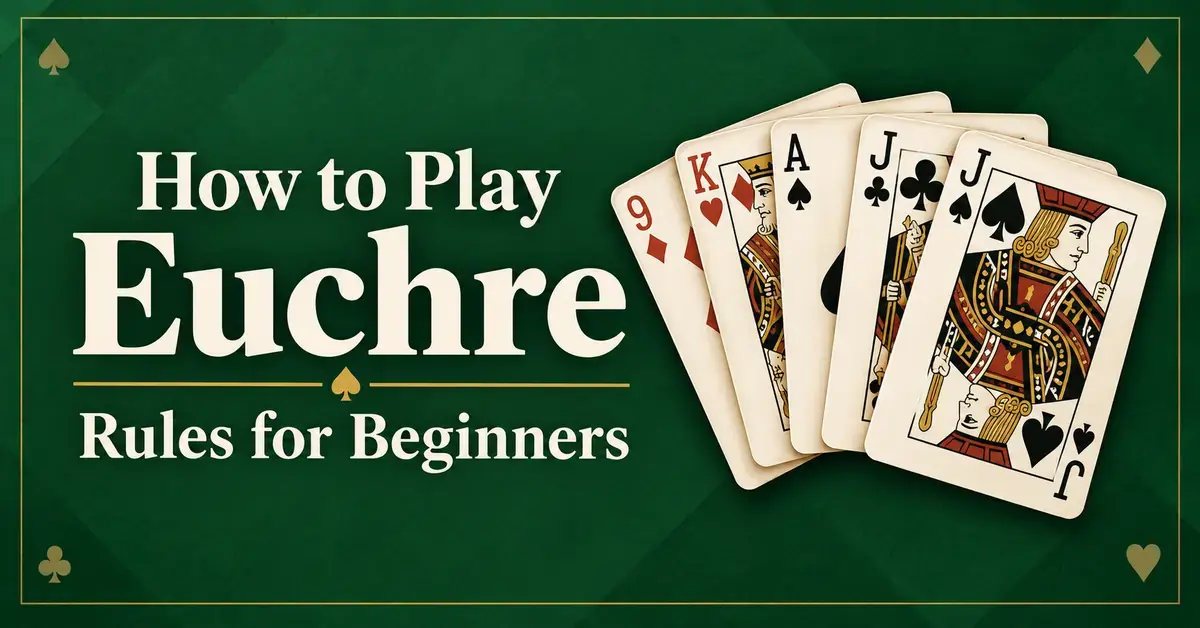
Euchre is a fast, social trick-taking card game for four players in two teams, played with a trimmed-down 24-card deck. It is one of the easiest classic card games to learn and one of the hardest to put down, which is why it has been a kitchen-table and community-hall fixture across Ontario and much of Canada for generations. This guide explains everything a beginner needs: the deck, the all-important bowers, how to call trump, going alone, playing tricks and the full scoring system.
Quick Facts
| Players | 4 (two partnerships of 2) |
|---|---|
| Deck | 24 cards (9, 10, J, Q, K, A of each suit) |
| Age | 8 and up |
| Play time | 15–30 minutes per game |
| Game type | Trick-taking card game |
| Objective | First team to 10 points |
What is euchre?
Euchre is a trick-taking game in which two partnerships compete to win the most “tricks” (rounds of four cards) over a short five-trick hand. One team commits to a trump suit each hand and must win at least three of the five tricks to score. The game descends from an old Alsatian game called Juckerspiel, carried to North America by German-speaking immigrants in the early 19th century, and it was once widely regarded as America’s national card game.
Today euchre is most strongly associated with the American Midwest and with Canada — especially Southern Ontario, where it remains a staple of family gatherings, legion halls and club nights. It is sometimes described as Canada’s unofficial national card game. If you are new to tabletop gaming in general, you may want to pair this with our wider beginner’s guide to board games before diving in.
What you need to play euchre
You need four players and a 24-card euchre deck. Euchre is designed around partnerships, so the social set-up matters as much as the equipment.
The 24-card euchre deck
Euchre uses only 24 cards: the 9, 10, Jack, Queen, King and Ace of all four suits. You make this deck by stripping every card from 2 through 8 out of a standard 52-card pack (purpose-made euchre decks are also sold). The smaller deck is what gives euchre its quick, punchy hands.
Players and teams
Standard euchre is a four-player game played as two partnerships. Partners sit directly across from each other, so play alternates between the two teams around the table. There are two- and three-handed variants (covered below), but partnership euchre is the real game and the version almost everyone learns first.
How the cards rank: trump and the bowers
Card ranking in euchre changes depending on which suit is trump, and this is the single most important idea for a beginner to absorb. Trump cards beat every card of every other suit, and the two highest trumps are both Jacks.
What are the right and left bowers?
The right bower is the Jack of the trump suit, and it is the highest card in the game. The left bower is the other Jack of the same colour, and it is the second-highest card. Crucially, the left bower stops being its own suit and becomes a trump card for that hand. For example, if hearts are trump, the Jack of hearts is the right bower and the Jack of diamonds (the other red Jack) becomes the left bower — a heart for scoring and following-suit purposes, no longer a diamond.
The table below shows the full ranking when hearts are trump, from strongest card to weakest.
| Rank | Card (hearts as trump) | Why |
|---|---|---|
| 1 (highest) | Jack of Hearts | Right bower — Jack of the trump suit |
| 2 | Jack of Diamonds | Left bower — same-colour Jack, now counts as a heart |
| 3 | Ace of Hearts | Highest “natural” trump |
| 4 | King of Hearts | Trump |
| 5 | Queen of Hearts | Trump |
| 6 | 10 of Hearts | Trump |
| 7 (lowest trump) | 9 of Hearts | Trump |
Note that when hearts are trump the trump suit has seven cards (because the left bower joins it), while diamonds is left with only five cards (A, K, Q, 10, 9) because it lost its Jack.
How non-trump suits rank
Non-trump suits — also called “plain” or “off” suits — rank in the usual order: Ace (high), King, Queen, Jack, 10, 9 (low). The one exception is the suit that is the same colour as trump, which loses its Jack to the left bower. So with hearts as trump, spades and clubs each keep their Jack, but diamonds does not.
Dealing the cards
The dealer gives each player five cards, dealt clockwise in two small packets (usually three then two, or two then three). That uses 20 of the 24 cards. The remaining four cards form the “kitty,” placed face down in the middle. The dealer then turns the top card of the kitty face up — this is the “upcard,” and it drives the first round of bidding. The deal passes clockwise after each hand.
Euchre bidding: calling trump
Euchre bidding decides which suit is trump, and it happens in up to two rounds starting with the player to the dealer’s left. Getting the trump call right is where euchre turns from luck into skill.
First round: ordering up
In the first round, the upcard’s suit is the only candidate for trump. Going clockwise, each player chooses to “pass” or to accept that suit as trump. A non-dealer who accepts it says “order it up” (or “I order it up”); the dealer’s partner accepting it is often called “assisting.” If the dealer wants that suit, the dealer “takes it up” by adding the upcard to their hand and discarding one card face down. Whoever commits to the suit becomes the “makers,” the team that must win at least three tricks.
Second round: naming trump
If all four players pass in the first round, the dealer turns the upcard face down and a second round begins. Now each player, again starting left of the dealer, may pass or name any suit as trump except the suit of the rejected upcard. The first player to name a suit sets trump and becomes a maker. If everyone passes again, the hand is normally thrown in and redealt — though many groups use the “stick the dealer” rule (see variants) that forces the dealer to choose.
Going alone
When a player calls trump, they may declare that they are “going alone.” Their partner sets their cards aside and sits out the hand entirely, so the lone player faces both opponents single-handed. Going alone is risky but pays well: winning all five tricks alone is worth four points instead of two. Players usually only go alone with a very strong hand — both bowers plus the trump Ace is the classic trigger.
Playing the tricks
Play consists of five tricks, each made up of one card per active player. The player to the dealer’s left (or to a lone player’s left) leads the first card, and the winner of each trick leads the next.
Following suit
You must follow suit if you can. If a heart is led and you hold a heart, you must play a heart. Only if you have no card of the led suit may you play a trump or discard an off-suit card. Remember that the left bower counts as trump, not as its printed suit — so if hearts are trump, you cannot use the Jack of diamonds to follow a diamond lead.
Winning a trick
The highest trump played wins the trick. If no trump is played, the highest card of the suit that was led wins. Cards of other off-suits, even an Ace, cannot win a trick they did not help lead. Each team keeps the tricks it wins in a tidy pile so both sides can count them at the end of the hand.
Key Points
- Euchre is a trick-taking game for 4 players in two teams, using a 24-card deck (9 through Ace).
- The two same-colour Jacks are the strongest cards: the right bower (Jack of the trump suit) and the left bower (Jack of the matching-colour suit), which counts as trump.
- One team names trump and must win at least 3 of the 5 tricks, or they are “euchred.”
- Scoring: 3–4 tricks = 1 point; all 5 (a march) = 2; euchreing the opponents = 2 to the defenders.
- A lone player who wins all 5 tricks scores 4 points.
- The first team to 10 points wins the game.
Euchre scoring
Euchre scoring rewards the makers for keeping their promise of three tricks and punishes them hard if they fail. The table below covers every outcome; the first team to 10 points wins the game.
| Outcome | Points | Who scores |
|---|---|---|
| Makers win 3 or 4 tricks | 1 | Makers |
| Makers win all 5 tricks (a “march”) | 2 | Makers |
| Makers win fewer than 3 tricks (“euchred”) | 2 | Defenders |
| Lone player wins 3 or 4 tricks | 1 | Makers |
| Lone player wins all 5 tricks (lone march) | 4 | Makers |
How many points do makers score?
The makers score 1 point for taking three or four of the five tricks. If they take all five tricks — a “march” (also called a sweep) — they score 2 points. These are the everyday results of most hands.
What is being euchred?
Being euchred means the makers failed to win at least three tricks, and it is the heart of the game’s name. When this happens, the defending team scores 2 points instead of the makers. Euchreing the opponents is just as valuable as calling a successful trump yourself, which is why defenders fight for every trick.
What does going alone score?
A lone player who wins all five tricks scores 4 points — the biggest single swing in the game. If the lone player only manages three or four tricks, they still score just 1 point, and if they are euchred the defenders still score only 2. The extra reward comes solely from sweeping all five alone.
How do you win the game?
The first team to reach 10 points wins. Some groups play to 5 or 7 points by prior agreement, and a traditional way to track score is to use a pair of spare low cards (like two 5s) to show points on each side. Because big hands are worth 2 or 4 points, leads can vanish quickly.
Common euchre variants and house rules
Euchre is famous for its house rules, and the version you learn may differ slightly from the next town over. The most common variants are worth knowing before you sit down at a new table.
- Stick the dealer: if everyone passes in both rounds, the dealer must name a trump suit rather than throwing the hand in. This speeds up the game and raises the stakes on a weak dealing hand.
- Benny (the Joker): a single Joker is added as the permanent highest trump, outranking even the right bower, no matter which suit is trump. This is common in parts of the UK and in some Canadian circles.
- Farmer’s hand (or “bare dealer”): a player dealt the three lowest cards (9s and 10s) may ask to swap three cards with the kitty before bidding, giving a hopeless hand a second chance.
- Three-handed (cut-throat) euchre: each player plays for themselves, and whoever calls trump plays alone against the other two.
- Two-handed euchre: a pared-back version for two players, usually using a smaller deck, good for practising the ranking and bidding.
You can find many more trimmed-deck and dice classics in our round-up of card and dice games, and the broader family of classic board game rules for when you want a change of pace.
Common mistakes beginners make
The fastest way to improve at euchre is to stop making a handful of predictable errors. Beginners lose the most points to these mistakes:
- Forgetting the left bower is trump. Players routinely count the same-colour Jack as its printed suit, then either misplay it or illegally fail to follow trump. Always re-map the left bower the moment trump is set.
- Calling trump on a weak hand. Ordering up with only one or two low trumps often leads to being euchred and handing the opponents 2 points. As a rough guide, call with three solid trumps, or two trumps plus an off-suit Ace.
- Going alone too often. Going alone is thrilling, but without both bowers and real top-end strength you usually scrape three tricks for a single point — the same as playing with your partner, but with more risk.
- Leading badly on defence. Leading trump into the makers can hand them control; leading your off-suit Aces first is usually safer when you are trying to euchre them.
- Not counting trumps. Only seven trumps exist each hand. Tracking which bowers and high trumps have appeared tells you when your remaining trump is a guaranteed winner.
Euchre strategy basics
Good euchre strategy starts with disciplined trump calling and ends with reading your partner. Call trump when the odds favour three tricks, pass when they do not, and trust that a euchre against the other team is worth just as much as a successful call of your own. On lead, think about whether you are trying to run your own trumps or deny the makers theirs. Signalling through the cards you lead and discard — within the rules, no table talk — is the subtle layer that separates casual and club play. For transferable principles like tempo, risk management and reading opponents, see our wider guide to board game strategy.
Where does euchre come from?
Euchre most likely descends from an old Alsatian game called Juckerspiel (also spelled Jucker), carried to North America by German-speaking immigrants in the early 1800s. The earliest published euchre rules appeared in 1844, when the game was spreading quickly through the United States — by the mid-19th century it was one of the most popular card games in the country, before bridge and poker later overtook it.
Euchre also shaped the deck itself: American players modifying the rules in the 1860s introduced an extra top trump, the “best bower,” which is widely credited as the origin of the modern joker card. Today euchre’s strongest followings are in the US Midwest (especially Michigan), Ontario and parts of Australia, New Zealand and England. It is often called Canada’s national card game, and in Ontario it remains a staple of legions, church halls and family gatherings — much like crokinole, another homegrown Canadian classic.
Who is euchre for?
Euchre suits anyone who wants a quick, social, team-based card game with a gentle learning curve and real depth underneath. It plays best with exactly four people, works for ages 8 and up, and a full game to 10 points takes only 15 to 30 minutes — ideal for a games night, a cottage weekend or a community tournament. If you enjoy partnership trick-taking, euchre is one of the most rewarding places to start.
Sources
Frequently Asked Questions (FAQ)
How many players do you need for euchre?
Standard euchre is for four players in two partnerships, with partners sitting opposite each other. Two- and three-handed variants exist, but the four-player partnership game is the classic version almost everyone learns.
What is the difference between the right and left bower?
The right bower is the Jack of the trump suit and the highest card in the game; the left bower is the other Jack of the same colour and the second-highest. The left bower counts as a trump card, not as its printed suit, for the whole hand.
How many cards are in a euchre deck?
A euchre deck has 24 cards: the 9, 10, Jack, Queen, King and Ace of all four suits. You make it by removing every 2 through 8 from a standard 52-card pack.
What does it mean to be euchred?
Being euchred means the team that called trump (the makers) failed to win at least three of the five tricks. When that happens, the defending team scores 2 points instead of the makers.
How do you win a game of euchre?
The first team to reach 10 points wins, though some groups play to 5 or 7 by agreement. Points come from winning 3–4 tricks (1 point), all 5 tricks (2 points), euchreing the opponents (2 points) or sweeping all 5 tricks alone (4 points).
