

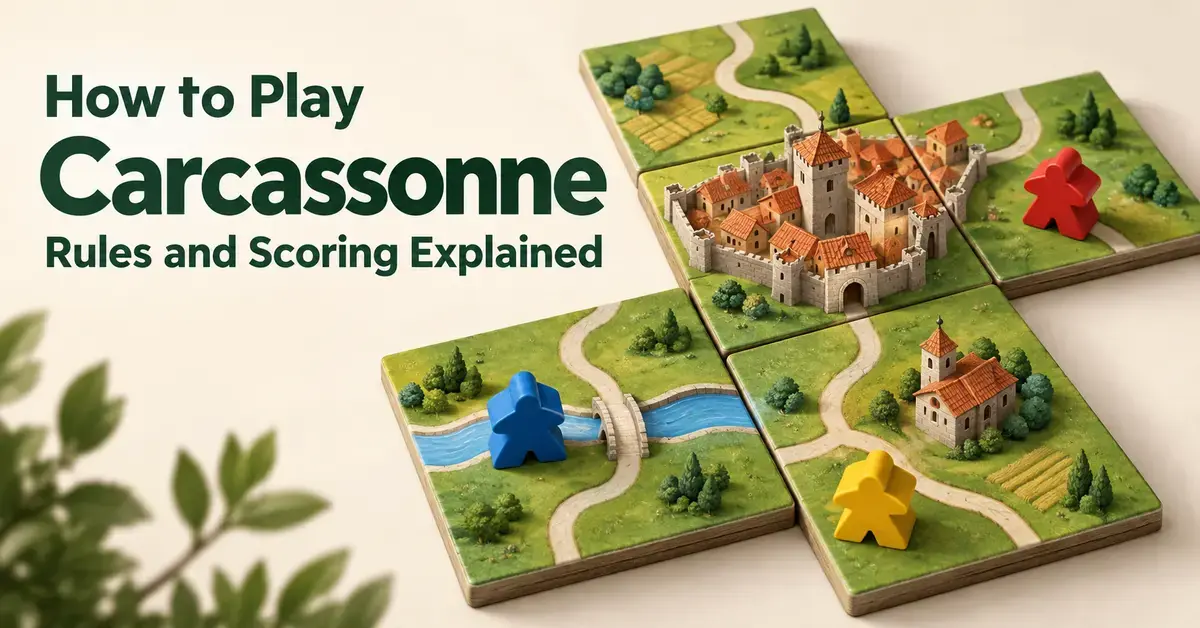
Carcassonne is a tile-laying board game for 2 to 5 players in which you build a medieval landscape of roads, cities, monasteries and farmland one tile at a time, then place small wooden figures called meeples to claim those features and score points. It is quick to learn, takes about 35 to 45 minutes, and rewards a little planning without ever feeling heavy — which is why it won the 2001 Spiel des Jahres (Game of the Year) and remains one of the most recommended gateway games in the hobby. This guide explains the setup, how a turn works, every way to score, how the game ends, and the common mistakes new players make.
Quick Facts
| Players | 2–5 (ages 7+) |
|---|---|
| Playing time | About 35–45 minutes |
| Designer | Klaus-Jürgen Wrede |
| Publisher | Hans im Glück (Germany); Z-Man Games (English) |
| First released | 2000 |
| Awards | Spiel des Jahres and Deutscher Spiele Preis, 2001 |
| Tiles | 72 land tiles (1 starting tile + 71 drawn) |
| Meeples | 8 per player (1 score marker + 7 followers) |
| Type | Tile-laying / area control |
What is Carcassonne?
Carcassonne is a competitive tile-placement game designed by Klaus-Jürgen Wrede and first published in 2000 by the German company Hans im Glück; the current English-language edition is published by Z-Man Games. It is named after the fortified French city of Carcassonne and its medieval walls. There is no board to set up in advance — the “board” is created during play as each player adds a square tile to the shared landscape.
The heart of the game is the meeple, a small wooden figure you place on a tile to claim a feature such as a road or a city. Claimed features earn points when they are finished, after which the meeple comes back to you to be used again. Because meeples are a limited resource, deciding when to commit one and when to hold back is the central tactical choice. If the word is new to you, the board game glossary explains “meeple” and the other terms used below.
What you need to play
Everything comes in the box. A standard current edition contains:
- 72 land tiles — 1 starting tile (with a darker back) plus 71 tiles that are shuffled face down into a draw supply.
- A scoreboard numbered 0 to 49 (and beyond), used to track each player’s points.
- 8 meeples per player in each player’s colour. One meeple goes on the scoreboard as a score marker, leaving 7 “followers” to place on tiles.
- Two mini-expansions — most current Z-Man editions include The River and The Abbot in the same box. You can set these aside for your very first game and add them later (see below).
Each tile shows some combination of road segments, city walls, open fields and sometimes a monastery. Many city tiles carry a small shield, called a pennant or coat of arms, which is worth bonus points.
How to set up Carcassonne
Setup takes a minute or two:
- Place the single starting tile face up in the middle of the table.
- Shuffle the remaining tiles face down into one or more draw piles everyone can reach.
- Give each player their 8 meeples. Each player puts one meeple on space 0 of the scoreboard as their score marker and keeps the other 7 in front of them.
- Return to the box any colours you are not using. For your first game, also set aside the River and Abbot pieces.
- Pick a start player — the youngest player going first is the usual convention.
How a turn works
Every turn follows the same three steps, always in this order: place a tile, optionally place a follower, then score anything you just completed. Play then passes clockwise.
1. Draw and place a tile
Draw one tile at random and add it to the landscape. The new tile must be placed next to at least one tile already on the table, sharing a full edge, and the artwork must match across that edge: road must connect to road, city wall to city wall, and field to field. Tiles connect only on their four straight edges, never diagonally. If a drawn tile genuinely cannot be placed anywhere legally, return it to the box and draw a replacement.
2. Place a follower (optional)
After placing the tile, you may place one of your 7 followers on it — but only on the tile you just laid, and only on a feature that no one has already claimed. You cannot add a follower to a city, road, field or monastery that another player (or you) already occupies. However, as the landscape grows you can sometimes merge two separate features by laying a connecting tile; when that happens the feature can end up with followers from more than one player. You are never forced to place a follower, and often the smart move is to keep one in reserve.
3. Score completed features
If the tile you placed completes a road, city or monastery that holds a follower, you score it immediately and the follower returns to its owner for future turns. Features that are not yet finished stay on the board and are scored later, at the end of the game.
The four ways to use a follower
A follower does a different job depending on which part of the tile you set it on. You still only ever place one per turn.
Knight — on a city
Place a follower inside a city section (an area enclosed by walls) and it becomes a knight. The city scores when it is fully enclosed with no gaps in its walls.
Thief — on a road
Place a follower on a road segment and it becomes a thief (or robber). A road is complete when both ends close off — at a city, a monastery, a crossroads or by looping back on itself.
Monk — on a monastery
Place a follower on a monastery tile and it becomes a monk. The monastery scores once it is completely surrounded by tiles on all eight sides, including the four diagonals.
Farmer — on a field
Place a follower lying down on a field (the open green area) and it becomes a farmer. Farmers are different from every other follower: they stay on the board for the whole game, never return to your supply, and score only in the final count. Committing a farmer is a long-term investment, so most players place them deliberately rather than every turn.
How scoring works in Carcassonne
Points come from four feature types. The key distinction to learn is that roads, cities and monasteries can be scored during the game (as soon as they are completed), while fields are only ever scored at the very end.
Roads
A completed road scores 1 point for each tile it runs across. A short two-tile road is worth 2 points; a long winding road can be worth far more.
Cities
A completed city scores 2 points for every tile it covers, plus 2 extra points for each pennant (shield) shown inside it. A compact four-tile city with one pennant, for example, is worth 10 points.
Monasteries
A monastery scores 9 points when it is finished — 1 for the monastery tile itself plus 1 for each of the 8 tiles surrounding it. It is one of the most reliable sources of points for a beginner, because you control it simply by building around your own monk.
Fields and farmers
Fields are scored only at game end and work unlike anything else. You do not count field tiles; you count the completed cities that the field touches. The player with the most farmers in a given field scores 3 points for each completed city bordering it. If players tie for the most farmers in a field, each tied player scores the full value. Note that only finished cities count — a field touching only unfinished cities scores nothing. (Older English rulebooks printed before 2008 used 4 points per city; the current third-edition rule is 3 points, so check which rulebook is in your box if the numbers differ.)
Scoring at a Glance
| Feature | When completed (during play) | If incomplete (at game end) |
|---|---|---|
| Road | 1 point per tile | 1 point per tile |
| City | 2 points per tile + 2 per pennant | 1 point per tile + 1 per pennant |
| Monastery | 9 points (tile + 8 surrounding tiles) | 1 point per tile placed so far |
| Field (farmer) | Not scored during play | 3 points per completed city the field borders |
How the game ends and final scoring
The game ends the moment the last tile is drawn and placed. Then you score every feature that still has a follower on it but was never completed:
- Incomplete roads: 1 point per tile.
- Incomplete cities: 1 point per tile, plus 1 point per pennant (half the completed value).
- Incomplete monasteries: 1 point for the monastery tile plus 1 point for each surrounding tile placed so far.
- Fields: 3 points for each completed city the field borders, counted for the player with the most farmers there.
Add every player’s end-game points to the running total on the scoreboard. The highest total wins. Carcassonne frequently ends in close scores, and a single well-placed farmer can swing the result, so it is worth adding up carefully.
The River and The Abbot mini-expansions
Most current editions include two small expansions in the box. They are optional and easy to add once you know the base rules.
The River replaces the single starting tile with a set of river tiles. You lay these first, following the water’s path, to carve the landscape into a larger, more open map before normal play begins. It changes the opening and tends to spread features out.
The Abbot adds one extra figure per player, the abbot, and a new feature called a garden. On a turn you may place your abbot (instead of a regular follower) on a monastery or a garden. Its special power is that you can also choose to take the abbot back on a later turn instead of placing a follower, scoring it then for however many surrounding tiles are in place — useful when a monastery looks unlikely to be completed.
Common mistakes beginners make
A few errors come up again and again in a first game. Avoiding them will raise your scores quickly:
- Trying to place a follower on a claimed feature. You can only claim a road, city, field or monastery that is currently empty, and only on the tile you just laid.
- Forgetting that farmers never come back. Every farmer you commit is one fewer follower for the rest of the game. Spend them with intent.
- Chasing one huge city. Large cities score big but are easy for opponents to block by leaving a wall open. Several small, finished features are often safer.
- Ignoring monasteries. A monk in a monastery is 9 nearly guaranteed points you control yourself — strong value for one follower.
- Mixing up scoring timing. Roads, cities and monasteries score when completed; fields only at the end. Do not try to score a field mid-game.
- Missing the chance to merge features. Joining your road or city to a rival’s bigger one lets you share the points you could not have reached alone.
Who Carcassonne is for
Carcassonne suits almost anyone looking for a short, approachable strategy game. The rules fit on a couple of pages, a game rarely runs past 45 minutes, and it plays well at every count from two up to five. It works especially well as a two-player duel, where blocking and farmer battles become sharper, and as a family game thanks to the age 7+ rating. If you enjoy it, it makes a natural stepping stone to other modern classics — see how to play Catan for another gateway Eurogame, the wider world of board game genres and mechanics to understand tile-laying in context, and our guide to board game strategy for ways to get better. For the rules of other tabletop staples, the classic board game rules hub collects them in one place.
Sources
Frequently Asked Questions (FAQ)
How many players can play Carcassonne?
The base game is for 2 to 5 players, ages 7 and up. It plays well across that whole range, and it is a strong choice for two players, where blocking and competing for farms matter more.
How long does a game of Carcassonne take?
A typical game without expansions runs about 35 to 45 minutes. It gets faster once everyone knows the rules, and setup takes only a minute or two because there is no fixed board.
What is a meeple in Carcassonne?
A meeple is the small wooden figure you place on a tile to claim a feature. Depending on where you place it, it acts as a knight (city), a thief (road), a monk (monastery) or a farmer (field), and it earns you the points for that feature.
When do you score farmers in Carcassonne?
Farmers are scored only at the end of the game. The player with the most farmers in a field earns 3 points for each completed city that the field borders. Farmers stay on the board the whole game and never return to your supply.
Do you have to place a meeple every turn?
No. Placing a follower is optional. Because you only have seven at a time and most of them return to you when a feature is scored, holding one back for a better opportunity is often the stronger play.
