

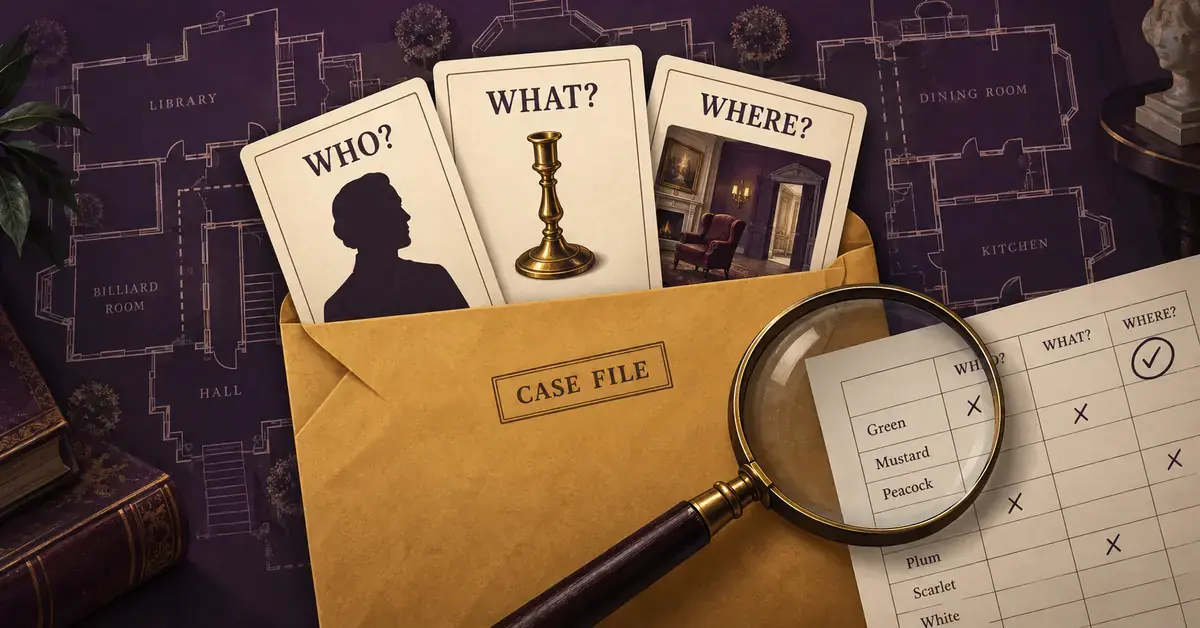
Clue (sold as Cluedo in the United Kingdom and many other countries) is a classic murder-mystery deduction game in which players race to work out three facts: who committed the crime, with which weapon, and in which room. One card for each of those three questions is hidden at the start of the game, and the first player to name all three correctly wins. This guide explains the components, the setup, every rule of a turn, and — most importantly — a clear method for using the clues you gather to solve the case.
Quick Facts
| Players | 3–6 (some editions list 2–6) |
|---|---|
| Recommended age | 8 and up |
| Playing time | About 45 minutes |
| Game type | Deduction / murder mystery |
| Designer | Anthony E. Pratt |
| First published | 1949 (UK as Cluedo; US as Clue) |
| Current publisher | Hasbro |
| Goal | Name the suspect, weapon and room in the hidden case file |
What is Clue?
Clue is a deduction game for a small group in which everyone is both a suspect and a detective. The board shows a mansion with nine rooms. Before play begins, one suspect card, one weapon card and one room card are placed, unseen, inside a “case file” envelope — that hidden trio is the solution. Every other card is dealt out to the players, so each player is holding part of the proof of what did not happen.
Because a card in your hand cannot be in the envelope, every card you see rules a possibility out. The whole game is a process of elimination: you move around the mansion, float theories called suggestions, and watch which cards other players reveal to disprove them. Narrow the field far enough and only one suspect, one weapon and one room remain — that is your answer. If you want a refresher on how components and turns work in general before diving in, our beginner’s guide to playing board games covers the basics.
What comes in the box?
A standard Clue set contains the board, the cards, player tokens, miniature weapons, two dice and a detective notepad. The exact contents are:
- The board — a floor plan of a mansion with nine rooms connected by hallways, plus doorways and secret passages.
- 21 cards — six suspect cards, six weapon cards and nine room cards. One of each type goes into the case file; the rest are dealt.
- The case file envelope — holds the hidden solution for the whole game.
- Six character tokens and six weapon pieces that move around the board.
- Two dice and a pad of detective sheets for crossing off clues.
The suspects, weapons and rooms are the three things you are trying to identify, so it helps to see the full list at a glance.
Suspects, Weapons and Rooms
| Suspects (6) | Weapons (6) | Rooms (9) |
|---|---|---|
| Miss Scarlett | Candlestick | Kitchen |
| Colonel Mustard | Knife (Dagger) | Ballroom |
| Mrs. Peacock | Lead Pipe | Conservatory |
| Professor Plum | Revolver (Pistol) | Dining Room |
| Mr. Green (Reverend Green) | Rope | Billiard Room |
| Dr. Orchid (was Mrs. White) | Wrench (Spanner) | Library |
| — | — | Lounge |
| — | — | Hall |
| — | — | Study |
One important update: in 2016, Hasbro retired Mrs. White, the mansion’s long-serving housekeeper, and replaced her with Dr. Orchid, a scientist with a doctorate in plant toxicology. Current editions include Dr. Orchid, while older boxes and “retro” editions still feature Mrs. White. Some names also differ by country — Mr. Green is “Reverend Green” in the United Kingdom, and the Knife, Revolver and Wrench are the Dagger, Pistol and Spanner.
How do you set up Clue?
Setup separates the cards into three stacks, hides one card from each stack in the envelope, then deals out everything that is left. Follow these steps:
- Place the board and tokens. Put each suspect token on its marked starting square and set the weapon pieces anywhere among the rooms, one weapon per room where possible.
- Sort the cards into three decks. Keep suspects, weapons and rooms in separate piles and shuffle each pile on its own.
- Build the case file. Without looking, draw the top card from each of the three piles and slide all three into the envelope. Those three cards — one suspect, one weapon, one room — are the murder, and no one sees them until someone wins.
- Deal the rest. Shuffle the remaining 18 cards together and deal them out clockwise. With some player counts a few people will hold one extra card; that is normal.
- Take a detective sheet. Each player takes a sheet and crosses off every card in their own hand straight away, because those cards cannot be in the envelope.
Choose a character to play, and remember that the game always begins with the player controlling Miss Scarlett; play then continues clockwise. Setting up a new game cleanly is a skill in itself — see our tips on learning a new board game fast if you are teaching the table.
How does a turn work?
On your turn you roll the dice and move that many squares through the hallways to try to enter a room. Movement is one square at a time, horizontally or vertically (not diagonally), and you cannot pass through walls or share a doorway with another token. You do not have to use every point of your roll, but you cannot move back and forth to waste steps.
Rooms are the only places anything happens, so your aim each turn is to reach a doorway and step inside. Once you are in a room you may — and usually should — make a suggestion (explained below). You can only be in one room per turn, and you must leave and re-enter (or use a passage) to suggest from the same room again.
Using secret passages
Secret passages let you cross the board instantly without rolling. The two rooms in each pair of diagonally opposite corners are linked: the Kitchen connects to the Study, and the Conservatory connects to the Lounge. If you start your turn in one of those rooms, you may announce that you are taking the passage and move straight to the far room instead of rolling the dice — then you may make a suggestion there.
How do you make a suggestion?
A suggestion is a theory you propose to force other players to reveal cards, and you can only make one from inside a room. When you enter a room, name that room together with one suspect and one weapon — for example, “I suggest it was Professor Plum, in the Library, with the Candlestick.” You must name the room you are actually standing in.
Two things then happen:
- The suspect token and weapon piece you named are moved into your room, even if they were elsewhere. This is useful: it can pull another player’s character into a room so that they can suggest from there on their next turn without travelling.
- Starting with the player on your left and going clockwise, each player checks whether they hold any of the three cards you named. The first player who holds one or more must privately show you exactly one of them — their choice which. As soon as one card is shown, the suggestion is over; later players do not reveal anything.
If nobody can disprove your suggestion, that is a powerful clue: the cards you named may be in the envelope (unless you are holding one or two of them yourself, which only you know).
How do you disprove a suggestion?
You disprove a suggestion by secretly showing the suggesting player one card from your hand that matches their theory. You never announce which card to the whole table — only the person who made the suggestion sees it. If you hold two or three of the named cards, you pick just one to reveal, and choosing which card to show (and which to keep hidden) is part of the strategy. If you hold none of the three, you say so and the next player clockwise checks.
How do you make an accusation and win?
An accusation is your single, final guess at the contents of the case file, and getting it wrong knocks you out. At the start of your turn you may announce an accusation — naming a suspect, a weapon and a room — from anywhere on the board; you do not need to be in the room you name. You then privately look inside the envelope.
- If all three cards match, reveal them to the table. You have solved the case and won the game.
- If any card is wrong, return all three to the envelope without showing anyone, and you are out of contention — you can no longer move or make an accusation. You stay at the table, though, and must still disprove other players’ suggestions with your cards.
You get only one accusation for the whole game, so never make one until your notes point to a single answer. A suggestion is a cheap question you can ask every turn; an accusation is a one-shot gamble.
How do you actually solve the case?
You solve the case by treating every revealed card as a fact and crossing it off until one suspect, one weapon and one room are left uncrossed. Your detective sheet is the real engine of the game — the movement and tokens just create chances to gather information. Work through it like this:
- Cross off your own hand first. Those cards are definitely not in the envelope.
- Record every card shown to you. When a player disproves your suggestion, note which card and who held it, then cross it off.
- Watch suggestions you are not part of. Track who could and could not disprove other players. If a suggestion goes all the way around with no one disproving, the named cards are strong suspects for the envelope.
- Suggest to probe, not just to guess. Deliberately include cards you already hold so that any card revealed must be one of the other two — this turns a suggestion into a targeted test.
- Use process of elimination. Once five of six suspects are crossed off, the sixth is in the envelope even if you have never seen it directly. The same logic applies to weapons and rooms.
Deduction games reward patience and careful bookkeeping, the same habits that pay off across most titles — our board game strategy tips go deeper on reading opponents and playing the odds.
What are the most common mistakes?
The mistakes that cost players games in Clue are nearly always about information, not movement. Avoid these:
- Accusing too early. Because a wrong accusation eliminates you, guessing before your notes confirm one answer usually ends your game on the spot.
- Confusing a suggestion with an accusation. A suggestion is a free, repeatable question made inside a room; an accusation is a final, once-only guess checked against the envelope. Only accusations win or lose the game.
- Forgetting to log who disproved what. Knowing a card exists is far less useful than knowing which player holds it — that tells you what is not in the envelope and often reveals it by elimination.
- Revealing more than you must. When disproving, show only one card, and think about which one gives away the least.
- Playing classic Clue with only two people. The disproving mechanic needs several hands to work; with two players almost nothing gets revealed. Use an edition’s two-player variant or add a third detective.
What variants and editions exist?
Clue has appeared in dozens of versions, and the core rules can shift between them. The main ones to know:
- Classic Clue / Cluedo. The standard game described above, now featuring Dr. Orchid in place of Mrs. White.
- Discover the Secrets (2008–2016). A reworked edition that changed several rooms, added new weapons and introduced “intrigue” and clock cards. Many players disliked the changes, and Hasbro later returned to the classic format.
- Clue: Master Detective. A larger version with ten suspects, eight weapons and more rooms for a longer, tougher game.
- Clue Junior. A simplified children’s edition that drops the murder theme — players work out who ate a snack or took a toy, and when.
- Licensed and themed editions. Countless tie-ins (Harry Potter, The Office, Game of Thrones and many more) reskin the characters and rooms but keep the same deduction engine.
Clue sits comfortably beside other mass-market classics; if you enjoy it you will likely take to other household staples covered in our guides to how to play Monopoly and the wider classic board game rules library.
A short history of Clue
Clue was invented in England during the Second World War by Anthony E. Pratt, who first called it “Murder!” Pratt applied for a patent in 1944 and received it in 1947, and the game was picked up by the Birmingham firm Waddingtons, whose executive Norman Watson coined the name “Cluedo” — a blend of “clue” and the Latin-rooted game Ludo. Post-war shortages delayed production, so it launched in the United Kingdom in 1949.
That same year the game was licensed to Parker Brothers in the United States, where it was shortened to “Clue.” The two publishers released their own editions for decades until Hasbro came to own both the Clue and Cluedo brands, which it still publishes today. More than 75 years on, it remains one of the best-selling board games ever made.
Who is Clue for?
Clue suits players who enjoy logic, note-taking and reading other people more than luck or combat. It works best with three to six players — enough hands for the disproving mechanic to feed you clues — and the box age of eight and up is realistic, since the deduction is simple to grasp but rewards careful thinking. A game runs about 45 minutes, making it a good fit for family game nights and casual gatherings. For lighter, faster options to mix in, see our overview of family and party board games.
Sources
Frequently Asked Questions (FAQ)
How many players do you need for Clue?
Clue is designed for three to six players, and some boxes list two to six. Three or more is strongly recommended: the game works by players disproving each other’s suggestions, and with only two people almost no cards get revealed, so the deduction falls apart unless you use a dedicated two-player variant.
What is the difference between a suggestion and an accusation?
A suggestion is a free theory you propose from inside a room every turn to make other players show you cards; it has no penalty. An accusation is your single final guess at the hidden solution, checked secretly against the case file. A correct accusation wins the game, while a wrong one eliminates you from winning.
What happens if you make a wrong accusation?
If your accusation is wrong, you return the three cards to the envelope without revealing them and you can no longer move or accuse for the rest of the game. You are not fully out, though — you must stay seated and keep disproving other players’ suggestions with the cards in your hand.
Who replaced Mrs. White in Clue?
Dr. Orchid replaced Mrs. White in 2016. Hasbro retired the housekeeper character and introduced Dr. Orchid, a scientist with a doctorate in plant toxicology, as the sixth suspect. Current editions feature Dr. Orchid, while older and retro-styled boxes still include Mrs. White.
Can you make a suggestion without entering a room?
No. You can only make a suggestion when your token is inside one of the nine rooms, and the room you name must be the one you are standing in. You can, however, make an accusation from anywhere on the board, because an accusation is checked against the envelope rather than tied to your location.
