

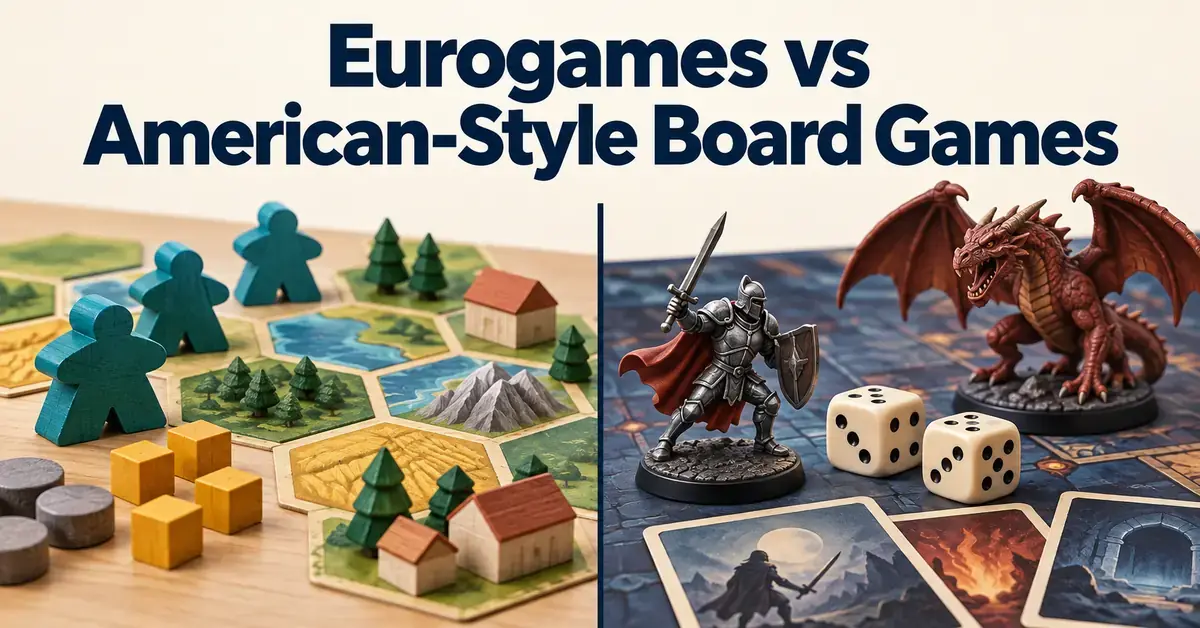
“Eurogame” and “Ameritrash” are the two nicknames hobbyists use for the two biggest design traditions in modern board games. A Eurogame (also called a German-style game) rewards quiet efficiency: you optimise resources, score points in several ways, and rarely attack another player directly. An American-style game — affectionately nicknamed “Ameritrash” — leans the other way, into strong themes, dice, miniatures and open conflict. Neither style is better; they simply aim for different feelings at the table. This guide defines both terms, lays out their differences side by side, uses Catan as a familiar Euro example, and helps you tell which style fits a given group.
Key Points
- Eurogame (German-style): efficiency, low luck, indirect competition, no player elimination, light theme, fixed playtime.
- American-style (Ameritrash / Thematic): strong theme, direct conflict, higher luck, miniatures, elimination, longer sessions.
- Catan (Klaus Teuber, 1995) is the classic Eurogame example and the hobby’s famous gateway game.
- Neither style is better — they aim for different feelings: clever optimisation versus dramatic storytelling.
- Hybrids such as Scythe blend both philosophies, so the two labels mark ends of a spectrum, not a strict divide.
What does “eurogame” mean?
A eurogame is a style of board game built around indirect competition, low luck and efficient decision-making. The label grew out of a design movement in Germany from the late 1970s and 1980s, which is why these games are also called German-style games or “Euros.” Instead of fighting other players, you usually compete for the same limited resources, spaces or tiles — so your choices affect opponents indirectly rather than through attacks.
Most eurogames share a recognisable set of traits:
- Indirect interaction: you block, out-bid or grab resources first, rather than destroying another player’s pieces.
- Low randomness: dice and cards exist, but careful planning usually matters more than luck.
- No player elimination: everyone stays in until the final scoring, so no one sits out the back half of the game.
- Multiple ways to score: you can often win by farming, trading, building or collecting — several valid strategies at once.
- Abstract or light theme: the setting (a medieval market, a bird sanctuary) decorates the maths rather than driving the action.
- Tight, fixed playtime: many Euros finish in 45–90 minutes with a clear end trigger.
If you want to go deeper on the underlying systems — worker placement, set collection, tile-laying and more — the overview of board game genres and mechanics breaks down the building blocks that most eurogames combine.
What does “ameritrash” mean?
“Ameritrash” is a nickname for American-style board games that put theme, drama and direct conflict ahead of mathematical efficiency. In an American-style game, the mechanics usually exist to create a story: heroes with special powers, factions at war, monsters to fight and big swingy moments decided by dice. Luck is a feature, not a flaw — a lucky roll or a traitor card is part of the drama.
Typical American-style traits include:
- Strong, specific theme: often fantasy, horror, science fiction or military, with named characters and lore.
- Direct conflict: you can attack, invade, eliminate or betray other players.
- Higher luck: dice rolls and card draws create big, memorable swings.
- Showy components: plastic miniatures, detailed boards and plenty of “toys” on the table.
- Player elimination and asymmetry: players can be knocked out, and each faction may play very differently.
- Longer, looser playtime: epic sessions can run several hours.
Where the term “ameritrash” came from
The word started as an insult. It appeared on the rec.games.board newsgroup around the year 2000 to mock games that felt dominated by dice and roll-and-move luck, and it spread on the hobby site BoardGameGeek from about 2006. Since then, many gamers have reclaimed it as a badge of pride for big, thematic, confrontational designs. Because the name can still sound dismissive to publishers, BoardGameGeek now files these titles under the neutral label “Thematic Games” — a useful term to know when you browse categories online.
Eurogames vs American-style games: the core differences
The clearest way to separate the two styles is by what each one is trying to make you feel. A eurogame wants you to feel clever — to find the most efficient path and squeeze value from every turn. An American-style game wants you to feel something dramatic — tension, triumph, revenge or disaster. Every other difference flows from that single goal, as the side-by-side comparison below shows.
Comparison
| Aspect | Eurogame (German-style) | American-style (Ameritrash / Thematic) |
|---|---|---|
| Main goal | Feel clever: optimise and out-score | Feel a story: drama and spectacle |
| Player interaction | Indirect (blocking, competing for resources) | Direct (combat, attacks, betrayal) |
| Luck / randomness | Low; planning usually decides | Higher; dice and cards create swings |
| Theme | Light, often abstract | Strong and specific (fantasy, horror, sci-fi, war) |
| Player elimination | Rare; everyone plays to the end | Common; players can be knocked out |
| Components | Wooden bits, tiles, cards | Miniatures, detailed boards, lots of “toys” |
| Typical playtime | 45–90 minutes, fixed end | Often 2+ hours, looser length |
| Scoring paths | Several valid strategies | Theme-driven objectives and conquest |
| Example games | Catan, Carcassonne, Ticket to Ride, Agricola | Twilight Imperium, Arkham Horror, Blood Rage |
Two caveats keep this honest. First, these are tendencies, not rules — plenty of games sit between the poles. Second, “more luck” does not mean “less skill”: American-style games reward reading opponents, pressing your advantage and managing risk, the same themes covered in any good guide to board game strategy.
Catan: a familiar Eurogame example
Catan is the game most people point to when they explain what a eurogame is. Designed by Klaus Teuber and first published in 1995 by the German company Kosmos, it won the 1995 Spiel des Jahres (“Game of the Year”) and went on to sell more than 32 million copies in dozens of languages — the title widely credited with carrying the German-style hobby into the English-speaking world.
Catan shows the Euro design philosophy in miniature:
- Indirect competition: players settle the same island and compete for the best hexes; you block with the robber rather than attacking armies.
- Resource engine: terrain tiles produce brick, wood, sheep, wheat and ore, which you spend on roads, settlements and cities.
- Trading and negotiation: deal-making with other players is central, not combat.
- Multiple paths to ten points: longest road, largest army, settlements and cities all add up.
- Managed luck: dice decide which tiles produce each turn, but smart placement and trading soften the randomness.
Because it is approachable yet strategic, Catan is a classic “gateway” game. If you want the full setup and turn sequence, see the rundown of classic board game rules, which covers Catan alongside other staples.
Popular examples of each style
The quickest way to feel the difference is to play one of each. Here are well-known, award-recognised titles that sit firmly in each camp.
Eurogames to try
- Carcassonne (Klaus-Jürgen Wrede, 2000) — tile-laying and area control; Spiel des Jahres 2001.
- Ticket to Ride (Alan R. Moon, 2004) — collect train cards to claim routes; a gentle gateway Euro.
- Puerto Rico (Andreas Seyfarth, 2002) — role selection and economic engine-building.
- Agricola (Uwe Rosenberg, 2007) — worker placement about running a farm.
- Wingspan (Elizabeth Hargrave, 2019) — a bird-themed engine-builder; Kennerspiel des Jahres 2019.
American-style (thematic) games to try
- Twilight Imperium — a sprawling 4X space epic of exploration, negotiation and war.
- Arkham Horror — cooperative Lovecraftian horror with dice and a sanity system; a top-100 BoardGameGeek fixture since 2005.
- Blood Rage — a Viking miniatures game built around combat and area control.
- Battlestar Galactica — hidden-traitor tension aboard a fleeing fleet.
- Zombicide — cooperative, miniatures-heavy survival against the undead.
Hybrid games: when the two styles blend
Many modern games deliberately mix both philosophies, so the old either/or line is blurrier than it used to be. A hybrid game combines a Euro-style scoring or engine with American-style theme and conflict, aiming to please both kinds of player.
The go-to example is Scythe (Jamey Stegmaier, 2016): underneath its alternate-history world of mechs and farmland sits a tight resource-and-action engine (the Euro part), wrapped in area control and asymmetric faction powers with the option to fight (the American-style part). Games like this show that “eurogame” and “ameritrash” are two ends of a spectrum, not a wall — and that the most interesting designs often live in the middle.
Which style suits you?
Pick the style that matches the feeling your group wants, not the one with the better reputation. Both have won major awards and devoted fans.
- Choose a eurogame if your group likes puzzles, prefers everyone staying in the game, wants a predictable playtime, and doesn’t enjoy being attacked. Euros are also easier to teach to mixed-skill and family tables, which is why most beginner lists in any guide to how to play board games start there.
- Choose an American-style game if your group loves story, spectacle and head-to-head drama, doesn’t mind luck or longer sessions, and enjoys a villain at the table.
- Choose a hybrid if you can’t agree — a game like Scythe gives the planners their engine and the fighters their conflict.
Common mistakes when comparing the two styles
Beginners (and plenty of veterans) trip over the same misconceptions. Avoiding them makes it far easier to pick the right game for a given night.
- Treating “eurogame” and “ameritrash” as quality ratings. They describe design goals, not good versus bad. “Ameritrash” is affectionate slang, not a verdict.
- Assuming Euros have no luck and American games have no strategy. Euros contain dice and cards; thematic games reward tactics, bluffing and risk management.
- Equating theme with complexity. A heavy theme doesn’t mean heavy rules, and a dry theme doesn’t mean a simple game — Agricola is abstractly themed but demanding.
- Forgetting player elimination when picking for a group. If someone hates being knocked out early, a confrontational American-style game can fall flat; a Euro keeps everyone involved to the end.
- Ignoring playtime and teaching load. An epic American-style game can run hours and need a long rules explanation — plan the evening around that, not just the box art.
Sources
Frequently asked questions (FAQ)
What is the difference between a eurogame and an American-style game?
A eurogame emphasises efficient decision-making, low luck, indirect competition and no player elimination, with theme layered lightly over the mechanics. An American-style (Ameritrash) game emphasises strong theme, direct conflict, higher luck and dramatic swings. In short: Euros want you to feel clever, American-style games want you to feel a story.
Is Catan a eurogame?
Yes. Catan is one of the most famous eurogames and is often called the gateway title that popularised the German-style hobby worldwide. It uses indirect competition, resource trading, managed luck and multiple paths to victory — all hallmarks of the Euro style.
Is “ameritrash” an insult?
It started as one around the year 2000 but has largely been reclaimed as affectionate slang for big, thematic, conflict-driven games. Because it can still sound dismissive, the hobby site BoardGameGeek files these titles under the neutral label “Thematic Games.”
Which style is better for beginners?
Lighter eurogames such as Catan, Ticket to Ride and Carcassonne are usually the easiest entry point: they have shorter playtimes, clearer rules and no player elimination. Beginners who love a strong theme can also start with an accessible cooperative thematic game before tackling the longer, rules-heavy epics.
Can one game be both a eurogame and an American-style game?
Yes — these are hybrid games. Titles like Scythe pair a Euro-style resource engine with American-style theme, area control and optional combat, blending both design philosophies into a single game.
