

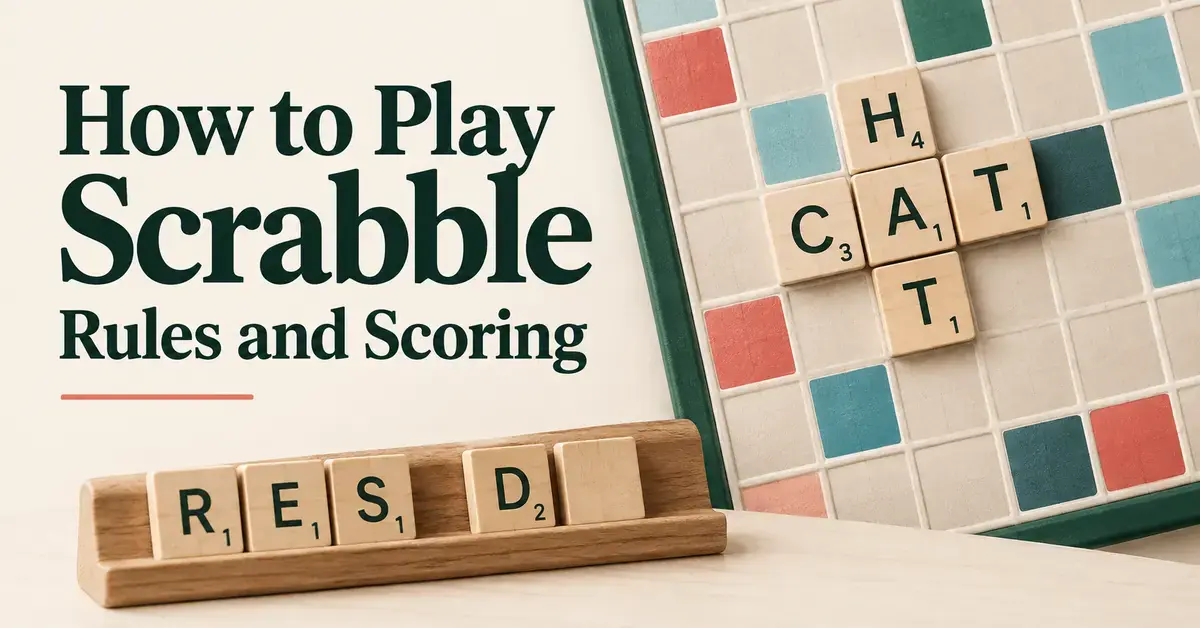
Scrabble is a word game for two to four players in which you build interlocking words on a 15×15 grid and score points based on the letter tiles you use and the premium squares you cover. This guide explains everything a beginner needs: how to set the game up, what every letter tile is worth, how to place and connect words, how premium squares and the 50-point bonus work, when you can challenge a word, and how to add up the final score. Scrabble rewards a good vocabulary, but the scoring and board tactics matter just as much — which is why a short, well-placed word often beats a long one.
Quick Facts
| Game type | Word / tile-laying game |
| Players | 2–4 |
| Age | 8+ |
| Playing time | About 30–60 minutes |
| Board | 15×15 grid (225 squares) |
| Tiles | 100 total (98 lettered + 2 blank) |
| Starting rack | 7 tiles per player |
| Designer | Alfred Mosher Butts (1938) |
| Name trademarked | James Brunot, 1948 |
| Publishers | Hasbro (US & Canada), Mattel (elsewhere) |
What is Scrabble?
Scrabble is a tile-based word game in which players take turns forming words on a shared board, crossword-style, to earn the most points. Each lettered tile has a fixed point value, and certain board squares multiply the value of a letter or a whole word, so where you place a word matters as much as the word itself.
The game was designed by American architect Alfred Mosher Butts in 1938 (originally under the names “Lexiko” and “Criss-Cross Words”). In 1948 James Brunot refined the board, coined the name “Scrabble” and trademarked it. Today Scrabble is published by Hasbro in the United States and Canada and by Mattel in the rest of the world. It is one of the best-selling board games ever made, and it sits alongside titles such as chess, checkers and Monopoly in our overview of classic board game rules.
What do you need to play Scrabble?
A standard English-language Scrabble set contains everything you need for a game:
- The board — a 15×15 grid of 225 squares, with 61 coloured “premium” squares scattered across it and a star at the centre.
- 100 tiles — 98 tiles each printed with a letter and its point value, plus 2 blank tiles that are worth zero points and can stand in for any letter.
- Four racks — one per player, each holding up to seven tiles hidden from opponents.
- A tile bag or pouch — to hold and draw tiles at random.
You will also want a dictionary or word list to settle challenges. Casual players can use any standard dictionary; clubs and tournaments use official word lists such as the Collins Scrabble Words list or the NASPA Word List used in North America. If you are brand new to tabletop games in general, our guide on how to play board games explains the common components and turn structures you will meet across many titles.
How to set up Scrabble
Setup takes under a minute. First, place the board in the middle of the table where everyone can reach it. Put all 100 tiles into the bag and mix them. Each player then draws one tile: whoever draws the letter closest to the start of the alphabet goes first, and a blank beats every letter. Return those tiles to the bag and mix again.
Now each player draws seven tiles and stands them on their rack, keeping them hidden from the others. The bag stays within reach so players can replenish their racks throughout the game. You are ready to play.
How a turn works in Scrabble
On your turn you do exactly one of three things, then draw back up to seven tiles if any remain in the bag. Knowing all three options is important, because passing or swapping is sometimes the smartest play.
Your three options each turn
- Play a word. Place two or more tiles to form a word (or add tiles to extend or cross existing words), then score it.
- Exchange tiles. If you dislike your rack, you may swap any number of tiles for new ones — but only while at least seven tiles remain in the bag. You forfeit your turn and score nothing when you exchange.
- Pass. You may pass without playing or swapping. You score nothing, and if every player passes in succession the game can end.
Placing the first word
The very first word must be placed so that one of its tiles covers the centre star. Because the centre star is a double-word-score square, the opening word always has its total value doubled. The first word must read left-to-right or top-to-bottom — never diagonally — and must contain at least two letters.
Placing and connecting words after the first
Every word after the opening one must connect to tiles already on the board, the way entries interlock in a crossword. A new play is legal if all of the following are true:
- Every new tile lies in a single row or single column.
- The tiles form a continuous word with no gaps.
- Every new word created — both the main word and any “cross-words” formed where your tiles touch existing letters — is a valid word.
That last point is the one beginners miss most: when your word runs alongside existing tiles, you often create several small words at once, and all of them must be legitimate. You score every new word your play forms on that turn.
Using blank tiles
The two blank tiles can represent any letter you choose. When you play a blank, you announce the letter it stands for, and it keeps that letter for the rest of the game. A blank is powerful because it lets you complete almost any word, but it always scores zero points — even when it sits on a letter-premium square.
How Scrabble scoring works
Your score for a word is the sum of its letter values, adjusted by any premium squares the new tiles cover, added up for every word the play creates. Premium squares only count on the turn a tile is first placed on them; once covered, that square gives no further bonus on later turns.
Scrabble letter values
Each letter’s value reflects how common it is in English: everyday letters like E and A are worth 1 point, while rare letters like Q and Z are worth 10. The table below lists every tile’s value and how many of each tile are in the bag. The counts add up to the full set of 100 tiles.
Letter Values
| Points | Letters (number of tiles) |
|---|---|
| 0 points | Blank (×2) |
| 1 point | E (×12), A (×9), I (×9), O (×8), N (×6), R (×6), T (×6), L (×4), S (×4), U (×4) |
| 2 points | D (×4), G (×3) |
| 3 points | B (×2), C (×2), M (×2), P (×2) |
| 4 points | F (×2), H (×2), V (×2), W (×2), Y (×2) |
| 5 points | K (×1) |
| 8 points | J (×1), X (×1) |
| 10 points | Q (×1), Z (×1) |
Premium squares
Premium squares multiply either a single letter or a whole word, and they are the key to big scores. There are four types, shown here with their classic colours and how many appear on the board:
| Square | Classic colour | Effect | On the board |
|---|---|---|---|
| Double Letter Score (DLS) | Light blue | Doubles that one tile’s value | 24 |
| Triple Letter Score (TLS) | Dark blue | Triples that one tile’s value | 12 |
| Double Word Score (DWS) | Pink | Doubles the whole word’s value | 17 (incl. centre star) |
| Triple Word Score (TWS) | Red | Triples the whole word’s value | 8 |
Two rules keep the maths consistent. First, apply letter premiums before word premiums: total the letters (doubling or tripling any that sit on letter squares), then apply any word multiplier to that sum. Second, if a word covers more than one word-premium square, the multipliers combine — a word crossing two triple-word squares is multiplied by nine. A blank placed on a premium square still multiplies to zero, because it has no value to begin with.
Bingos: the 50-point bonus
If you use all seven tiles from your rack in a single turn, you score a 50-point bonus on top of the word’s value. This is called a “bingo” (or a “bonus” in British usage), and it is one of the biggest point swings in the game. Holding onto common letters like S, E and R to set up a seven-tile play is a core skill — something we explore further in our board game strategy guide.
Challenging a word
Any player may challenge a word they believe is not valid. In the common home and school rules, you challenge before the next player starts their turn, and the disputed word is looked up in the agreed dictionary. If the word is unacceptable, the player who made the play takes their tiles back and loses that turn and its score. If the word turns out to be valid, the challenger loses their next turn as a penalty.
Rules vary beyond the kitchen table: sanctioned North American tournaments use a “double challenge” system with a penalty for a wrong challenge, while Collins-based play elsewhere often uses a penalty-free challenge. Agree on which version you are using before you start, so there are no arguments mid-game.
How the game ends and final scoring
The game ends when all the tiles have been drawn from the bag and one player uses the last tile on their rack, or when no further plays are possible — for example, when every player passes in succession and the board is blocked.
Final scoring adjusts for the tiles still on each rack:
- Each player subtracts the total value of their own unplayed tiles from their score.
- If one player used all of their tiles (“going out”), that player adds the combined value of every other player’s unplayed tiles to their score.
This double effect — losing your own leftover points while handing them to your opponent — makes emptying your rack at the end valuable, and it is why a trailing player will sometimes play a short word just to get rid of a heavy Q or Z before the bag runs dry. The player with the highest adjusted total wins; if scores tie, the player with the higher score before adjustments usually wins, though some rule sets simply declare a draw.
Tips to score more points in Scrabble
Knowing the rules wins you nothing on its own — points come from placement and rack management. These habits raise your score the fastest. For a broader look at improving across games, see our board game strategy guide.
Spend high-value letters on premium squares
Playing a J, X, Q or Z on a double- or triple-letter square, rather than on a plain square, can double or triple a single play’s value. Hold a valuable tile for a turn or two if a premium square is within reach rather than dumping it cheaply.
Keep a balanced rack and hunt for bingos
Aim to keep a rough mix of vowels and consonants on your rack so you always have playable options and a chance at a seven-tile bingo. If your rack clogs with awkward letters, use a turn to exchange the worst ones rather than forcing a weak word. The 50-point bonus is worth planning around.
Save your S tiles and blanks
An S lets you pluralise an existing word while building a second word at the same time, often for a big combined score. There are only four in the set, so spend them where they pull double duty. The two blanks are even scarcer — hold them for a bingo or a high-multiplier play rather than a routine word.
Play parallel words for stacked points
Laying a word directly alongside one already on the board can form several short crosswords at once, and you score every one of them. Learning the valid two- and three-letter words is the highest-value study a Scrabble player can do, because they make these parallel plays possible.
Think defensively about the board
Every opening you create is one your opponent can use. Avoid placing a tile that hands them an easy path to a triple-word square, and be cautious about leaving a premium square exposed next to a convenient letter when you are ahead.
Common mistakes beginners make
A few errors cost new players points again and again. Avoiding them will raise your scores quickly:
- Playing long words for their own sake. A compact word on a triple-word or double-letter square usually beats a longer word on plain squares. Look at the board, not just your rack.
- Dumping your S tiles and blanks early. These tiles unlock bingos and hook onto existing words; spend them with purpose, not just to clear your rack.
- Forgetting the cross-words. When a play touches existing tiles, check that every new word it creates is valid — one bad cross-word makes the whole play illegal if challenged.
- Opening up triple-word squares. Placing a tile next to an unused triple-word square can hand your opponent a huge score. Think about what you leave behind.
- Never exchanging. A rack of awkward consonants can stall you for turns. Swapping tiles costs one turn but often pays off.
- Ignoring two-letter words. Short words like QI, ZA, EX and JO are legal in standard word lists and are invaluable for hooking onto the board and using high-value tiles.
Scrabble variants and editions
Beyond the standard game, several official and informal variants change the pace or scale:
- Super Scrabble uses a larger 21×21 board and 200 tiles, with quadruple-letter and quadruple-word squares for much higher scores.
- Travel and deluxe editions add tile grids or rotating boards to keep tiles from sliding, but use the same rules and scoring.
- Speed or timed play adds a chess clock, giving each player a fixed total of thinking time across the game.
- House scoring tweaks — some families allow proper nouns or drop the challenge penalty. These are fine for casual games as long as everyone agrees first.
If you enjoy Scrabble, you may also like other tile and word games, as well as the classics played with a standard deck — see our hub on card and dice games for more rules explainers.
Who is Scrabble for?
Scrabble suits 2 to 4 players aged 8 and up and plays in roughly 30 to 60 minutes, making it a good fit for families, couples and small groups. It rewards both vocabulary and tactical placement, so it stays interesting whether you are a casual player chasing a fun word or a competitor hunting high-scoring bingos. Because turns are self-contained and the rules are simple to learn, it also works well as a relaxed two-player game or a solo puzzle against yourself.
Sources
Frequently Asked Questions (FAQ)
How many tiles do you start with in Scrabble?
Each player draws seven tiles at the start and keeps their rack topped up to seven after every turn, drawing replacements from the bag until it is empty.
What are the highest-value letters in Scrabble?
Q and Z are each worth 10 points, the most of any tile. J and X are worth 8 points each, and K is worth 5. The two blank tiles are worth zero.
Does the first word in Scrabble score double?
Yes. The first word must cover the centre star, which is a double-word-score square, so the opening word’s total value is always doubled.
What is a bingo in Scrabble?
A bingo is when you use all seven tiles from your rack in a single turn. It earns a 50-point bonus on top of the word’s normal score.
How do blank tiles work in Scrabble?
A blank can stand for any letter you choose, and you announce that letter when you play it. It stays that letter for the rest of the game but always scores zero points.
