

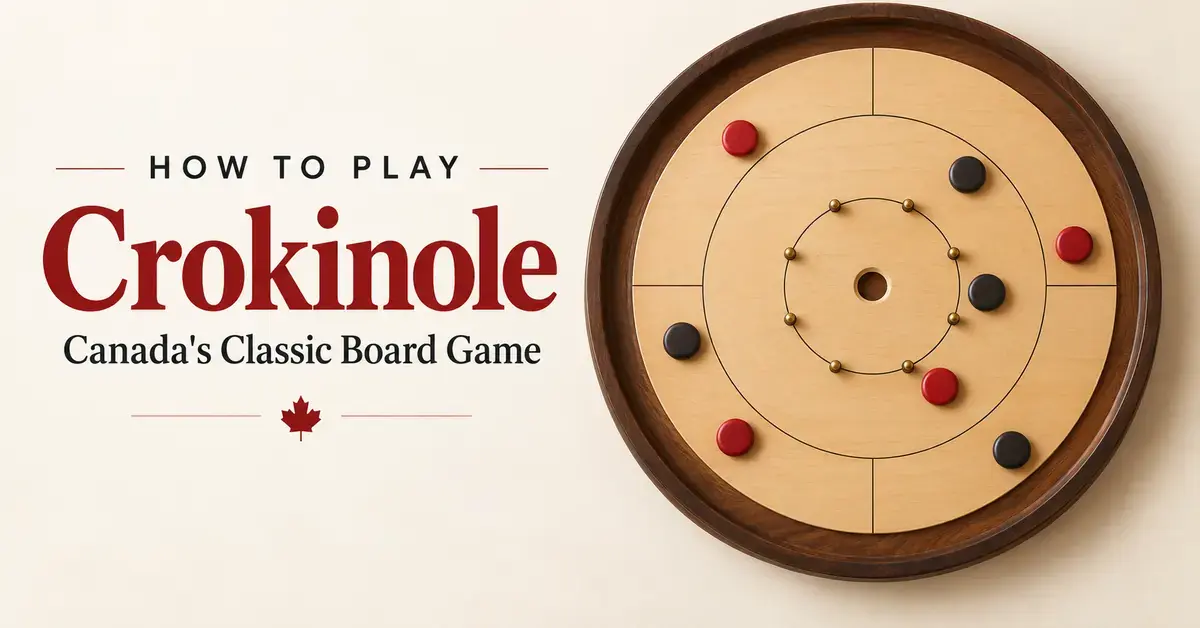
Crokinole is a flicking dexterity game in which players snap small wooden discs across a round board, aiming for a central 20-point hole while knocking opponents’ discs out of scoring position. Invented in Ontario in 1876, it has become one of Canada’s best-loved kitchen-table traditions, and it is easy to learn in a single round. This guide explains the board, the equipment, the rules, how scoring works, the differences between 2- and 4-player games, and the mistakes beginners make most often.
Key Facts
| Players | 2 or 4 (singles or doubles) |
|---|---|
| Age | 8 and up |
| Playing time | About 15–30 minutes |
| Equipment | Round crokinole board (~26 in / 66 cm) and 24 wooden discs (12 per colour) |
| Type | Dexterity / flicking game |
| Origin | Perth County, Ontario, Canada (earliest known board, 1876) |
| Goal | Score more points than your opponent, commonly playing to 100 |
| Difficulty | Easy to learn, hard to master |
What is crokinole?
Crokinole is a tabletop disc-flicking game for two to four players in which you score points by landing your discs closer to the centre of a circular board than your opponent. It belongs to the same family as carrom, shuffleboard and the East Indian game pichenotte, but it is widely recognised as a uniquely Canadian creation. The name is usually traced to the French word croquignole, referring to a flick of the finger.
The earliest known crokinole board was built by craftsman Eckhardt Wettlaufer in 1876 in Perth County, Ontario — reportedly a gift for his young son. The game spread quickly through rural Ontario and remains a fixture of community halls, church basements and family gatherings. Since 1999 the World Crokinole Championship has been held each June in Tavistock, Ontario, close to where the Wettlaufer family lived. If you are new to tabletop gaming in general, our beginner’s guide to playing board games covers the shared vocabulary used below.
What you need to play
You only need a crokinole board and a set of discs — no cards, dice or score track are required. Everything else is handled on the board itself.
The crokinole board
A standard crokinole board is round, roughly 26 inches (about 66 cm) across overall, with a playing surface of about 24 inches. It is marked with three concentric scoring rings and a shallow hole at the exact centre. A ring of eight small pegs (also called posts or bumpers) stands guard just outside the centre, protecting the highest-scoring zone and deflecting discs that are not aimed cleanly. The surface is usually smooth hardwood, sometimes waxed or dusted with a fine powder so discs glide freely.
The discs
Discs are flat wooden buttons, about an inch and a quarter wide, in two contrasting colours — one colour per player or team. A full traditional set contains 24 discs (12 of each colour). The most common standard is that each player shoots 8 discs in a two-player game and 6 discs in a four-player game, although many households simply split the set and play all 12 per side. Whatever you choose, both sides must use the same number.
The ditch
The ditch is the recessed gutter running around the outer edge of the playing surface. It collects any disc that is knocked off the board or that fails to make a legal shot. A disc in the ditch is out of play for the rest of that round and scores nothing. Understanding the ditch is central to strategy: much of the game is about keeping your own discs on the board while sending your opponent’s into it.
What does a crokinole board look like?
A crokinole board is a round, raised playing surface, about 26 inches (66 cm) across, encircled by a recessed gutter called the ditch. The surface is marked with concentric scoring rings and divided into equal quadrants, one shooting area for each playing position.
Working outward from the middle, the board has four scoring areas:
- The 20 hole: a small recessed centre hole, roughly 1 3/8 inches (3.5 cm) across. A disc that drops fully into it and lies flat scores 20 – the highest value.
- The 15 region: the inner ring around the hole, worth 15 points. It is ringed by eight small, springy posts (also called pegs or bumpers) that deflect discs.
- The 10 region: the next ring out, beyond the posts, worth 10 points.
- The 5 region: the large outer ring, worth 5 points. Its outer edge is the shooting line.
A disc always scores the lowest value of any region it is touching. Any disc resting on or beyond the outer shooting line, or sitting in the ditch, is out of play and scores nothing. The eight posts around the 15 ring are important: they guard the high-scoring centre and bounce stray shots away, which is a big part of what makes the game tricky.
The discs themselves are smooth wooden pucks about 1 1/4 inches (3.2 cm) in diameter. A standard set comes in two colours so each side can tell its discs apart.
How to set up a game
Setup takes seconds:
- Place the board flat on a table so every player can reach their own shooting area comfortably.
- Give each player or team all the discs of one colour.
- Decide who shoots first — a coin toss or rock-paper-scissors is the usual method. Players then alternate the first shot in later rounds.
- The player starting a round places their first disc on the outer line within their own quadrant and flicks it.
How to play: the basic rules
The core loop is simple: players take turns flicking one disc each from their own edge of the board, trying to score while displacing the other side. A round ends when every disc has been shot.
Taking a shot
You shoot by flicking a disc with a finger — a quick snap from behind the disc, never a push with a finger resting on top. Each disc must start on or touching the outer shooting line within your own quadrant of the board. You may aim directly for the centre, try to knock out an opponent’s disc, or set up a defensive position behind the pegs.
Taking turns
Players alternate one shot at a time. In a two-player game that simply means you and your opponent trade shots until both have played all their discs. In a four-player game, play passes around the table so the two teams alternate, with partners seated on opposite sides.
The open shot and contact rule
This rule is what makes crokinole a game of attack and not just target practice. If your opponent has any discs on the board, your shot must make contact with one of them — either by striking it directly, or indirectly by driving one of your own discs into it (a ricochet counts). A shot that fails to touch any opposing disc is illegal.
When there are no opposing discs on the board — most often on the opening shot of a round — the no-hiding rule applies instead: your disc must finish touching or inside the 15-point line. If it stops short in the outer ring, it is removed. This stops players from parking discs safely in low-scoring territory where they can’t be reached.
Invalid shots and the ditch
If a shot is illegal — it misses a required contact, or an opening disc fails to reach the 15 line — the offending disc and any discs it moved are taken off the board and placed in the ditch for that round. That penalty is why a missed attacking shot can cost you far more than the single disc you flicked.
Crokinole scoring explained
Scoring is based entirely on where your discs come to rest at the end of a round. The board has four values, increasing toward the centre.
Crokinole Scoring
| Region | Where it is | Value |
|---|---|---|
| Centre hole (20) | Recessed hole at the exact centre; disc must drop in and lie flat | 20 points |
| Inner ring (15) | Inside the ring of eight pegs | 15 points |
| Middle ring (10) | Outside the pegs | 10 points |
| Outer ring (5) | Outermost scoring ring, before the ditch | 5 points |
| Ditch | Outer gutter; out of play for the round | 0 points |
A disc touching a line scores the lower of the two adjoining values.
A disc scores the value of the region it is resting in. The three rings are worth 5 (outer), 10 (middle, outside the pegs) and 15 (inner, inside the pegs). The centre is a recessed hole worth 20 points — but only if the disc drops completely into it and lies flat; a disc balanced on the rim does not count as a 20.
If a disc is touching a line between two regions, it scores the lower of the two values. Discs that land on a 20 during play are usually lifted out immediately and set aside in a visible spot, then counted at the end of the round so they are not accidentally knocked out later.
How a round is scored
Once all discs are shot, add up the value of each side’s discs left on the board. In the common recreational method, the side with the higher total scores the difference between the two totals — so if you have 55 and your opponent has 40, you score 15 that round. In tournament play under the National Crokinole Association format, the round is instead worth 2 points to the higher scorer, or 1 point each in a tie.
Two-player and four-player crokinole
Crokinole works equally well head-to-head or in pairs, and the rules barely change between them.
Two-player (singles)
In a two-player game the players sit opposite each other and each shoots their own colour — commonly 8 discs per round. Singles is the purest test of skill: every shot is yours, and there is no partner to clear up a mistake. It is one of the best two-player dexterity games you can keep on a shelf.
Four-player (doubles)
In a four-player game, two teams of two compete. Partners sit across the board from each other, so each team shoots from two opposite quadrants and the colours alternate around the table. Each player typically shoots 6 discs. Doubles adds a cooperative layer — one partner can set up a disc for the other to use as a ricochet — and is the format used for team events at the World Crokinole Championship.
How to win: playing to 100
A casual game is usually played to 100 points. Teams play round after round, adding each round’s score to a running total, and the first side to reach 100 wins. Because recreational scoring awards only the point difference each round, close games can run many rounds, while a dominant round can swing the total sharply. Tournaments instead play a fixed number of rounds per game and a best-of series of games, but the goal is the same: finish with more points on the board, more often, than the other side.
Common mistakes beginners make
Most early losses come from a handful of avoidable errors:
- Pushing instead of flicking. Resting a finger on top of the disc and shoving it is both less accurate and, strictly, an illegal motion. A clean snap from behind gives far better control.
- Forgetting the contact rule. Once your opponent has a disc on the board, every shot must hit one. Firing for the 20 and missing their discs forfeits your shot and removes it to the ditch.
- Over-hitting the 20. Too much power bounces the disc off the rim of the centre hole instead of dropping it in. The 20 rewards touch, not force.
- Ignoring the pegs. The eight posts can block a direct line to the centre — but they can also be used to deflect a disc into a better spot. Beginners treat them only as obstacles.
- Playing purely offensively. Knocking out opponents matters, but so does leaving your own discs in high-scoring zones. Good players balance attack with keeping discs near the 15 and 20.
Tips to improve quickly
Start by grooving a consistent flick: aim for the same finger motion and power on open shots so you can land the opening disc near the 15 line every time. From there, learn the “take” — hitting an opponent’s disc so that your disc stops in a scoring position rather than following it off the board. Practising takes off the pegs, and deliberately using ricochets, will raise your game faster than chasing 20s. The same habit-building and risk-management ideas appear across many games in our board game strategy guide.
Crokinole also pairs naturally with Canada’s other kitchen-table classics. If you enjoy its social, quick-to-learn feel, the rules for cribbage and euchre in our card and dice games hub make a good next stop, and you can find every rules explainer collected in our classic board game rules pillar.
Sources
Frequently asked questions (FAQ)
Is crokinole hard to learn?
No. The rules take a couple of minutes to explain and you can play your first round immediately. The skill lies in the flick itself, which improves steadily with practice, so the game is easy to start but rewarding to master.
How many points do you need to win a game of crokinole?
In casual play, games are usually played to 100 points, with each round’s score added to a running total until one side reaches it. Tournaments instead use a set number of rounds and a best-of series of games.
What is the 20 in crokinole?
The 20 is the recessed hole at the centre of the board. A disc scores 20 only if it drops fully into the hole and lies flat; a disc resting on the rim does not count. Discs that sink the 20 are usually set aside and tallied at the end of the round.
Do you have to hit your opponent’s disc every turn?
Yes, whenever your opponent has at least one disc on the board. Your shot must contact an opposing disc directly or by ricochet, or the shot is void and your disc goes to the ditch. If no opposing discs are on the board, your disc must instead reach the 15-point line.
How many players can play crokinole?
Crokinole is played by two or four players. Two-player singles is a direct contest, while the four-player doubles format pits two teams of partners seated on opposite sides of the board against each other.
