

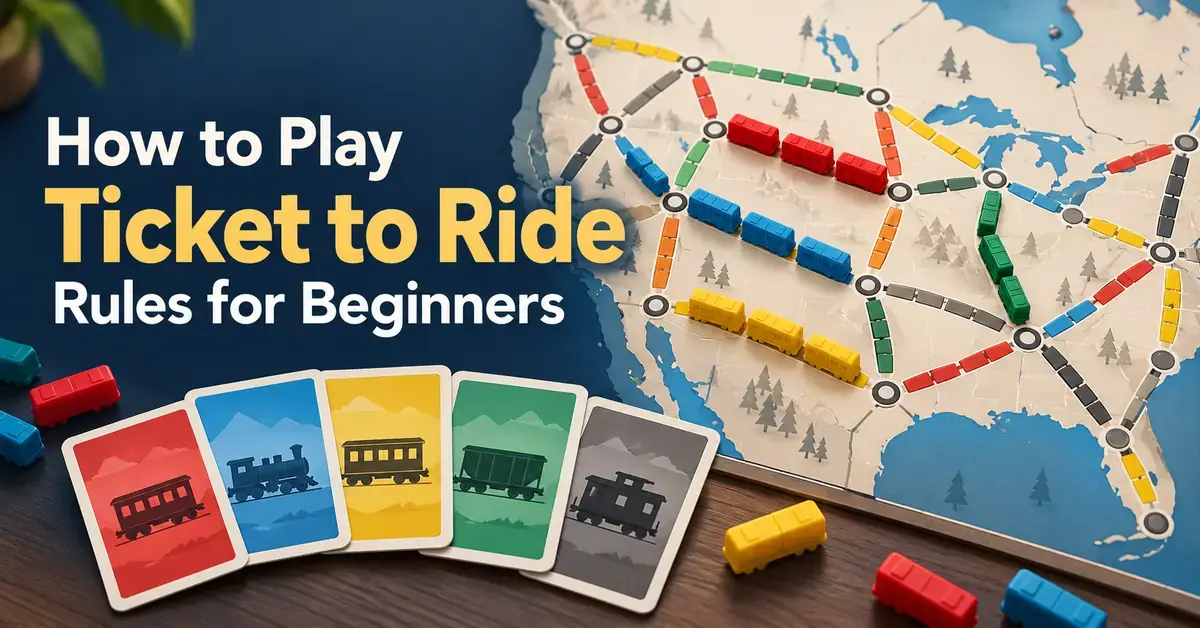
Ticket to Ride is a railway-themed board game in which 2 to 5 players collect coloured train-car cards and spend them to claim railway routes between cities across a map of North America. It is built for ages 8 and up and plays in about 30 to 60 minutes. The rules are light enough to learn in roughly ten minutes, which is a big reason the game won the 2004 Spiel des Jahres (the German “Game of the Year”) and the 2004 Origins Award. This guide walks a first-time player through the components, setup, every turn action, scoring and the most common beginner mistakes. If you are completely new to the hobby, our beginner’s guide to board games covers the basics first; this article then sits alongside our other classic board game rules.
Quick Facts
| Players | 2–5 |
|---|---|
| Recommended age | 8+ |
| Playing time | 30–60 minutes |
| Designer | Alan R. Moon |
| Publisher | Days of Wonder (2004) |
| Game type | Route building / set collection |
| Train cars | 45 per player |
| Train-car cards | 110 (8 colours + 14 locomotive wild cards) |
| Destination tickets | 30 (USA base game) |
| Notable awards | Spiel des Jahres 2004, Origins Award 2004 |
What is Ticket to Ride?
Ticket to Ride is a route-building game where the goal is to score the most points, mostly by claiming train routes and by completing secret destination tickets. Designed by Alan R. Moon and published by Days of Wonder in 2004, it has become one of the most widely owned “gateway” games — a title experienced players use to introduce newcomers to the hobby.
Each player builds their own network of coloured train routes across the board. Every route you claim scores points immediately, and at the end of the game you gain or lose points depending on whether you connected the two cities named on each destination ticket you are holding. The player with the highest total wins. Mechanically it combines two common systems — set collection (gathering matching cards) and route building (connecting points on a map) — both of which we explain in our board game genres and mechanics guide.
What do you need to play?
The base USA edition comes with everything a game needs. The exact plastic-train-car total varies slightly between printings, so count what matters per player rather than the boxed figure.
- One game board showing a map of the United States and southern Canada, with cities joined by coloured route spaces.
- 45 coloured plastic train cars per player, in five player colours (blue, red, green, yellow and black), plus a few spares.
- 110 train-car cards: 12 cards in each of eight colours (red, orange, yellow, green, blue, purple/pink, white and black) and 14 locomotive cards, which act as wild cards.
- 30 destination ticket cards, each naming two cities and a point value.
- Five wooden scoring markers and a Longest Continuous Path bonus card.
- The rulebook.
The route spaces on the board are colour-coded. A red route must be claimed with red cards, a blue route with blue cards, and so on. Grey (uncoloured) routes can be claimed with any single colour, as long as every card in that set is the same.
How do you set up Ticket to Ride?
Setup takes only a minute or two once you know the steps. Do it in this order:
- Place the board in the middle of the table where everyone can reach it.
- Choose a colour. Each player takes all 45 train cars of one colour and the matching scoring marker, placing the marker on the “Start” space of the scoring track that runs around the edge of the board.
- Prepare the train-car deck. Shuffle the 110 train-car cards and deal four to each player. Place the rest as a face-down draw pile beside the board.
- Reveal the market. Turn the top five cards of the draw pile face up in a row next to the deck. These are the face-up cards any player may take.
- Deal destination tickets. Shuffle the 30 destination tickets and deal three to each player. Look at them privately. You must keep at least two, but may keep all three. Return any you do not want to the bottom of the ticket deck.
- Pick a starting player (the most experienced traveller, youngest player, or simply at random) and play proceeds clockwise.
How does a turn work? The three actions
On your turn you must take exactly one of three actions, then play passes to the left. You never do more than one of these in a single turn, which keeps the game fast and easy to follow.
Action 1: Draw train-car cards
Take two cards in total. You may take them from the five face-up cards, from the top of the face-down deck (drawn blind), or any mix of the two. Whenever you take a face-up card, immediately replace it from the deck so there are always five face-up again.
Locomotives (the wild cards) have one special rule: if you take a face-up locomotive, that is your entire turn — it counts as both of your card draws, so you take nothing else. Drawing a locomotive blind from the top of the deck does not trigger this; it counts as a normal single card. Finally, if three of the five face-up cards are locomotives at any time, discard all five and deal five new face-up cards.
Action 2: Claim a route
Play a set of train-car cards that matches the colour and length of a route on the board, then place one of your plastic train cars on each space of that route. A three-space blue route, for example, needs three blue cards. A grey route needs any set of the same colour equal to its length. Locomotives are wild and can stand in for any colour within a set.
Score the route immediately by moving your marker up the scoring track (see the table below). Return the spent cards to a discard pile. A few things to remember: you cannot claim a route you have already claimed, and where two parallel routes connect the same pair of cities (a “double route”), only one of the two may be used in games with 2 or 3 players — both become available with 4 or 5 players, but one player may never claim both halves of a double route.
Action 3: Draw destination tickets
Draw the top three destination tickets from the ticket deck and keep at least one of them. Return any you do not keep to the bottom of the deck. This is how you add new goals mid-game, but take them carefully: every ticket you hold at the end either adds or subtracts points depending on whether you completed it.
How does scoring work?
Points come from three places: routes you claim during the game, destination tickets at the end, and one bonus card. The key idea is that longer routes are worth far more per train car, so efficient players chase long connections rather than lots of short ones.
Route Scoring
| Route length (train cars) | Points scored |
|---|---|
| 1 | 1 |
| 2 | 2 |
| 3 | 4 |
| 4 | 7 |
| 5 | 10 |
| 6 | 15 |
You score route points the moment you claim a route. Destination tickets, by contrast, are scored only at the very end of the game. A ticket is completed if you have an unbroken chain of your own train cars connecting the two cities it names — the path can be as long and winding as you like, and it may share routes you built for other tickets. Completed tickets add their printed value to your score; tickets you failed to complete subtract their printed value instead.
Finally, the player with the single longest continuous path of connected train cars takes the Longest Continuous Path bonus, worth 10 points. If two or more players tie for the longest path, each of them scores the full 10 points.
How does the game end?
The end is triggered by running low on train cars. When any player finishes a turn with only 0, 1 or 2 train cars left in their supply, each player — including the one who triggered it — takes exactly one more turn. The game then ends and final scoring takes place.
Add up each player’s score: the route points tracked during play, plus completed tickets, minus failed tickets, plus the longest-path bonus if you hold it. The highest total wins. If scores are tied, the player who completed the most destination tickets wins; if still tied, the holder of the Longest Continuous Path card wins.
Common mistakes beginners make
Most first-game losses come from a handful of avoidable errors rather than bad luck. Watch for these:
- Keeping too many hard tickets. Every incomplete ticket subtracts points. Holding three long, scattered tickets you cannot finish can wipe out a game’s worth of route scoring. Keep goals you can realistically connect.
- Hoarding cards for too long. While you sit collecting the perfect hand, opponents claim the routes you need. Key bottleneck routes — narrow connections everyone wants — should be claimed early.
- Forgetting double routes are blocked. With 2 or 3 players, only one of each pair of parallel routes can be used, so a city pair may close faster than you expect.
- Drawing new tickets too late. New tickets taken in the final few turns are almost impossible to complete and usually cost you points. Draw extra tickets early, when you still have time to build toward them.
- Building a disconnected network. Scattered short routes rarely link your destination cities. Plan one connected backbone that several tickets can share.
Simple strategy for your first game
Beginners do not need deep tactics to enjoy Ticket to Ride, but a few habits help. Start by looking at the two tickets you kept and sketch the shortest sensible path between each pair of cities — overlapping those paths means the same train cars count toward several goals. Claim contested routes through busy regions before opponents can block them, and favour longer routes, which score more points for each card you spend. Keep an eye on which card colours your opponents are collecting, since that hints at the routes they are planning. For more general principles, see our board game strategy guide.
Ticket to Ride versions and variants
The game you have just learned is the original USA map, but Ticket to Ride is a whole family of standalone games and expansions that share the same core rules. Ticket to Ride Europe adds tunnels, ferries and train stations, and is a popular alternative first map. Ticket to Ride: Nordic Countries is tuned for 2 to 3 players. Ticket to Ride: First Journey is a simplified version for younger children, while larger editions such as Rails & Sails broaden the map and mechanics. Many additional map packs — Germany, the United Kingdom, Asia and more — layer new ideas onto the base rules. If you enjoy the route-building and set-collection mix here, the modern classic Catan scratches a similar itch with trading and resource management.
Sources
Frequently Asked Questions (FAQ)
How many players do you need for Ticket to Ride?
The base game supports 2 to 5 players. It works well at every count, though some editions, such as Nordic Countries, are designed specifically for 2 to 3 players.
How long does a game of Ticket to Ride take?
A typical game runs about 30 to 60 minutes. New groups may take a little longer the first time while everyone learns the turn structure, but play speeds up quickly because each turn is a single action.
Can you block other players in Ticket to Ride?
Yes. Claiming a route removes it from everyone else, so you can block an opponent by taking a connection they need — especially at narrow bottlenecks. In 2- and 3-player games, double routes count as a single usable route, which makes blocking more powerful.
What happens if you do not complete a destination ticket?
You lose points. At the end of the game, the printed value of any ticket you failed to connect is subtracted from your score, so an overloaded hand of impossible tickets can easily cost you the win.
Do you have to announce when you complete a ticket?
No. Destination tickets are kept secret in your hand throughout the game and are only revealed and scored at the very end. Your claimed routes are visible on the board, but your specific goals stay hidden.
