

Scrabble rewards a good vocabulary, but games between evenly matched players are decided by strategy: how you balance the tiles on your rack, where you place words on the board, and when you hold letters back for a bigger turn later. Knowing a long word is useless if you cannot fit it onto a scoring square. This guide covers the core skills that separate casual players from consistent winners — rack management, premium-square use, two-letter words, bingos, and defensive board control — with the real numbers behind each one so you can see why they work.
Key Points
- Rack management beats raw vocabulary. Keep a balance of about 3–4 vowels to 3–4 consonants and mind the tiles you leave behind.
- Save the best tiles. The two blanks and the S tiles are worth holding for a bingo or a big premium-square play.
- Learn the two-letter words. 107 are valid in North America (NWL2023), 127 in Collins (CSW24); they unlock parallel plays and premium squares.
- Bingos win games. Using all seven tiles in one turn scores a 50-point bonus on top of the word.
- Play two ways. Score points and defend — don’t leave triple-word squares open for your opponent.
What is Scrabble strategy?
Scrabble strategy is the set of decisions that maximise your score over a whole game rather than on a single turn. It blends three things: finding the highest-value word you can play, managing the letters you keep on your rack for future turns, and limiting the scoring chances you hand your opponent. A strong player often plays a lower-scoring word on purpose because it keeps better tiles in reserve or denies a juicy square to the other side.
Scrabble is a word game with deep positional play, closer to an abstract strategy game than to a pure vocabulary quiz. If you are new to tactical thinking in games generally, the broader principles of tempo, resource efficiency and reading your opponent carry straight over from general board game strategy, and they apply to Scrabble just as they do to chess or Catan.
How does Scrabble scoring work, and why does it shape strategy?
Every strategic choice in Scrabble traces back to the scoring system, so it helps to know the numbers exactly.
A Scrabble set has 100 tiles: 98 lettered tiles plus 2 blanks. The lettered tiles are worth 187 face points in total, and each player draws a rack of 7 tiles at a time. Common letters are cheap (E, A, I, O, N, R, T, L, S and U are worth 1 point each) while rare letters are expensive — J and X are worth 8 points, and Q and Z are worth 10. The two blanks score 0 points but can stand in for any letter, which makes them the most valuable tiles in the bag.
The board is a 15×15 grid of 225 squares, dotted with premium squares that multiply your score. Letter multipliers are applied first, then word multipliers, and a premium square only pays out the turn its square is first covered.
| Premium square | Effect | Number on board |
|---|---|---|
| Double Letter (DLS) | Doubles the value of the tile placed on it | 24 |
| Triple Letter (TLS) | Triples the value of the tile placed on it | 12 |
| Double Word (DWS) | Doubles the whole word score (the centre star is one) | 17 |
| Triple Word (TWS) | Triples the whole word score | 8 |
The first word of the game must cross the centre star, which is a double-word square, so the opening play is always doubled. Because word multipliers apply to the entire word, the biggest scores come from landing a high-value letter on a letter-premium that also sits inside a word-premium — for example, placing a 10-point Z on a triple-letter square within a triple-word line. For a refresher on the setup, turns and legal plays before you dive into tactics, see the overview of classic board game rules.
How should you manage your rack?
Rack management — choosing which tiles to play and which to keep — is the single most important Scrabble skill after knowing the words. The tiles you leave on your rack after a play are called your leave, and a good leave sets up high-scoring turns to come.
Balance vowels and consonants
Aim to keep a workable mix on your rack — roughly three or four consonants to three or four vowels. A rack jammed with vowels (or starved of them) produces only short, low-scoring words. If you get stuck with too many vowels, dump two or three of them in a single short word rather than one at a time, so you refill with fresh tiles faster.
Protect your best tiles
The letter S and the two blanks are the best tiles in the game because they turn ordinary racks into big plays. Do not spend an S on a small word unless it earns at least about 10 extra points over your next-best option — an S is often worth more saved for pluralising an opponent’s word onto a premium square, or for completing a seven-letter word. Blanks should almost always be held for a bingo (see below).
Avoid awkward clumps
Duplicated letters, and hard-to-use tiles like Q, J, V and W, tend to clog a rack. Playing them off early — even for modest points — keeps your options open. Memorise the short words that use a Q without a U (such as QI) so a lone Q never traps you.
How do you use premium squares effectively?
Premium squares are where games are won, so plan around them rather than taking the first word you see. A few reliable tactics:
- Chase the double-double and triple-triple. A single tile can sit on two premium squares at once if your word stretches between them, multiplying the word score twice. These are the highest-scoring plays in the game.
- Put heavy letters on letter premiums. Landing a J, X, Q or Z on a triple-letter square adds 16 to 20 points from one tile before any word multiplier.
- Play parallel words. Instead of building off the end of a word, lay your word alongside an existing one so it forms several short words at once — every new two-letter and three-letter combination scores. This is one of the fastest ways to rack up points from a short rack.
- Use hooks. A hook is a letter added to the front or back of a word already on the board to make a new word (adding an S to make HEAT into HEATS, or a C to make HARM into CHARM). Hooks let you reach a distant premium square you could not otherwise touch.
Why do two-letter words matter so much?
Two-letter words are the glue of advanced Scrabble because they let you play parallel to existing words and squeeze onto premium squares. There are 107 valid two-letter words in the North American word list (NWL2023) and 127 in the international Collins list (CSW24), and memorising them is the highest-return study any player can do.
The payoff is twofold. First, obscure two-letter words such as QI and ZA let you cash in your heaviest tiles — each is worth 11 points on its own. Second, when you play a word parallel to one already on the board, every two-letter word formed in the cross-direction has to be valid; knowing the full list is what makes those multi-word parallel plays legal and lucrative.
Two-Letter Power Words
| Purpose | Example words | Why they help |
|---|---|---|
| Cash in heavy tiles | QI, ZA (11 pts each); JO, XI, XU, AX, OX, EX (9 pts) | Turn a high-value Q, Z, X or J into points without needing a long word |
| Dump surplus vowels | AA, AE, AI, OE, OI, OY | Clear a vowel-clogged rack in one play and draw fresh tiles |
| Relieve consonants | BY, MY, HM | Play off awkward consonants when vowels are scarce |
Validity varies between the NWL and Collins word lists — always check the list your game uses.
How do you score a bingo, and why does the 50-point bonus change everything?
A bingo is a play that uses all seven of your tiles in a single turn, and it earns a 50-point bonus on top of the word’s normal score. The bonus is added after any double or triple word multiplier, so a bingo that also lands on a word premium can easily score 70 to 100-plus points — often more than an opponent manages in several turns combined. Outside North America the same play is called a “bonus”, but the 50-point reward is identical.
Scoring bingos regularly is the clearest marker of a strong player. A few habits make them far more frequent:
- Keep bingo-friendly leaves. After a play, favour common one-point letters and the ever-useful S over awkward tiles. Leaves such as S, E, R, T, I, N and A combine into seven-letter words again and again.
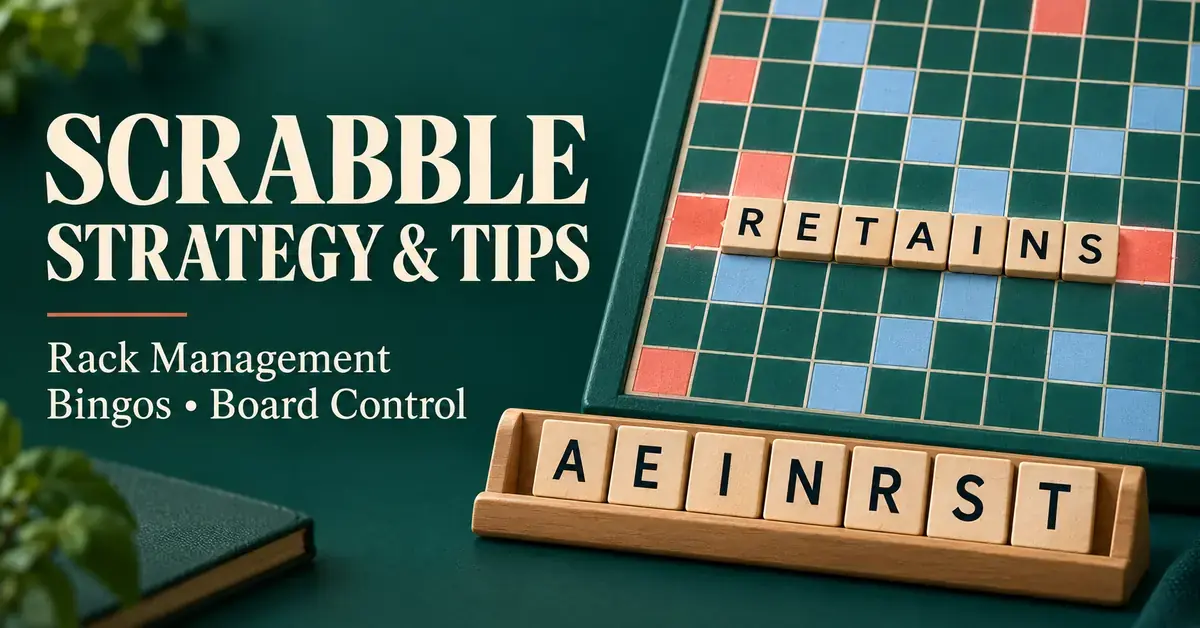
- Learn the stems. A stem is a set of six letters that forms a seven-letter word with many different seventh tiles. The classic example is SATIRE / SATINE — keeping those six on your rack means dozens of possible bingos. SATIRE plus the right letter makes words like RETINAS, RETAINS, STAINER and many more.
- Hold your blanks. Because a blank can be any letter, keeping one dramatically raises the odds that your seven tiles form a word. It is usually correct to pass up a 15-point play to keep a blank for a possible bingo next turn.
- Keep a lane open. A bingo needs seven connected squares. If the board tightens up, look for places you can extend an existing word so there is room to lay down a full rack.
How do you play defence and control the board?
Scrabble is a two-way game: every open premium square you leave is a gift to your opponent. Board control means shaping the board so that your scoring chances outnumber theirs.
- Watch the triple-word squares. Avoid placing a tile one or two squares away from an unused triple-word square unless you have no better play, because you may be handing your opponent an easy bridge to it.
- Close down dangerous lines. If the board offers a long open row leading to a premium, playing a word that blocks or shortens it denies a big turn, even at the cost of a few of your own points.
- Control the pace when ahead. With a lead, prefer tight, low-variance plays that keep the board closed. When behind, open the board and take risks to create bingo lanes — you need the swing.
- Track the tiles. Keeping a rough count of which high-value letters, blanks and S tiles have been played tells you what your opponent might be holding and whether a triple-word square is safe to leave open.
- Mind the endgame. When the bag is empty, you can see what is left to play. Count your opponent’s likely tiles, play out quickly to avoid being stuck with heavy letters (unplayed tiles are deducted from your score at the end), and if you go out first you gain the sum of everyone else’s remaining tiles.
Which dictionary and word list should you use?
Two official word lists govern competitive Scrabble, and which one applies depends on where you play. North America uses the NASPA Word List; most of the rest of the world uses Collins Scrabble Words. The lists overlap heavily but differ on thousands of words, so agree on one before a serious game.
| Word list | Current edition | Where it is used | Approx. total words | Valid two-letter words |
|---|---|---|---|---|
| NASPA Word List (NWL) | NWL2023 (effective Feb 2024) | USA, Canada, Thailand, Israel | ~196,600 | 107 |
| Collins Scrabble Words (CSW) | CSW24 (2024) | Rest of the world | ~290,000+ | 127 |
For the family table, the consumer-friendly Official Scrabble Players Dictionary (seventh edition) is a practical reference because it includes definitions. Casual players can simply agree to allow any word found in a standard English dictionary — the important thing is that everyone uses the same source.
Common Scrabble strategy mistakes to avoid
Most rating points are lost to a handful of repeated errors rather than to missing rare words. Watch for these:
- Always playing your highest-scoring word. The top-scoring play can leave you with a terrible rack. Weigh the points against the leave.
- Spending S tiles and blanks cheaply. These tiles are worth far more saved for a bingo or a big hook than used on a 6-point word.
- Ignoring the cross-words in parallel plays. Lay a word alongside another and every two-letter word it forms must be valid — one illegal pairing voids the whole play.
- Hoarding a lone Q, J, Z or X. Holding a stuck high-value tile for “the big play” that never comes costs you turns; learn the short words that unload them.
- Playing without defence. Scoring well while leaving triple-word squares wide open hands your opponent the game. Consider what you are giving away on every turn.
- Studying long words before short ones. The two-letter and three-letter lists earn more points per hour of study than any fancy vocabulary. Learn them first.
Who is this strategy for?
These tactics suit anyone moving from casual family games to competitive play, whether at a club, in a tournament, or against the strongest setting of a Scrabble app. Beginners should start with the two-letter words and basic rack balance; intermediate players gain the most from bingo stems and premium-square planning; and experienced players win close games on defence, tile tracking and the endgame. If you are still finding your feet with tabletop games in general, the fundamentals in our guide on how to play board games pair well with this one, and you can see where word games sit among the wider families of titles in our overview of board game genres and mechanics.
Sources
Frequently Asked Questions (FAQ)
What is the single best Scrabble strategy tip for beginners?
Learn the valid two-letter words. They let you play parallel to existing words, reach premium squares, and unload heavy letters like Q and Z for big points. Memorising the short-word lists gives a bigger scoring boost per hour of study than learning rare long words.
How many points is a bingo in Scrabble?
Playing all seven of your tiles in one turn earns a 50-point bonus on top of the word’s normal score. The bonus is added after any double or triple word multiplier, so a bingo on a word-premium square can score well over 70 points.
How many two-letter words are valid in Scrabble?
There are 107 valid two-letter words in the North American NWL2023 list and 127 in the international Collins (CSW24) list. The exact set depends on which official word list your game uses, so agree on one before you play.
Should I always play my highest-scoring word?
No. The top-scoring play can leave you with a poor rack or open a triple-word square for your opponent. Balance the immediate points against your leave (the tiles you keep) and against the scoring chances you give away.
Which Scrabble dictionary is official?
In the United States and Canada, competitive play uses the NASPA Word List (NWL2023). Most other countries use Collins Scrabble Words (CSW24). For casual home games, any standard English dictionary works as long as every player uses the same one.
