

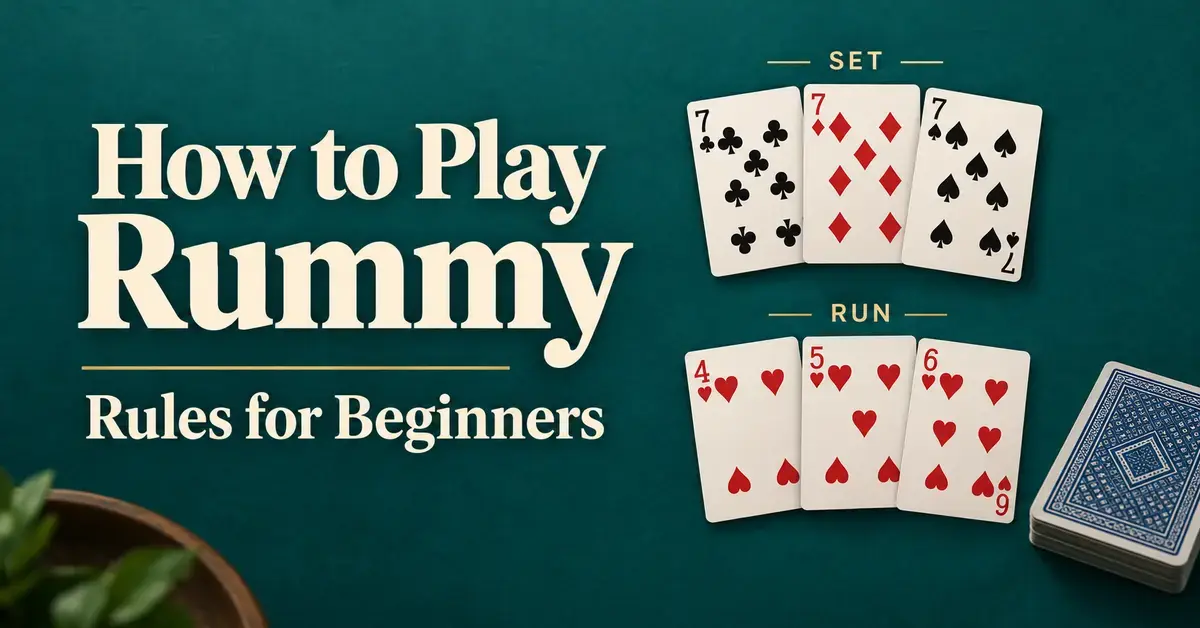
Rummy is one of the world’s most widely played card games: a draw-and-discard game in which you build matching combinations called melds and race to empty your hand before your opponents do. This beginner’s guide explains the standard rules step by step: how to deal, what counts as a valid meld, how a single turn works, how to go out and how the points are counted. It also covers Gin Rummy, the best-known two-player version, along with the other variants you are most likely to meet at the kitchen table. Rummy belongs to the wider family of card and dice games played with a standard deck, and it is one of the easiest of them to learn in a single sitting.
Quick Facts
| Players | 2–6 (best with 2–4) |
|---|---|
| Equipment | One standard 52-card deck (two decks for 5–6 players); no jokers in basic Rummy |
| Cards dealt | 10 (2 players), 7 (3–4 players), 6 (5–6 players) |
| Age | About 8 and up |
| Round length | Roughly 10–30 minutes |
| Game type | Draw-and-discard matching card game |
| Objective | Form all your cards into melds (sets and runs) and go out |
| Best-known variant | Gin Rummy (2 players) |
What is Rummy?
Rummy is a matching card game for two to six players in which the goal is to arrange all the cards in your hand into valid melds. The name covers a whole family of games that share the same core: you draw a card, you may form or extend melds, and you discard a card, repeating until someone arranges their entire hand. “Basic Rummy” (also called Straight Rummy) is the plain version described here; Gin Rummy, Rummy 500 and Canasta are popular relatives built on the same foundation.
Because the rules are simple but the decisions are not, Rummy is a good entry point for anyone learning how to approach games generally. If you are completely new to tabletop play, our guide on how to play board games explains common components and turn structure that carry over to card games like this one.
What you need to play
You need a single standard 52-card deck for two to four players, and two decks shuffled together for five or six players. No jokers are used in basic Rummy (some variants add them as wild cards). A pen and paper are handy for keeping score across several rounds.
The dealer shuffles, and each player draws a card to decide who deals first (lowest card typically deals). The number of cards dealt depends on how many are playing:
- 2 players: 10 cards each
- 3 or 4 players: 7 cards each
- 5 or 6 players: 6 cards each
The remaining cards are placed face down in the centre to form the stock pile. The top card of the stock is turned face up beside it to start the discard pile. Play usually proceeds clockwise, starting with the player to the dealer’s left.
What are melds? Sets and runs explained
A meld is a group of cards that follows one of two legal patterns: a set or a run. Forming melds is the entire point of the game, so it is worth getting these two shapes clear before you start.
Sets (also called groups or books)
A set is three or four cards of the same rank in different suits. For example, 7♠ 7♥ 7♦ is a valid set of three, and K♣ K♠ K♥ K♦ is a valid set of four. You cannot use two cards of the same suit in a set, because they would be the identical card.
Runs (also called sequences)
A run is three or more consecutive cards of the same suit, such as 3♥ 4♥ 5♥ or 9♠ 10♠ J♠ Q♠. In standard play the ace is low, so A-2-3 is a valid run but Q-K-A is not, and a run may not “wrap around” the corner (K-A-2 is never legal). Some groups play aces high or allow either; agree on this before you deal.
How does a turn work? Draw, meld, discard
Every turn follows the same three-step rhythm: draw one card, optionally lay down melds, then discard one card. Each step matters, so take them in order.
- Draw. Take the top card of the stock (face down, so you do not know what it is) or the top card of the discard pile (face up, so you know exactly what you are getting). Picking from the discard tells opponents something about what you are collecting, so use it deliberately.
- Meld (optional). If you can, place one or more complete sets or runs from your hand face up on the table. In basic Rummy you may meld on any turn, and you are never forced to.
- Discard. End your turn by placing exactly one card face up on top of the discard pile. You must always discard, and you may not discard the same card you just drew from the discard pile on that turn.
If the stock runs out before anyone goes out, set aside the top discard, shuffle the rest of the discard pile to make a fresh stock, and continue.
What does laying off mean?
Laying off is adding a card from your hand to a meld that is already on the table, so you can shed cards without completing a whole new meld. For example, if a set of 7♠ 7♥ 7♦ is showing, you may lay off the 7♣ to it; if a run of 4♥ 5♥ 6♥ is on the table, you may add the 3♥ or the 7♥. In most versions you may lay off onto any player’s melds, not just your own. The card must keep the meld legal, and laying off is only possible after you have made at least one meld of your own in some variants, so confirm the house rule.
How do you go out and end the round?
A player goes out the moment they get rid of their last card, which ends the round immediately. You go out by melding and laying off until your hand is empty, finishing with a final discard (in most versions your last card is discarded rather than melded). The round then stops, and everyone counts the cards still in their hands.
Some groups allow “going rummy”: melding your entire hand in a single turn without having melded or laid off previously. When allowed, this usually doubles the points scored for that round. It is an optional bonus rule, so agree on it in advance.
How is Rummy scored?
At the end of a round, the player who went out scores points equal to the total value of the cards left in the other players’ hands. The card values are:
- Face cards (King, Queen, Jack): 10 points each
- Aces: 1 point each (when aces are played low)
- Number cards (2 through 10): their face value
Only cards still held in hand count against a player; cards already melded on the table do not. Games are usually played to an agreed target (for example 100 or 250 points) or for a set number of deals, and the highest total wins. This article describes scoring only and does not cover playing for money. If you enjoy keeping score in card games, you may also like the pegged scoring in our wider collection of board game rules for the classics.
Gin Rummy: the most popular variant
Gin Rummy is the best-known two-player version of Rummy, and it changes how you end a hand and how you score. Each player is dealt 10 cards, the next card starts the discard pile, and the rest form the stock. Instead of melding cards onto the table during play, you keep your whole hand concealed and arrange it mentally, revealing everything only when the hand ends.
Deadwood and knocking
“Deadwood” is any card in your hand that is not part of a complete set or run, and your deadwood count is the total point value of those unmatched cards (same values as basic Rummy). On your turn, after drawing and discarding, you may knock if your deadwood totals 10 points or fewer. Knocking ends the hand and reveals both hands.
Going gin and undercutting
If you knock with zero deadwood — every card matched into melds — you have gone gin and earn a bonus (20 points in the official Bicycle rules; many players use 25) on top of your opponent’s deadwood. If you knock with a few points of deadwood, your opponent may first lay off any of their own deadwood onto your melds, then both deadwood counts are compared. If the knocker has the lower count, they score the difference. If the opponent ties or has the lower count, they undercut you and score the difference plus an undercut bonus (10 points in the Bicycle rules; 25 is also common). You cannot lay off against a gin hand.
Winning a Gin Rummy game
Hands are played until one player reaches an agreed target, traditionally 100 points. The winner then adds a line (box) bonus of 25 points for each hand they won and a game bonus of 100 points for reaching the target first; if the loser scored nothing all game, the winner’s total is often doubled (a “shutout” or “skunk”). Exact bonus figures vary by house rules, so settle them before the first deal.
Other popular Rummy variants
Rummy’s simple core has produced dozens of spin-offs. The table below compares the most common ones so you can see how they differ in players, equipment and the twist each adds.
Rummy Variants
| Variant | Players | Deck(s) | Key difference | Typical target |
|---|---|---|---|---|
| Basic (Straight) Rummy | 2–6 | 1 (2 for 5–6) | Meld openly during play; winner takes opponents’ hand points | Agreed total or set deals |
| Gin Rummy | 2 | 1 | Concealed hand; knock at 10 or fewer deadwood, go gin for a bonus | 100 points |
| Rummy 500 | 2–8 | 1–2 | Score the value of cards you meld; may take several cards from the discard pile | 500 points |
| Canasta | 4 (partners) | 2 + jokers | Build seven-card melds (canastas) with wild cards; partnership play | 5,000 points |
| Contract / Shanghai Rummy | 3–5 | 2 + jokers | Each round sets a required contract of melds to achieve | Lowest total after set rounds |
| Indian Rummy | 2–6 | 2 + jokers | 13-card hands; need a pure run before you can go out | Lowest score |
Common mistakes beginners make
Most early mistakes come from focusing only on your own hand. Watch for these:
- Forgetting to discard, or discarding the wrong card. A turn is not complete until you discard exactly one card, and you cannot discard the card you just took from the discard pile on the same turn.
- Holding high cards too long. Kings, Queens and Jacks are worth 10 points each if you are caught with them when someone goes out. Meld or shed them early rather than hoping to complete a set.
- Taking from the discard pile too freely. Every card you pick up face down from the stock keeps your plan hidden; drawing from the discard tells opponents what you are building.
- Ignoring the discard pile entirely. The flip side: watch what opponents discard and pick up, because it reveals which cards are safe to throw and which you should keep.
- Building one big meld instead of several options. Keeping cards that could join more than one meld gives you flexibility if the draw does not cooperate.
Tips to improve your Rummy game
Beyond the rules, a few habits raise your win rate. Keep your deadwood low at all times so you are never badly caught if an opponent goes out suddenly. Track discards to work out which cards are dead and which opponents are collecting. Discard middle cards (like 6s, 7s and 8s) with care, since they fit the most possible runs. And balance speed against value: going out fast limits your opponents’ chance to meld, but waiting for a cleaner hand can score more. For general principles that apply across many games, see our guide to board game strategy.
Sources
Who is rummy for?
Rummy suits almost any group. The rules are simple enough for children aged about eight and up, a hand takes only 15 to 30 minutes, and it scales from a quick two-player duel to a lively table of six. Because it blends luck with genuine decision-making, it stays interesting for experienced players while remaining welcoming to complete beginners — which is exactly why it has stayed popular for well over a century.
Frequently Asked Questions (FAQ)
How many cards do you deal in Rummy?
For two players deal 10 cards each; for three or four players deal 7 cards each; for five or six players deal 6 cards each, using two decks shuffled together. The rest of the cards form the face-down stock, with one card turned up to start the discard pile.
Can an ace be high or low in Rummy?
In standard Rummy the ace is low and worth 1 point, so A-2-3 is a valid run but Q-K-A is not, and a run cannot wrap around from King to Ace to 2. Some groups agree to play aces high or either way, but this should be settled before the deal.
What is the difference between a set and a run?
A set is three or four cards of the same rank in different suits, such as three Queens. A run is three or more consecutive cards of the same suit, such as 4-5-6 of hearts. Both are valid melds, and a hand is cleared by arranging all its cards into sets and runs.
What does it mean to knock in Gin Rummy?
Knocking means ending the hand when your unmatched cards (deadwood) total 10 points or fewer. If you have no deadwood at all you have “gone gin” and earn a bonus. If your opponent ends up with an equal or lower deadwood count after laying off, they undercut you and score the bonus instead.
How do you count points in Rummy?
Face cards (King, Queen, Jack) are worth 10 points each, aces are 1 point, and number cards are worth their face value. When a player goes out, they score the total value of the cards still held in the other players’ hands; cards already melded on the table do not count.
