

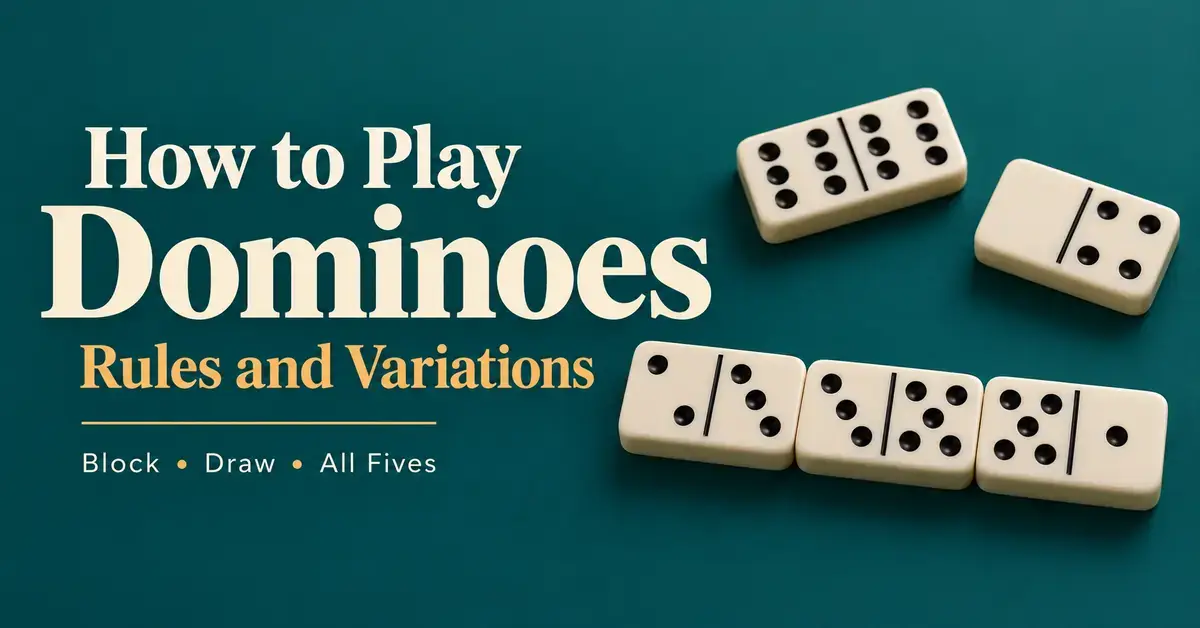
Dominoes is a classic tile-matching game you can learn in a few minutes and keep enjoying for years. The most common version is played with a double-six set of 28 tiles, where you take turns adding tiles to a shared line so that touching ends show the same number. This guide explains the standard rules step by step, how to score, and the three best-known families of variations the editor asked about: Block, Draw and the fives-scoring games (All Fives, Muggins and Five-Up). Everything below has been checked against established rules references so you can trust the numbers.
Key Points
- Set: A standard double-six set has 28 tiles and 168 total pips, ranging from 0-0 to 6-6.
- Players: Best with 2 to 4 players; deal 7 tiles each for two players (fewer for more players).
- Goal: Be the first to play all your tiles, or hold the fewest pips if the game blocks.
- Core rule: Each tile you play must match a number on one of the open ends of the line.
- Boneyard: The face-down leftover tiles — drawn from in the Draw game, untouched in the Block game.
- Scoring: The winner of each hand scores the pips left in opponents’ hands; play to an agreed target such as 100.
- Variants: Block, Draw, and the fives games (All Fives, Muggins, Five-Up) that score multiples of five during play.
What you need: the double-six domino set
A standard double-six set contains 28 tiles. Each tile (also called a bone or a stone) is split into two square halves, and each half shows between zero and six dots, called pips. The set includes every possible pairing from the double blank (0-0) up to the double six (6-6), with no repeats. A tile with the same number on both halves is a double, so there are seven doubles in the set (0-0 through 6-6).
Across the whole set there are 168 pips in total, which matters when you score, because scoring is based on counting the pips left in players’ hands. You do not need a board — just a flat table and two to four players. If you want a refresher on reading any new set of components and turn order before you start, our guide on how to play board games covers the basics that apply to almost every game.
How to set up a game of dominoes
Setup takes under a minute once everyone knows the steps. The goal of setup is to give each player a hidden hand and leave the rest of the tiles available as a draw pile.
- Shuffle. Turn all 28 tiles face down and mix them thoroughly with both hands so no one can see the faces. The shuffled face-down pile is called the boneyard (also the stock).
- Draw your hand. Each player takes a set number of tiles and stands them on edge so only they can see the pips. The number depends on the variant and player count (see the counts below).
- Leave the boneyard. Any tiles not dealt stay face down in the boneyard. Depending on the variant, you either draw from it during play or leave it untouched.
- Decide who goes first. A common house rule is that whoever holds the highest double plays it first; many rule books instead have players draw a tile to decide the lead. Agree on one method before you start.
Typical starting hand sizes are 7 tiles each for two players, and 5 tiles each for three or four players in the Block game. The Draw game usually deals a little differently (7/7/6 for two/three/four players), which is covered in the variants section below.
How to play dominoes, turn by turn
On your turn you add one tile to the line on the table so that it matches an open end. Play passes around the table, and the line grows in both directions as the game goes on.
Placing tiles and matching ends
The first tile played opens the line. After that, each new tile must be placed so that one of its halves touches an open end showing the same number. For example, if an open end shows a 4, you may play any tile that has a 4 on it, lining up the two 4s. The chain now has a new open end equal to the other half of the tile you just played. The line has two open ends — one at each end — and you may play on either.
Doubles are usually laid crosswise (at a right angle to the line) so they are easy to spot. In the basic Block and Draw games a double is not a spinner: it does not open extra branches, and it simply presents its number as the open end like any other tile.
Drawing from the boneyard
Whether you can draw depends on the variant. In the Draw game, if you cannot play a tile from your hand, you must take tiles from the boneyard one at a time until you find a playable tile. You keep drawing until you can play or until the boneyard is reduced to its last two tiles — those final two are never drawn. In the Block game there is no drawing at all.
When you cannot play: passing and blocking
If you have no legal tile and cannot (or may not) draw, you pass your turn. When every player in a row is forced to pass because no one can add to either open end, the hand is blocked and play stops immediately. Blocking is a normal, strategic part of the game — sometimes your best move is to leave an end that you know your opponents cannot match.
How to score dominoes
Scoring in the standard game is based on the pips left in players’ hands at the end of each hand, and games are played over several hands up to an agreed target. Here is how it works in the Block and Draw games.
When a player “dominoes”
The first player to get rid of all their tiles has dominoed (gone out) and wins the hand. That player scores the total number of pips remaining in the other players’ hands. The more tiles — and the higher the pips — your opponents are stuck with, the bigger your score.
When the game is blocked
If the hand is blocked before anyone goes out, each player totals the pips still in their own hand. The player with the lowest pip total wins the hand and scores the pips held by the other players (minus their own, in many rule sets). If there is a tie for the lowest total, the hand is usually a draw and no points are awarded, though some groups award the points to the player who last placed a tile — agree in advance.
Reaching the target score
You keep playing hands and adding up scores until someone reaches the agreed target. Traditional references list 100 points for a two-player or partnership game and 61 points for three or four players, but many casual players simply pick a round number such as 100 or 150. Pick your target before the first hand.
Block vs Draw dominoes: what is the difference?
Block and Draw are the two simplest and most common domino games, and they are identical except for one rule: what happens when you cannot play. In Block dominoes, there is no boneyard to draw from during play — if you cannot match an open end, you pass. In Draw dominoes, you must draw tiles from the boneyard until you can play (or until only two tiles remain in the boneyard). That single difference changes the feel of the game: Block is faster and more about managing the hand you were dealt, while Draw gives you more chances to stay in but also lets hands run longer.
Hand sizes differ slightly too. Block typically deals 7 tiles for two players and 5 each for three or four. Draw typically deals 7 tiles for two or three players and 6 each for four. The table below compares all the main variations at a glance.
Variant Comparison
| Variant | If you cannot play | How you score | Doubles | Best for |
|---|---|---|---|---|
| Block | Pass (no drawing) | Winner takes pips left in opponents’ hands | Not spinners | Fast, simple games and beginners |
| Draw | Draw from the boneyard until you can play or two tiles remain | Winner takes pips left in opponents’ hands | Not spinners | Longer, more forgiving family games |
| All Fives / Muggins | Pass or draw (as agreed) | Score the open-end total whenever it is a multiple of five | Counted by full pip value | Players who want ongoing scoring and arithmetic |
| Five-Up | Pass or draw (as agreed) | Open-end multiples of five, divided by five (often to 61 on a cribbage board) | All doubles are spinners (branch up to four ways) | Experienced players wanting more depth |
Scoring variants: All Fives, Muggins and Five-Up
Beyond simply going out, a whole family of domino games adds scoring during play by rewarding you for making the open ends add up to a multiple of five. These are the games most people mean when they talk about “scoring dominoes.”
All Fives and Muggins
In All Fives (also called Muggins), you score whenever you place a tile that makes the total of all the open ends equal a multiple of five — and you score that whole total. For example, if the open ends show 6 and 4, that totals 10, so you score 10 points; if they show 5 and 5, that is 10 again. If the ends total something that is not a multiple of five, such as 12, you score nothing that turn. In these games doubles are counted by their full pip value at the end (a 6-6 at an end counts as 12). At the end of the hand, the player who goes out also adds the pips left in opponents’ hands, often rounded to the nearest multiple of five.
Five-Up
Five-Up uses the same fives idea but with two twists. First, every double is a spinner: once both long sides of a double have a tile against them, the line can branch in up to four directions, giving you more open ends to add up — and more ways to score. Second, scores are usually divided by five and tracked on a cribbage board, so making the ends total 15 earns you 3 points rather than 15, and games are commonly played to 61. The underlying skill is the same — do quick mental arithmetic on the open ends — but the branching board and the smaller numbers give Five-Up its own rhythm.
The “Muggins” call
The name Muggins comes from a catch rule: you must announce your score out loud when you make one. If you place a scoring tile but forget to claim the points, an alert opponent can call “Muggins!” and you forfeit that score (in some house versions, the caller takes it). It keeps everyone paying attention to the running total on the open ends.
Common mistakes beginners make
Most new players lose avoidable points. Watching for these habits will improve your results quickly.
- Dumping your lowest tiles first. Playing your small-pip tiles early feels safe, but if the hand blocks or an opponent goes out, you are left holding the heavy doubles that inflate your opponent’s score.
- Ignoring the doubles in your hand. Doubles are the hardest tiles to play because they need a specific number at an open end. Look for chances to play them early while matching numbers are still available.
- Forgetting to track the ends in fives games. In All Fives, Muggins and Five-Up, missing a scoring play — or forgetting to announce it — hands points to your opponents. Total the open ends every turn.
- Not counting what has been played. Experienced players track which numbers are exhausted so they can create ends their opponents cannot match. A little memory work turns blocking into a weapon.
- Playing the wrong variant’s rules. Drawing from the boneyard in a Block game, or treating a double as a spinner in basic play, are common mix-ups. Confirm the variant before you deal.
If you want to go deeper on reading opponents, tempo and risk, our general board game strategy guide covers principles that carry straight over to dominoes.
Which version of dominoes should you play?
Choose the variant that matches your group and the time you have. Block is the quickest to teach and play, making it ideal for young children and short sessions. Draw adds a little depth and keeps everyone in the hand longer, which suits mixed-ability family games. The fives games — All Fives, Muggins and Five-Up — reward arithmetic and planning, so they are the best fit for players who want ongoing scoring and more to think about each turn. If you enjoy dominoes, you will likely enjoy other classic card and dice games, and you can browse the full set of classic board game rules for your next game night.
Sources
Who is dominoes for?
Dominoes suits almost everyone, which is why it is a kitchen-table staple worldwide. The Block and Draw games are simple enough for young children and anyone new to games, and they shine as a quick, portable two-player game. All Fives adds just enough arithmetic and tactics to reward adults who want more depth, while Mexican Train is built for larger, chatty groups and family gatherings. A single inexpensive set covers all of them, and a game takes anywhere from a few minutes to half an hour per hand.
If you are new to tabletop games in general, the beginner’s guide to playing board games covers components and turn structure, and the classic board game rules hub explains other timeless games the same way.
Frequently Asked Questions (FAQ)
How many tiles do you start with in dominoes?
With a double-six set, two players usually draw 7 tiles each. With three or four players you typically draw 5 tiles each in the Block game, or 7 (three players) and 6 (four players) in the Draw game. The rest stay in the boneyard.
What is the boneyard in dominoes?
The boneyard is the pile of face-down tiles left over after everyone has drawn their hand. In the Draw game you take tiles from it when you cannot play; in the Block game it is set aside and not used during the hand.
How do you win a hand of dominoes?
You win a hand either by being the first to play all your tiles (going out, or “dominoing”) or, if the game is blocked, by holding the lowest total of pips. The winner scores the pips left in the other players’ hands.
What is the difference between Block and Draw dominoes?
They are the same game except for one rule. In Block dominoes you pass when you cannot match an open end; in Draw dominoes you must draw from the boneyard until you can play or until only two tiles remain.
How does scoring work in All Fives (Muggins)?
You score whenever the open ends of the line add up to a multiple of five, earning that total (for example, ends of 6 and 4 score 10). Five-Up uses the same idea but all doubles are spinners and the count is divided by five, usually tracked on a cribbage board to 61.
