

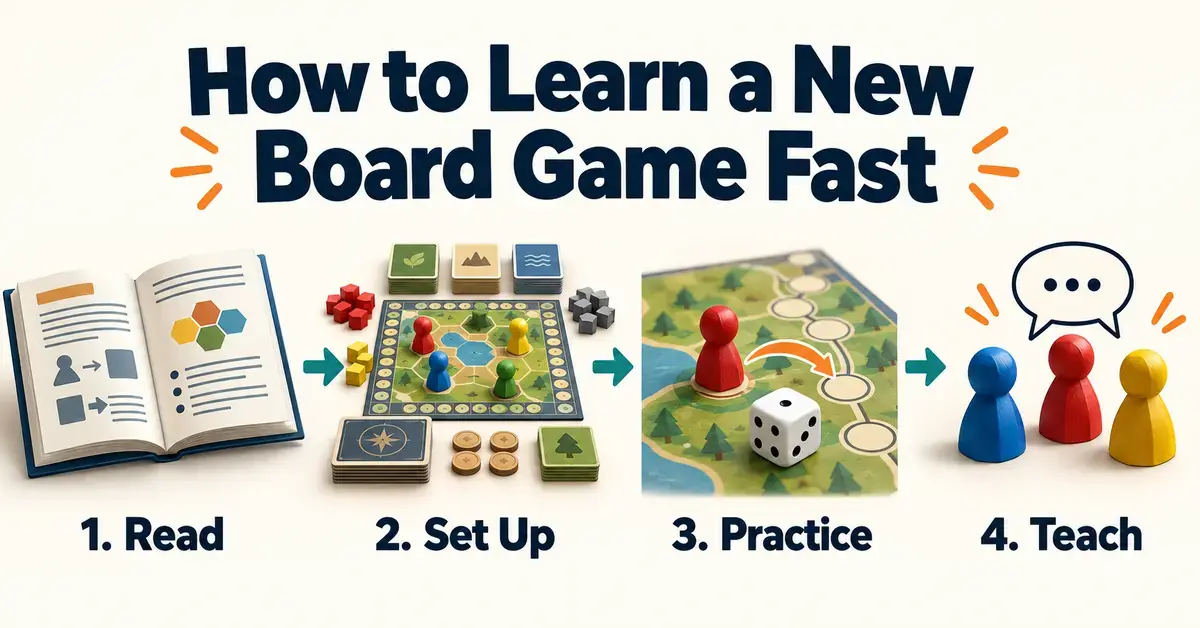
Learning a new board game is a skill in its own right, and like any skill a repeatable method makes it faster. Most of the frustration people feel when they first open a box comes from three avoidable habits: reading the rulebook in the wrong order, setting the game up incorrectly, and trying to explain everything to the table at once. This guide gives you a practical, four-part method — read the rulebook efficiently, set the game up correctly, play a low-stakes practice turn, and teach the other players — so everyone starts on the same page. Follow the steps below and you can get from shrink-wrap to your first real turn in well under an hour for most games.
Key Points
- Learning a game is a method, not a talent. Read, set up, practise, teach — in that order.
- Read the rulebook actively. Learn the goal first, then setup and a single turn, with the components laid out in front of you.
- Set up exactly as the diagram shows. A wrong setup is the most common reason a first game feels broken.
- Play a no-stakes practice turn before the game counts — it is where the rules finally click.
- Teach the win condition first, then a basic turn, then the details; make the first game a learning game.
- Use videos, player aids and rules-enforcing apps to see a turn in motion before you teach it.
Why does learning a new board game feel so hard?
The main reason is that most rulebooks are written as reference documents, not as teaching tools. They are organised so an experienced player can look up a single rule mid-game, which is almost the opposite of how a beginner needs to absorb a game for the first time. On top of that, the components are unfamiliar, the vocabulary is new, and the “20 minutes” printed on the box usually describes a game played by people who already know the rules — not your slower first run-through.
Understanding this changes your approach. Instead of reading passively from the first page to the last, you work through the rulebook actively, with the pieces in front of you, building a clear mental model of a single turn. If you want a broader foundation first, our guide to how to play board games explains the common components and turn structures that almost every game shares.
Step 1 — How to read a board game rulebook
Read the rulebook actively and in a learning order rather than cover to cover in one pass. A well-written rulebook already follows a sensible teaching sequence, but many do not, so it helps to know what to look for and in what order.
Read the sections in a learning order
Work through the rulebook in this sequence, even when the physical pages are arranged differently:
- The goal. Find out how you win before anything else. Every other rule makes more sense once you know what you are trying to achieve.
- The overview or theme. A short description of what the game is about gives the rules context and makes them far easier to remember.
- Setup. Read this with the box open so you can match each instruction to a real component.
- The structure of a turn. This is the heart of the game: what you may do on your turn, and in what order.
- How the game ends and how you score. The end condition tells you which actions actually matter.
- Edge cases and exceptions. Read these last — they rarely make sense until you understand a normal turn.
Lay out the components as you read
Pull everything out of the box and sort it before you read the setup section. Seeing the pieces the rulebook refers to turns abstract instructions into something concrete, and it doubles as a check that nothing is missing. When a rule mentions a specific card, token or board space, physically find it and look at it. This one habit removes most of the confusion beginners report, because you are no longer imagining the game — you are looking at it.
Flag the fiddly bits
Keep a pen or a few sticky notes to hand and mark anything you are unsure about: an unusual scoring rule, a tie-breaker, or a sentence you had to read twice. You do not need to resolve every question before you play. You just need to know where the answers are so you can look them up quickly mid-game. For the classics, you can also cross-check against our plain-language classic board game rules, which summarise player counts, ages and play times.
Step 2 — How to set up a board game correctly
Set the game up by following the rulebook’s setup section step by step, because an incorrect setup is the single most common reason a first game feels broken. Many groups quietly play a game “wrong” for years simply because they rushed the setup once and never noticed. A careful setup takes a few extra minutes and saves you a confusing session.
- Inventory the components first. Count the main pieces against the rulebook’s component list so a missing card does not surface halfway through.
- Follow the setup diagram. Most rulebooks include a labelled picture of a ready-to-play table. Copy it exactly before worrying about why each piece is where it is.
- Separate shared and per-player pieces. Many games give every player an identical starting set (tokens, a player board, a hand of cards). Build one player’s setup, then repeat it for everyone.
- Double-check starting resources. Starting money, cards or workers are easy to get wrong and quietly unbalance the whole game.
- Leave the rulebook open. Keep it beside the board at the setup page for your first game so you can glance back without hunting.
Step 3 — Play a practice turn before you start for real
Play one or two turns openly as a dry run before the game “counts”, because rules you half-understood on paper usually click the moment you perform them. Deal the starting hands face up, talk through the options out loud, and take a sample turn or two so everyone can see how a turn actually flows from start to finish.
If you are learning alone, this is even more valuable: play a few rounds solo, controlling two or three imaginary players, until a full turn feels automatic. A short practice turn is the fastest way to turn a page of text into something your hands already know how to do, and it surfaces the questions you did not realise you had.
Step 4 — How to teach a board game to other players
Teach a board game by giving players the destination first and the controls second, in small pieces, rather than reciting the rulebook front to back. A good teach is the difference between a table that is engaged and a table that is lost by the second turn.
Start by explaining how to win
Tell players how the game is won before you explain anything else. The win condition is the most important piece of information a new player needs, because it tells them what every rule you are about to describe is actually for. Keep it to a sentence or two: “We are each trying to score the most points by the end of round eight, mainly by building the longest routes.”
Give the theme, then the shape of a turn
Set the scene with a quick “who, what and why” before diving into mechanics, then describe what a typical turn looks like. A little theme makes players more attentive and gives the rules something to stick to. Follow it immediately with the shape of a normal turn — the two or three things a player does each time it is their go — so everyone has a frame to hang the details on.
Teach one phase at a time and run a dummy round
Break the game into small chunks and let players absorb each one before moving on, instead of explaining every rule at once. Demonstrate with real components where you can, and hand out any player-aid or reference cards the game includes. Then walk the table through a practice (dummy) round with no stakes, pausing for questions. This safety net is often where the rules finally land, because players are doing rather than just listening.
Let the first game be a learning game
Agree in advance that the first play is for learning, not winning, and the whole table relaxes. Allow take-backs, answer questions freely, and do not pile on advanced strategy before people can execute a basic turn. Save the deeper thinking for later; once everyone is comfortable, our board game strategy guide covers how to actually get better at the games you have learned.
Learn faster with videos, apps and online tools
Use a short tutorial video or a rules-enforcing app to shortcut the hardest part of learning: seeing a complete turn actually played. These tools do not replace the rulebook, but they let you watch the game in motion before you commit your own table’s evening to it.
- Tutorial videos. Watch It Played, the long-running YouTube channel from Prince Edward Island creator Rodney Smith, teaches complete games step by step with the components on screen, so you can see how a turn works and decide whether the game is for you.
- BoardGameGeek. The hobby’s main database hosts rules forums, official FAQ files and community-made summaries and player aids for thousands of games — ideal for settling a rules dispute or printing a one-page reference.
- BoardGameArena. This free, browser-based platform offers more than 1,400 games and enforces the rules automatically, so you literally cannot make an illegal move. Playing a title there once is a quick way to learn its flow before you teach it in person. It has been owned by publisher Asmodee since 2021.
Knowing a game’s category also speeds up learning, because games that share a mechanic share a lot of rules; our overview of board game genres and mechanics explains the common families you will meet again and again.
How long does it take to learn a new board game?
Expect to spend roughly 10 to 90 minutes learning a game depending on its complexity, and remember that the playtime on the box assumes everyone already knows the rules. Hobbyists often describe a game’s complexity as its “weight” on a rough 1-to-5 scale, from light family games up to heavy strategy games. The table below gives realistic first-time figures.
| Complexity (weight) | Example games | Read or teach time | First game vs box time |
|---|---|---|---|
| Light / gateway | Ticket to Ride, Azul | 10–15 minutes | Add about 50% |
| Medium | Catan, Wingspan | 20–40 minutes | Roughly double |
| Heavy | Terraforming Mars, Gloomhaven | 45–90 minutes | Double or more |
These are guidelines, not promises. Your first play of any game runs slower while everyone looks up rules and thinks through options, and the second play is usually much faster. If a group is new to the hobby entirely, start light: a gateway game teaches good habits without overwhelming anyone.
Common mistakes when learning a new game
Avoiding a handful of predictable errors does more for your first session than any clever tip. Watch for these:
- Reading the rulebook cover to cover. Reading passively, without the pieces out, means almost nothing sticks. Read actively, in a learning order, with the components in front of you.
- Skipping the setup diagram. A rushed setup is the top cause of a game feeling broken or unbalanced. Copy the diagram exactly the first time.
- Teaching everything at once. Explaining every rule and exception up front overwhelms new players. Teach the goal, then a basic turn, then the details.
- Starting with a heavy game. A complex game as a group’s first ever play often ends in frustration. Build up from lighter titles.
- Skipping the practice turn. Diving straight into a game that “counts” turns the first few rounds into a confusing rules lookup. A dummy round prevents this.
- House-ruling by accident. Playing a half-remembered rule wrong, then repeating it every game, is extremely common. When in doubt, look it up.
- Learning late, tired or hungry. New rules need attention. Tackle an unfamiliar game early in the evening, not at midnight after three other games.
Learning Checklist
- Unbox and sort all components; count them against the rulebook’s list.
- Find the win condition so you know what every rule is for.
- Read in learning order: goal → theme → setup → turn structure → game end → exceptions.
- Lay out the pieces and match each one to the rules as you read.
- Set up using the diagram, exactly, with the rulebook left open.
- Flag anything unclear with a sticky note instead of stopping.
- Play one or two practice turns face up, talking the options through.
- Teach others: win condition first, then theme, then one phase at a time.
- Run a dummy round and take questions before the game counts.
- Keep the first game relaxed — allow take-backs and look up disputes.
Sources
- BoardGameArena — free online platform that enforces game rules automatically.
- Watch It Played (YouTube) — Rodney Smith’s step-by-step game tutorials.
- BoardGameGeek — rules forums, FAQ files and community player aids.
- Meeple Mountain — Tips for teaching new board games.
- Asmodee Canada — Teaching complex games to new players.
- My Kind of Meeple — Teaching board games to new players.
Frequently Asked Questions (FAQ)
What is the fastest way to learn a new board game?
The fastest route is to combine a short tutorial video with a hands-on practice turn. Watching a complete turn played, then performing one yourself with the components in front of you, turns written rules into something you can actually do far quicker than reading alone. Learn the goal first, then a single basic turn, and leave the exceptions until later.
Should I read the rulebook or watch a video first?
Watch a short tutorial first for a visual overview, then read the rulebook to fill in the details and confirm the specifics. The video shows you how a turn flows, and the rulebook remains the authoritative source for edge cases and exact wording. Using both is faster and more accurate than relying on either one.
How do I teach a board game without boring everyone?
Start by telling players how to win, add a sentence of theme, then describe a single basic turn before any exceptions. Teach one phase at a time, demonstrate with the pieces, and run a no-stakes practice round so people learn by doing. Keep the energy up and save advanced strategy for later.
Is it better to learn a new game solo first?
Yes, learning solo first is a good idea for anyone who will teach the game. Playing a few rounds alone, controlling two or three hands, lets you work through the rules at your own pace and spot the tricky parts before you explain them to others. You will teach far more confidently afterwards.
Why do my group and I keep playing a game with the wrong rules?
Almost always it traces back to a rushed setup or a rule that was misremembered on the first play and then repeated every game afterwards. Re-read the setup section and the turn structure carefully, and check any rule you are unsure about against the rulebook, an official FAQ or a rules-enforcing app. Correcting it once fixes it for good.
