

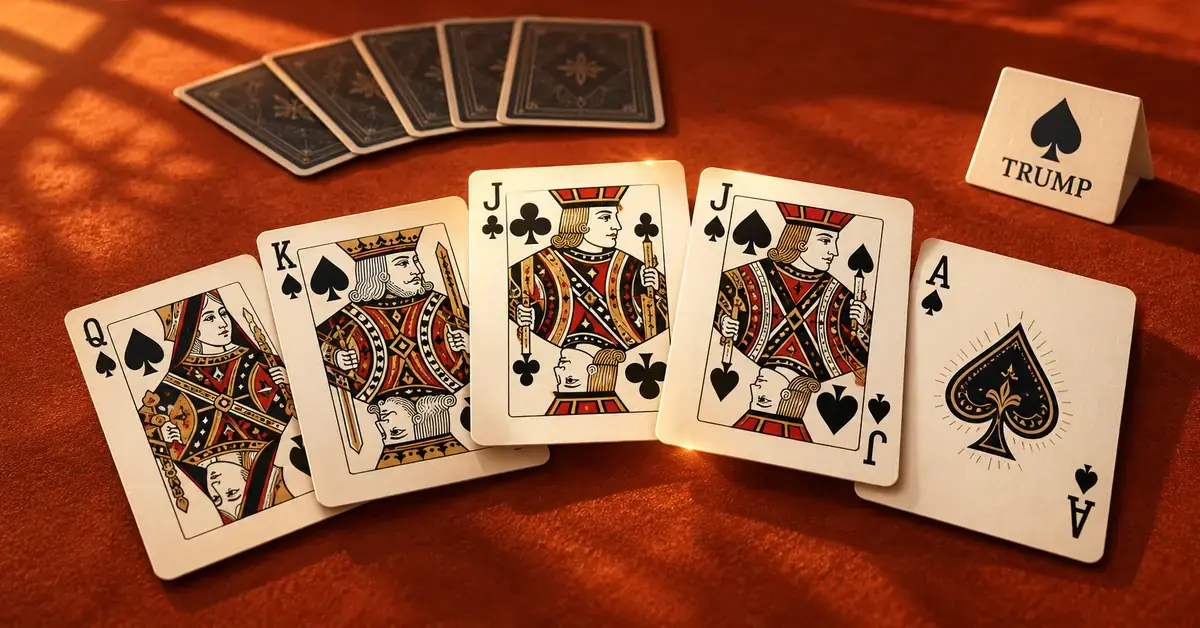
Euchre is a fast trick-taking card game where most of the skill lives in two decisions: whether to name the trump suit, and whether to play the hand by yourself. The cards you are dealt matter, but players who win consistently do so by reading their seat at the table, calling trump at the right moments, and working with a partner instead of against them. This guide assumes you already know the mechanics; if you need a refresher on the deck, the bowers and scoring, start with our full guide to how to play euchre, then come back for the strategy.
Key Points
- Strength is measured in trump. Count likely trumps, including both bowers, before you call — not high off-suit cards.
- Seat decides how much you need. First and third seat arm the dealer when they order up, so they call strong; the dealer and the dealer’s partner can call lighter.
- Going alone pays four points for all five tricks but only one point for three or four — reserve it for near-certain sweeps.
- Lead trump for your partner when they called it, to pull the opponents’ trumps and protect your partner’s winners.
- Defence needs just three tricks to euchre the makers for two points — and only one trick to stop a lone hand scoring four.
- Game is to 10 points; take the safe points when the score is close rather than gambling for a march.
Euchre strategy starts with the trump suit
Every strategic decision in euchre flows from trump, so it pays to picture the trump hierarchy before a hand begins. Euchre uses a 24-card deck (9, 10, Jack, Queen, King and Ace in each suit). When a suit is trump, the ranking changes: the right bower (the Jack of the trump suit) is the highest card, the left bower (the Jack of the other suit of the same colour) becomes the second-highest trump, and then come Ace, King, Queen, 10 and 9. That means naming a suit as trump quietly promotes two Jacks and reshapes your whole hand.
The practical takeaway is that a hand’s strength is measured in trump, not in high off-suit cards. Three trumps including a bower is a genuinely strong hand; three Aces in three different plain suits is not, because each of them can be beaten by the smallest trump. Before you ever call, count your likely trumps for each possible suit and ask which choice turns your Jacks into bowers.
How to decide when to call trump
Calling trump well is the single biggest edge in euchre, and the right answer depends heavily on where you sit. The maker’s side must win at least three of the five tricks or it is “euchred” and hands two points to the other team, so a call is a bet that you and your partner can take three tricks. Position changes that bet because the turned-up card goes to the dealer, helping whichever team the dealer is on.
Read your seat before you speak
Your seat decides how strong a hand you need to call, because ordering up the turned card may arm the dealer. Play moves clockwise from the dealer’s left, and the four positions behave very differently:
- First seat (left of the dealer) acts first with no information and, by ordering up, would give the dealer an extra trump. It needs the strongest hand of all.
- Second seat is the dealer’s partner. Ordering up here hands the extra trump to your own side, so you can call on a lighter hand.
- Third seat is the dealer’s right-hand opponent. Like first seat it would feed the dealer a trump, so it calls cautiously — but it has seen two players pass, which is useful information.
- The dealer gets to pick the card up personally, so ordering up almost always means gaining a trump. It is the cheapest seat from which to call.
Calling Trump by Seat
| Seat | Position | Who gains the turned card | Suggested minimum to call |
|---|---|---|---|
| First | Left of the dealer (opponent) | The dealer (your opponent) | Very strong — both bowers, or right bower + Ace + another trump |
| Second | Dealer’s partner | Your own side (the dealer) | Lighter — any bower plus one more trump |
| Third | Right of the dealer (opponent) | The dealer (your opponent) | Strong, but informed by two prior passes |
| Dealer | Deals and picks up the card | Yourself | Often enough to hold three trumps after picking up |
Round one: ordering up the turned card
In the first round you are deciding whether the turned-up suit should be trump, knowing the dealer will add that exact card to their hand. From first seat, order up only with a powerful holding — both bowers, or the right bower with the Ace and another trump is a safe benchmark. From second seat, where the card strengthens your partner, any bower plus one more trump is usually enough. As the dealer, a common rule of thumb is to take the card up whenever doing so leaves you holding three trumps. Remember that a short off-suit — ideally being “void” in a suit, meaning you hold none of it — lets you trump that suit early and is worth as much as an extra trump.
Round two: naming a suit and the “next” play
If everyone passes the turned card, the second round lets you name any suit except the one that was turned down, which is where the “next” idea comes in. “Next” means calling the other suit of the same colour as the rejected card (if a red card was turned down, you call the other red suit). The logic: because nobody ordered up, the bowers of the turned-down colour are probably scattered or buried, and the same-colour suit — the “next” suit — is where the remaining strength tends to sit. Calling “across” to a suit of the opposite colour, by contrast, usually needs a genuinely strong hand of its own. One large bot-tuning dataset from World of Card Games found first-seat “next” calls winning around 80% of qualifying hands when the turned-down card was a Jack, but treat that as a heuristic for a narrow situation, not a guarantee.
Stick the dealer and forced calls
Many groups play “stick the dealer,” where the dealer must name a suit if the first three players pass in round two. If you play this way, late-seat opponents can pass marginal hands and force the dealer to call on weak cards, often setting up a euchre. If you are the dealer under this rule, factor it into round one: taking a modest hand up voluntarily is sometimes better than being forced into a worse suit later.
When to go alone in euchre
Going alone is worth the risk only when the math favours it, so learn what it pays before you reach for it. After trump is set, a maker may declare they are playing alone; their partner lays their cards down and sits out the hand. The reward is steep: a lone player who takes all five tricks scores four points instead of the two a normal march earns. But a lone hand that wins only three or four tricks still scores just one point, and if it is euchred the other team takes two — so you are trading a safe partnership call for a shot at a game-swinging four.
Hands worth going alone on
Go alone when you can plausibly win all five tricks without a partner’s help, not merely when you have a good hand. The clearest cases are:
- Both bowers plus the Ace of trump, with a side Ace or a void that lets you win or trump the last trick.
- A hand so trump-heavy that opponents simply cannot gather three tricks — four or five trumps including a bower.
- A hand where your partner’s cards would add little, because you already hold the top trumps that decide the hand.
Some aggressive engines go alone on any five-trump hand, reasoning that even the weakest five trumps usually outscore keeping a partner. That is defensible, but it is an edge-case rule; most tables profit more from going alone only on near-certain sweeps.
When not to go alone
Avoid going alone when a single off-suit lead could cost you a trick, because one lost trick wipes out the entire bonus. If your hand has a weak plain-suit card that an opponent can beat, your partner’s hand might have covered it — by going alone you throw that protection away. Also think twice near the end of a game: if two points already wins, a safe partnership march is better than gambling four points you do not need and risking a euchre that lets the opponents back in.
Partner play and table position
Euchre is a partnership game, and the biggest leaks come from players who ignore their partner’s information. Once trump is called, the two of you are trying to win three tricks together, which means your leads and discards should send and receive signals rather than simply grabbing the highest card you can.
Leading when your partner called trump
If your partner called trump and you are on lead, leading a trump is often the strongest play. Drawing out the opponents’ trumps protects your partner’s long trump suit and clears the way for their Ace or bower to score later tricks. This is sometimes resisted at casual tables, but pulling trump for the maker is a classic winning tactic. The main exception is when you hold the right bower yourself — then you can lead it to guarantee the first trick and keep control.
Signalling with off-suit leads
When you did not call trump, your opening lead tells your partner what you hold, so choose it deliberately. A high off-suit card (an Ace or King) tries to win a quick trick before opponents can trump it and signals strength in that suit. A low card can be a feeler that keeps your strong cards back. Leading a plain-suit Ace early is usually safe, but be aware it can still be trumped by a player who is void in that suit.
Trust the call and count the cards
Assume your partner called trump for a reason and play to support that call rather than second-guessing it. If your partner is winning a trick, do not waste a high card on it — throw off a weak plain-suit card instead and save your trumps. Keeping a rough count of which trumps and off-suit Aces have been played is what separates intermediate players from beginners; by the fourth trick a good player usually knows which cards are still out.
Defensive strategy: how to euchre the makers
Defence is half of euchre, and the goal is simple: stop the maker’s team from taking three tricks to score two points for your side. You do not need to win the hand — taking three of the five tricks euchres the makers, and even denying a single trick can matter against a lone hand.
Defending a normal call
Against an ordinary call, lead to force out the makers’ trumps and set up your own winners. Leading your longest plain suit can make the maker trump in early and burn their trumps faster than they would like. Coordinate with your partner the same way the makers do: if your partner is winning a trick, do not overtake it, and hold back a trump to capture a later lead. Watch the turned-down card too — it is a trump you now know no one holds.
Defending against a lone hand
Against a player going alone, your only job is to win one trick, which drops their score from four points to one. Lead your strongest off-suit Ace or King to try to steal a trick before the lone player can trump it, or lead a suit where you hold several cards so you are more likely to force them to follow or run out. Never assume a loner will succeed and throw away cards carelessly; one carefully kept winner is often enough to deny the sweep.
Common euchre strategy mistakes
Most lost euchre games come from a handful of repeatable errors rather than bad luck. Watch for these:
- Calling on off-suit strength. Three Aces in different plain suits is a weak euchre hand because any trump beats them. Count trumps, not high cards.
- Ordering up from first seat too often. Doing so hands the dealer a free trump; reserve it for strong hands.
- Going alone on a merely good hand. A single beatable off-suit card can cost the whole four-point bonus.
- Never leading trump for your partner. Failing to pull trump leaves your partner’s winners exposed.
- Trumping your partner’s winning trick. If your partner already has the trick won, save the trump and throw off.
- Ignoring the turned-down card. It is public information about one trump that is out of play.
- Chasing all five tricks when two points wins the game. Take the safe points when the score calls for it.
For broader principles that apply across trick-taking and other games, see our round-up of board game strategy tips, and if you enjoy the bidding side of euchre you will find familiar ideas in Spades and the trick-avoidance twist of Hearts. Euchre also sits inside our wider library of card and dice games if you want to branch out.
Sources
Frequently Asked Questions (FAQ)
What is the best first move in euchre?
The best opening decision is a disciplined trump call based on your seat. From the dealer’s left you need a strong hand before ordering up because you would give the dealer an extra trump, while the dealer and the dealer’s partner can call on lighter hands. Once trump is set, the player on lead often does well to lead trump if their partner made the call.
When should you go alone in euchre?
Go alone when you can realistically win all five tricks on your own, since only a lone sweep earns the four-point bonus. Hands with both bowers and the Ace of trump, or four to five trumps including a bower, are the usual candidates. If a single off-suit card could lose a trick, a normal partnership call is safer.
What does calling the “next” suit mean?
“Next” means naming the other suit of the same colour as the card that was turned down in round two. Because nobody ordered up the turned card, the bowers of that colour are often weak or buried, so the same-colour suit tends to hold the remaining strength. It is mainly a first-seat tactic used with a modest hand.
Should you always lead trump in euchre?
No, but leading trump is often right when your partner called trump, because it draws out opponents’ trumps and protects your partner’s winners. When you are defending, or when you hold strong off-suit Aces, a plain-suit lead can be better. Match the lead to who called and what you are holding.
How do you euchre the other team?
You euchre the makers by taking three of the five tricks, which scores two points for your side. Force out their trumps with long plain-suit leads, coordinate with your partner so you do not waste high cards, and against a lone hand focus on stealing just one trick to cut their score to a single point.
