

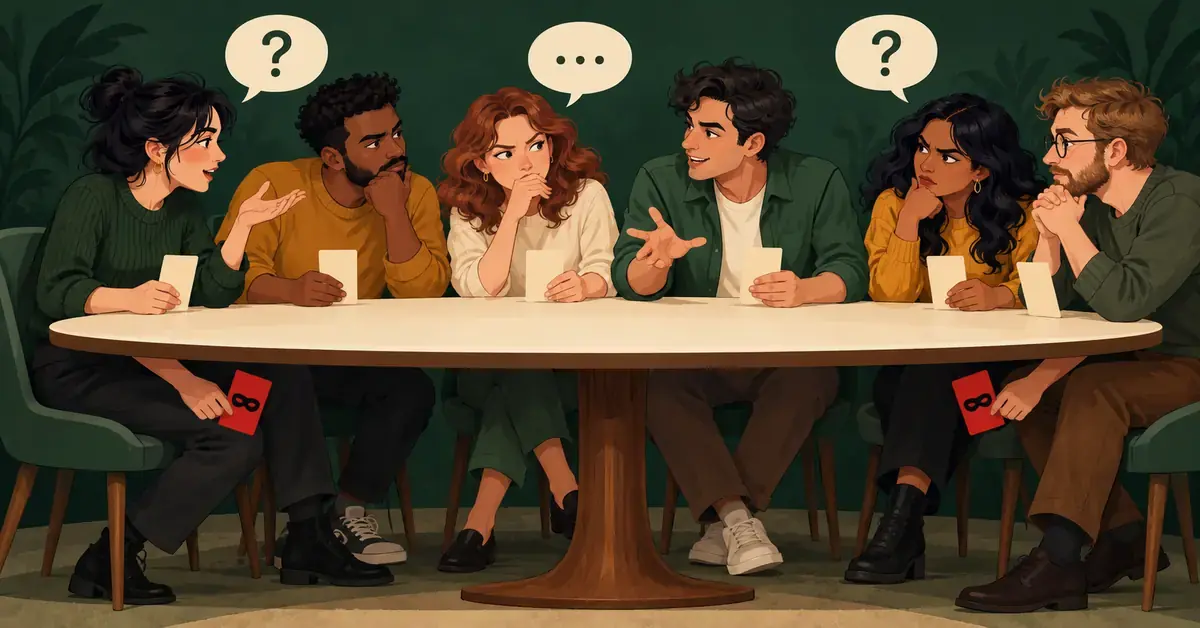
Social deduction games are party and tabletop games in which a hidden group of players secretly works against everyone else, and the rest of the table has to figure out who they are by talking, questioning and watching how people behave. There are no hidden boards or dice to blame — the real game happens in the conversation. This guide explains what social deduction games are, how hidden-role games work turn by turn, the main types you will meet, and how to play (and lose) well.
Key Points
- What they are: games where a hidden group of players secretly works against the rest, who must deduce their identities through conversation.
- Core mechanic: secret roles handed out at the start create an “informed minority” and an “uninformed majority.”
- The real game: discussion, questioning, accusation and voting — not moving pieces on a board.
- Best group size: usually five or more players; many scale to ten or more.
- Typical length: from about 10 minutes (One Night Ultimate Werewolf) to two hours (Blood on the Clocktower).
- Who wins: the majority wins by unmasking the hidden team; the hidden team wins by surviving or completing a secret goal.
What are social deduction games?
A social deduction game is a game built around secret identities, where part of the group knows something the others do not and uses that knowledge to deceive them. The word “deduction” points to the goal: the uninformed majority has to deduce who is lying. The word “social” points to the method: you reach that conclusion through discussion, accusation and persuasion rather than by moving pieces on a board.
Most of these games give every player a secret role at the start, usually on a card you look at privately. A small “informed minority” (for example, the mafia, the spies or the traitors) learns who their teammates are and shares a hidden goal. The larger “uninformed majority” (the townspeople, the resistance, the loyal players) does not know who anyone is, and must find and remove the hidden team before it is too late.
The core idea: hidden roles
The hidden role is the engine of the whole genre. Because you cannot see other players’ cards, every statement someone makes is either true or a bluff, and you can never be completely sure which. That uncertainty is what turns an ordinary conversation into a game. A player defending themselves might be an innocent townsperson telling the truth, or a guilty insider performing innocence convincingly. Working out which is the entire challenge.
How social deduction differs from co-op and traditional games
Social deduction sits between two other well-known styles of play. In a traditional competitive game such as chess or Catan, all information that matters is either public or random, and everyone is openly an opponent. In a fully cooperative board game, the whole table is on the same team against the game itself. Social deduction mixes the two: you cooperate and compete at the same time, because you do not yet know which players are genuinely on your side.
That hidden-team structure is why these titles are grouped as their own category in most overviews of board game genres and mechanics. The components are usually simple — a deck of role cards and maybe a few tokens — but the decisions are driven by people, not parts.
How hidden-role games work, step by step
Almost every social deduction game follows the same basic loop, even when the theme changes. Understanding the loop once means you can learn most of these games in minutes.
1. Setup and secret role assignment
The group decides how many hidden “bad” roles to include, usually based on the number of players. Role cards are shuffled and dealt face down, and each player looks at their own card without showing it. From this moment, half the table is quietly playing a different game from the other half.
2. The hidden phase (often a “night”)
Many games include a closed phase where secret information is exchanged. In Mafia and Werewolf this is literally called the “night”: everyone closes their eyes, and the hidden team silently opens their eyes to recognise each other or to secretly choose a victim. A moderator — a neutral person who runs the game but does not win or lose — narrates these steps. Not every game has a night phase, but most have some private step where the informed players coordinate.
3. The day phase: discussion and accusation
Play then opens up into free discussion. This is the heart of a social deduction game. Players share what they claim to know, ask pointed questions, defend themselves and accuse others. Because no one can prove their own innocence with a component, arguments rest on behaviour, consistency and logic. A “tell” is any small habit or inconsistency that hints at a player’s true role.
4. Voting and resolution
Discussion ends in a decision, usually a vote. In elimination-style games the group votes to remove one suspected player, who reveals their role and leaves the active game. In team games such as The Resistance, the vote instead approves or rejects a proposed mission. The loop of hidden phase, discussion and vote then repeats.
5. How a game is won
Each side has its own win condition. The uninformed majority usually wins by correctly identifying and removing the whole hidden team. The hidden minority usually wins by surviving until they equal or outnumber everyone else, or by completing a secret objective before they are caught. Because the two teams win in different ways, the tension lasts until the final vote.
The main types of social deduction games
Although they share a loop, social deduction games split into a few distinct styles. Knowing the type tells you how long a game runs, how many people it needs and whether anyone sits out.
Moderated elimination games
These are the originals. Mafia was created in 1986 by Dmitry Davidoff, a psychology student at Moscow State University, and the same rules were later given a fantasy skin as Werewolf by Andrew Plotkin in 1997. One player acts as moderator, players are eliminated one per round, and removed players usually watch the rest in silence. They scale to very large groups but need a good host and can leave early-eliminated players with little to do.
No-elimination team games
A newer wave fixed the “sitting out” problem by removing player elimination entirely. In The Resistance and its King Arthur–themed version The Resistance: Avalon, designed by Don Eskridge, nobody is ever knocked out: the resistance and the hidden spies fight over a series of team missions for the whole game. Secret Hitler, released in 2016 by Mike Boxleiter, Tommy Maranges and Max Temkin, uses the same no-elimination idea with liberals trying to stop a hidden fascist team from installing their leader. Everyone plays until the end, which keeps the table engaged.
Fast micro-games
Some titles compress the whole experience into a few minutes. One Night Ultimate Werewolf, designed by Ted Alspach and Akihisa Okui and published by Bézier Games in 2014, plays a single night and one discussion — roughly ten minutes — and a companion app can act as the moderator so no one has to sit out. Coup, designed by Rikki Tahta, is a tight bluffing game for 2–6 players where you claim role powers you may or may not actually hold, and get challenged if others doubt you.
Storyteller-driven games
Blood on the Clocktower, published by The Pandemonium Institute in 2022 and designed by Steven Medway, is run by a “Storyteller” who makes live judgement calls to keep the game balanced. Its signature twist is that dead players stay involved: they lose their vote power down to a single “ghost vote” but keep talking, so no one is truly out. It supports large groups of 5–20 players plus the Storyteller.
One-versus-many hidden-information games
A final group hides information rather than loyalty. In Spyfall, published in 2014, every player but one shares a secret location; the lone spy does not know where everyone is and must blend in by asking and answering questions without being obvious. Deception: Murder in Hong Kong, from Grey Fox Games, flips the usual roles: one player silently knows the solution and gives clues while a hidden murderer sits among the investigators. These lean on questioning and reading clues more than on pure accusation.
Popular social deduction games compared
The table below compares widely played social deduction titles on the details that matter most when you are choosing one for a group: player count, length, whether anyone is eliminated and whether you need a dedicated host. Figures are the publishers’ stated ranges.
Comparison
| Game | Designer / publisher | Players | Length | Player elimination? | Needs a moderator? |
|---|---|---|---|---|---|
| Mafia / Werewolf | D. Davidoff / A. Plotkin (public domain) | ~7+ | Varies | Yes, one per round | Yes |
| The Resistance: Avalon | Don Eskridge / Indie Boards & Cards | 5–10 | ~30 min | No | No |
| Secret Hitler | Boxleiter, Maranges & Temkin / Goat, Wolf & Cabbage | 5–10 | 30–60 min | No | No |
| One Night Ultimate Werewolf | Alspach & Okui / Bézier Games | 3–10 | ~10 min | No | No (optional app) |
| Blood on the Clocktower | Steven Medway / The Pandemonium Institute | 5–20 + Storyteller | ~30–120 min | Dead players keep playing | Yes (Storyteller) |
| Coup | Rikki Tahta / Indie Boards & Cards | 2–6 | ~15 min | Yes | No |
| Deception: Murder in Hong Kong | Grey Fox Games | 4–12 | ~20 min | No | No (fixed clue-giver role) |
| Spyfall | Alexander Ushan / Hobby World | 3–8 | ~15 min | No | No |
Key skills: how to play well
Social deduction rewards attention and communication more than rules mastery. A few repeatable skills help on either team.
Reading behaviour and tells
Watch how people act, not just what they say. Hesitation before answering, over-eager defence, changing a story between rounds and who someone chooses to attack can all hint at a hidden role. None of these is proof on its own — nervous innocent players exist — but patterns across several rounds are informative.
Bluffing as the informed minority
When you are on the hidden team, your job is to behave exactly like an innocent player would. The most common mistake is trying too hard: staying unusually quiet, or loudly accusing others to look helpful, both stand out. Blending in, contributing normal-looking logic and occasionally agreeing to vote out a teammate to protect your cover are stronger plays.
Building and testing a case
On the uninformed team, share your reasoning out loud and invite others to poke holes in it. Asking a suspect a direct question and watching how they handle pressure reveals more than quietly forming a theory. Co-ordinating a vote only works if the group actually agrees on the evidence, so make your case before the vote, not during it.
Common mistakes beginners make
The fastest way to improve is to avoid the usual errors.
- Staying silent. Saying nothing feels safe, but it gives the group no information and often reads as suspicious. Active, reasonable players are harder to pin down than quiet ones.
- Treating a single tell as proof. One nervous laugh is not evidence. Look for patterns across rounds before committing a vote.
- Voting on a hunch too early. Removing a player on thin evidence can hand the game to the hidden team by eliminating an innocent.
- Taking it personally. You will be accused and lied to — that is the game, not a comment on you. Groups that keep it light play better and longer.
- Revealing information at the wrong time. Powerful “good” roles that announce themselves too early often get targeted immediately. Timing matters as much as truth.
Who are social deduction games for?
Social deduction games suit groups that enjoy talking, arguing and laughing together more than quietly optimising a board. They shine as party board games and are a reliable centrepiece for a larger board game night, because many of them scale to seven, ten or more players — counts that most strategy games cannot handle.
They work best with at least five or six people; with only three or four, there is too little cover for the hidden roles to stay hidden. Most mainstream titles are aimed at ages 13 and up, largely because the bluffing and argument reward a bit of social experience, though lighter options play fine with older children. If your group dislikes direct confrontation or being lied to, a cooperative game may be a gentler fit. If you want to go deeper on the vocabulary used above, the board game glossary explains terms like bluffing, tell and moderator in plain language.
Sources
- Blood on the Clocktower — official site (The Pandemonium Institute)
- Bézier Games — official site (Ultimate Werewolf, One Night Ultimate Werewolf)
- Indie Boards & Cards — official site (The Resistance, Avalon, Coup)
- Secret Hitler — official site
- Grey Fox Games — official site (Deception: Murder in Hong Kong)
- The Dice Tower — The Resistance: Avalon listing
- Opinionated Gamers — Spyfall first impressions
Frequently asked questions (FAQ)
What is the difference between social deduction and bluffing games?
All social deduction games involve bluffing, but not all bluffing games are social deduction. Social deduction specifically hinges on hidden roles or loyalties that the group tries to uncover through discussion. A pure bluffing game like poker hides your cards, not your identity, and there is no hidden team to unmask.
How many players do you need for a social deduction game?
Most work best with at least five or six players, and many scale comfortably to ten or more. With only three or four people there is too little room for the hidden roles to stay concealed, so smaller groups should pick a title designed for low counts, such as a fast bluffing card game.
Do social deduction games always eliminate players?
No. Classic Mafia and Werewolf remove one player per round, but many modern designs avoid it entirely. Team games like The Resistance keep everyone playing to the end, and Blood on the Clocktower lets eliminated players keep talking and cast a final “ghost vote,” so no one simply sits out.
Is a moderator always required?
Not always. Mafia, Werewolf and Blood on the Clocktower use a neutral host or Storyteller to run hidden phases. Games such as The Resistance, Secret Hitler and Coup are self-moderating, and One Night Ultimate Werewolf can use a free companion app instead of a human host.
Are social deduction games good for beginners?
Yes. The rules are usually simple and learned in a few minutes, and the real skill is conversation, which everyone already has. Short titles like One Night Ultimate Werewolf or Coup are gentle starting points before trying longer, more complex games.
