

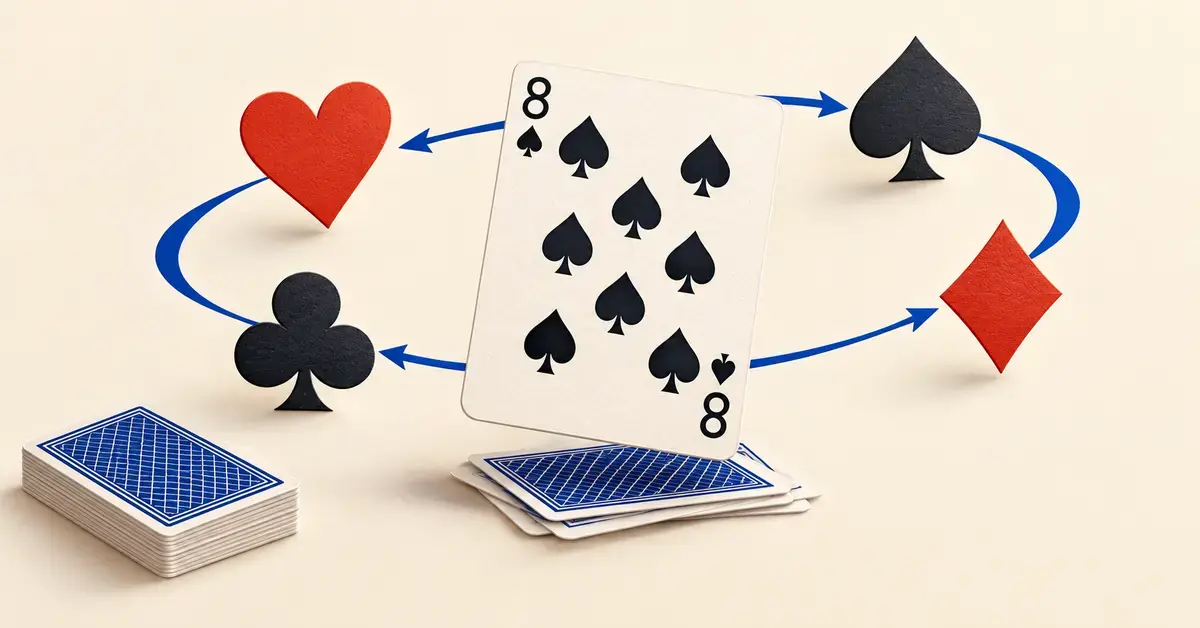
Crazy Eights is a classic shedding card game for two or more players in which the goal is simple: be the first to get rid of every card in your hand. You play using an ordinary 52-card deck, you match the card on top of the discard pile by either suit or rank, and the eights are wild cards that let you change the suit whenever you like. It takes a minute to learn and works well with children, families and friends. This guide explains the setup, the turn-by-turn rules, how scoring works, the most common variations and house rules, and the mistakes that trip up new players.
Key Points
- Goal: be the first to get rid of all the cards in your hand.
- Match: play a card that matches the top of the discard pile by suit or rank.
- Eights are wild: an 8 can be played on anything, and you name the next suit.
- Can’t play? draw from the stock (one card, or until playable, by agreement).
- Scoring: 8s = 50 points, court cards = 10, aces = 1, other cards at face value — lowest total wins.
- No official rules: action cards (Queen skips, Ace reverses, 2 draws two) are optional house rules.
What is Crazy Eights?
Crazy Eights is a matching-and-discarding game in the family card-game historians call the “Eights Group” or “stops” games. Each player tries to empty their hand by playing cards that match the top of a central discard pile, and the first to do so wins the round. The eights are the game’s signature feature: any eight can be played on any card, and the player who plays it chooses which suit comes next.
The game first appeared under the name Eights in the 1930s, and the label Crazy Eights became common in the 1940s. That nickname is often linked to “Section 8,” the old United States military discharge category for soldiers deemed mentally unfit, though this origin story is a popular explanation rather than a documented certainty. Crazy Eights is closely related to European games such as Mau-Mau and Switch, and it is the direct ancestor of the commercial card game Uno. If you already know Uno, you know most of Crazy Eights.
Because no official body governs the rules, Crazy Eights is one of the easiest card games to modify. Many groups add their own “action cards” and penalties. This guide separates the widely agreed core game from the popular optional rules so you can see exactly what is standard and what is a house choice.
Quick Facts
| Players | 2–8 (best with 2–5) |
|---|---|
| Equipment | One standard 52-card deck (two decks for 5+ players) |
| Age | About 6 and up |
| Round length | Roughly 5–15 minutes |
| Game type | Shedding / matching card game |
| Goal | Empty your hand first; lowest penalty score wins |
What you need to play
You need one standard 52-card deck and two to around five players. For larger groups of five to eight players, shuffle two decks together so there are enough cards to keep the game moving. No special board, timer or score sheet is required, although a pen and paper help if you want to track points across several rounds.
- Players: 2 to 8 (best with 2 to 5; use two decks for 5 or more).
- Deck: one standard 52-card deck, no jokers needed.
- Age: suitable from about 6 years up.
- Round length: roughly 5 to 15 minutes.
- Type: a shedding (get-rid-of-your-cards) game.
Crazy Eights sits comfortably alongside other quick-to-learn card and dice games, and it is a reliable choice for casual sessions and family game nights.
How do you set up Crazy Eights?
Setup takes under a minute. Choose a dealer, who shuffles the deck and deals cards one at a time, face down, to each player. The standard deal depends on the number of players:
- Two players: deal 7 cards each.
- Three or more players: deal 5 cards each.
Some groups deal a different number — eight cards each is another common choice — so agree on the hand size before you start. Place the remaining cards face down in the middle as the stock (the draw pile). Turn the top card of the stock face up and set it beside the stock to begin the discard pile; this first face-up card is called the starter or upcard.
If the starter happens to be an eight, the dealer names the suit that the first player must follow, or the eight is simply buried in the stock and a new card turned up — again, decide which approach you prefer before dealing.
How to play Crazy Eights
Play begins with the person to the dealer’s left and moves clockwise. On your turn you must play one card from your hand onto the discard pile if you can, or draw from the stock if you cannot. The rules below cover the core actions that nearly every group agrees on.
Matching the top card
To play a card, it must match the top card of the discard pile by suit or by rank. For example, if the top card is the seven of hearts, you may play any heart (same suit) or any seven (same rank). The card you play then becomes the new top card that the next player must match. Only one card is played per turn in the basic game.
Playing an eight: the wild card
An eight is wild and can be played on top of any card at any time, regardless of suit or rank. When you play an eight, you immediately name any suit you choose — hearts, diamonds, clubs or spades — and the next player must either play a card of that named suit or play another eight. This is the heart of the game: eights let you escape a hand with no legal play and steer the colour toward your strongest suit.
What happens when you cannot play?
If you have no card that matches the top card’s suit or rank and no eight, you draw from the stock. Groups handle the draw in a few ways, so agree in advance:
- Draw one: take a single card. If it is playable you may play it immediately; if not, your turn ends.
- Draw until playable: keep drawing until you get a card you can play, then play it, or until the stock runs out.
In the basic version you are also allowed to draw even when you do have a legal play, for example to hold onto a useful card — though many groups require you to play if you can.
What happens when the stock runs out?
If the draw pile is emptied, take the discard pile, leave the current top card in place, shuffle the rest and turn it face down to form a fresh stock. If you prefer not to reshuffle, a player who cannot play simply passes. If every player passes in a row, the round is blocked and ends; players then total the cards left in their hands as penalty points.
How do you win Crazy Eights?
You win a round the moment you play your last card and empty your hand. Many groups ask you to announce when you are down to a single card — similar to calling “Uno” — and failing to do so before the next player acts can cost you a two-card penalty. Whether this call is required is a house choice, so confirm it before you deal.
A single round is quick, so Crazy Eights is usually played as a series of rounds with running scores. The overall winner is decided by points, explained next.
How is Crazy Eights scored?
When a player goes out, every other player counts the cards remaining in their hand, and those points are recorded against them (or collected by the winner). Lower is better. The standard point values are:
| Card | Points |
|---|---|
| Each 8 | 50 |
| King, Queen, Jack (court cards) | 10 each |
| Ace | 1 |
| 2 through 10 (except 8) | Face value (2–10) |
Play continues round after round until someone reaches an agreed target. A common target is 50 points multiplied by the number of players — for example 100 points in a two-player game or 200 points with four players. When a player crosses that total, the game ends and the lowest score wins. Because eights are worth a hefty 50 points each, holding one when an opponent goes out is painful, which is the main tension in the scoring game.
Popular variations and house rules
Crazy Eights invites tinkering, and most families play with at least one or two extra rules. None of these are official, so treat them as optional and agree on them before you start. They are also what connects Crazy Eights to relatives like Switch, Mau-Mau and Uno.
Special action cards
The most common additions give certain ranks an effect when played:
- Queen — skip: the next player misses their turn. In a two-player game, you simply take another turn.
- Ace — reverse: the direction of play switches from clockwise to anticlockwise. In a two-player game it has no real effect.
- Two — draw two: the next player must draw two cards instead of playing. If they have their own two, they can play it to pass the penalty along, stacking the total so the following player draws four, six and so on.
Some groups swap which ranks carry these powers — using a Jack to skip, for instance — or add cards such as a “draw five” penalty card. The important thing is that everyone agrees before the deal.
Playing multiple cards and stacking
Many groups let you play several cards of the same rank at once, as long as the first one is a legal match. If you play two aces under the reverse rule, the direction changes twice; if you lay down two “draw two” cards together, the penalty doubles. This speeds the game up and makes big turns possible.
Crazy Eights Countdown
Countdown is a popular North American variant that turns the game into a race to zero. Each player starts with a score of 8 and is dealt 8 cards. Going out does not end the game; instead you subtract 1 from your score and are dealt a new hand equal to your new score, while everyone else keeps their cards. Your current score also sets which rank is wild for you — eights first, then sevens, and so on down to aces. The first player to reach zero (going out on their final hand of one card, an ace, with ace wild) wins the whole game.
Related games worth knowing
Because Crazy Eights is really a pattern of play rather than one fixed game, it has many named cousins: Switch and Mau-Mau in Europe, Craits, Last Card, Spoons, and the heavily rule-laden Mao. The best-known commercial descendant is Uno, which replaces the standard deck with its own cards and bakes the action cards and wilds directly into the deck.
Common mistakes to avoid
New players tend to lose points in a handful of predictable ways. Watch for these:
- Hoarding eights too long. Eights are your escape hatch, but each one left in your hand when someone goes out costs 50 points. Keeping one for emergencies is fine; sitting on two or three is risky.
- Not tracking the named suit. After an eight is played, the active suit is whatever the player called, not the suit printed on the eight. Playing to the wrong suit is the most common illegal move.
- Forgetting to announce your last card. If your group uses the last-card call, forgetting it can mean drawing penalty cards and losing your winning position.
- Dumping high cards randomly. Court cards are worth 10 points each. If you cannot go out, shed your highest-value cards when you have a legal play rather than holding them.
- Assuming everyone uses the same house rules. Whether twos make you draw, whether you can stack, and whether you must play when able all vary. Settle the rules before the first deal.
Simple strategy tips
Crazy Eights has a strong element of luck, but a few habits improve your odds. First, use an eight to switch to the suit you hold the most of, so you keep legal plays available on later turns. Second, pay attention to which suits opponents keep drawing on — it hints at the suits they lack, which you can exploit when you play an eight. Third, when you cannot win this turn, prioritise discarding your highest-scoring cards so you are not caught holding them. Finally, if your group plays with draw-two cards, try to keep one in reserve to bounce a penalty back at an opponent.
If you enjoy the match-and-shed rhythm of Crazy Eights, you will likely take to other quick card classics. Trick-taking games such as Hearts and Spades reward reading the table in a similar way, while set-collection games like Rummy scratch a related itch.
Who is Crazy Eights for?
Crazy Eights suits almost anyone looking for a light, fast card game with a gentle learning curve. It is a strong pick for young children learning suits and ranks, for mixed-age family tables, and for filling a few minutes between heavier games. It is portable, needs only a single deck, and scales from two players up to a crowd. Players who want deep strategy will find it thin, but as a social, forgiving classic it is hard to beat. It also fits naturally into a rotation of family and party games when you want something everyone can join.
Sources
Frequently Asked Questions (FAQ)
How many cards do you deal in Crazy Eights?
Deal 5 cards to each player in a game of three or more, and 7 cards each in a two-player game. Some groups deal 8 cards instead; agree on the number before you start. The remaining cards form the face-down stock, with one card turned up to begin the discard pile.
What does an 8 do in Crazy Eights?
An 8 is wild. You can play it on any card regardless of suit or rank, and when you do, you name the suit the next player must follow. They must then play a card of that suit or play another 8.
How do you win Crazy Eights?
You win a round by being the first to play all the cards in your hand. Across a full game, players record penalty points for cards left when someone goes out, and the player with the lowest total once an agreed target is reached wins overall.
What happens if you cannot play a card?
If you have no card matching the top card’s suit or rank and no 8, you draw from the stock. Depending on your house rules, you either draw one card or keep drawing until you get a playable card. If the stock is empty, you pass.
Is Crazy Eights the same as Uno?
No, but they are close relatives. Uno is a commercial game descended from Crazy Eights that uses its own special deck and builds the wild and action cards directly into the cards. Crazy Eights uses an ordinary 52-card deck, with the 8s acting as the wild cards.
