

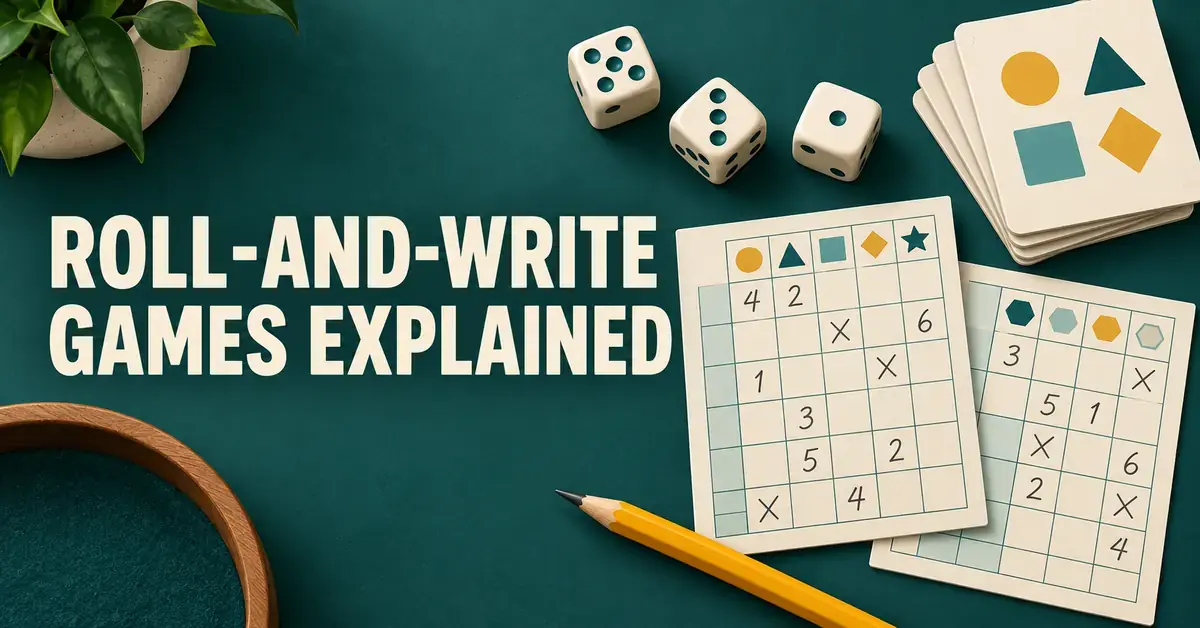
Roll-and-write games are a family of light, portable games in which players roll dice (or reveal cards), then record the results by writing or drawing on a personal sheet. The name is literal: you roll, then you write. Over the past decade the format has grown from a single mid-century classic into one of the busiest shelves in modern tabletop gaming. This guide explains how the core loop works, how “flip-and-write” differs, where the genre came from, what equipment you need, which well-known titles are worth trying, and the mistakes new players tend to make.
Key Points
- What it is: games where you roll dice (or flip cards) and record the results on your own sheet.
- Core loop: a randomizer offers options, you write them down, and earlier marks limit later ones.
- Roll vs flip: roll-and-write uses dice; flip-and-write uses a card deck — otherwise the designs are similar.
- Origin: Yahtzee (1956) is the ancestor; the modern genre boomed in the late 2010s, peaking around 2020.
- Kit: usually just dice or cards, a pad of identical sheets and a pencil — small and very portable.
- Best for: short, low-conflict games, solo play and large or mixed groups; less suited to players who want direct confrontation.
What is a roll-and-write game?
A roll-and-write game is any game in which a shared randomizer produces results and each player marks those results on their own score sheet or board. Instead of moving pieces around a central board, you convert dice rolls into decisions you record on paper. Everyone usually has an identical sheet, so players compete to use the same random results more cleverly than their rivals.
Two features set the genre apart from most other board games. First, interaction is usually indirect: you rarely attack or block an opponent directly, so there is little “take-that” conflict. Second, the choices build on each other — a number you write now often limits what you can write later, which is where the real decisions live. If you are new to the vocabulary, a quick look at a board game glossary will make terms like “press your luck” and “score track” easier to follow.
How roll-and-write games work
The core loop is short and repeats until an end condition is met: a randomizer generates options, players write the results onto their sheets, and earlier marks constrain later ones. Because the loop is so compact, most roll-and-writes teach in a few minutes and finish in 15 to 45 minutes. It is one of the most beginner-friendly board game mechanics to learn.
The randomizer: dice or cards
The randomizer is what makes each turn unpredictable, and in classic roll-and-writes it is dice. A player rolls a set of dice whose faces — numbers, colours or symbols — become the menu of things everyone may record that turn. Some games use a shared pool that all players draw from; others let each player use only their own roll.
The score sheet
The score sheet is the real board in a roll-and-write, and it is usually more structured than a simple tally pad. A sheet might hold coloured number rows, a grid to draw on, zones that unlock bonuses, or linked tracks that reward filling things in a particular order. Reading your sheet well — seeing which spaces are still reachable — is most of the skill.
Constraints and pressing your luck
Constraints are what turn a dice roll into a decision. In many games you can only write to the right of your last mark, or only in ascending order, so skipping a number closes off the ones behind it. That creates a constant tension: take a safe result now, or hold out for a better one and risk writing nothing at all. Managing that risk — not luck alone — decides most games.
Simultaneous play and interaction
Many roll-and-writes let everyone act at the same time, which keeps downtime low and player counts high. When one player’s roll (or a revealed card) is the menu for the whole table, all players can write at once rather than waiting for individual turns. That design also makes the genre a natural fit for solo board games, since a single player can simply chase a target score.
Roll-and-write vs flip-and-write: what is the difference?
The difference is the randomizer: roll-and-writes use dice, while flip-and-writes replace the dice with a deck of cards that is flipped to generate each turn’s options. Everything else — the personal sheets, the constraints, the simultaneous play — can be identical. The terms “flip-and-write” and “flip-and-fill” are used interchangeably for this card-driven variant.
Cards change the feel in two ways. They can remove the swinginess of a single bad roll, because a deck can be balanced and even counted as it depletes, and they can carry more information than a die face, such as a value and an action at once. Welcome To… (2018) is widely credited with popularising the flip-and-write format for large groups; Cartographers (2019) applied the same card-flip idea to drawing maps.
A short history: from Yahtzee to the modern boom
The ancestor of the genre is Yahtzee, first sold in 1956 by the New York toy maker E.S. Lowe, with the Yahtzee trademark registered on 19 March 1957. Its concept drew on older dice games such as Poker Dice, Yacht and Generala: you roll five dice over up to three throws and record scoring combinations — three of a kind, a full house, a small straight — in fixed boxes on a pad. The rights later changed hands as Milton Bradley bought the E.S. Lowe Company in 1973, and Hasbro acquired Milton Bradley in 1984.
For decades Yahtzee stood largely alone, but the modern genre exploded in the late 2010s. Designers found that cheap components — some dice and a pad — could carry surprisingly deep puzzles, and a wave of titles followed. The trend peaked around 2020, when roll-and-writes made up roughly 2.26% of all games released that year and more than 100 new titles were tagged with the roll-and-write mechanism on the hobby database BoardGameGeek. Several became award contenders: Qwixx was a Spiel des Jahres nominee in 2013, That’s Pretty Clever was a 2018 Kennerspiel des Jahres nominee, and Cartographers was nominated for the 2020 Kennerspiel des Jahres.
What you need to play
Most roll-and-writes need only three things: dice (or a card deck), a pad of identical player sheets, and a pencil for each player. Boxes are typically small and light, which is why the genre is a favourite for travel, cafes and lunch breaks. You can learn more about reading components and turns in this beginner’s guide to how to play board games.
A common beginner question is whether you “use up” the game. In the standard edition of most titles the player sheets are paper and single-use, so a pad will eventually run out — though publishers sell refill pads, and many players photocopy or print the sheets at home for personal use. Some games ship with wipe-clean boards and dry-erase markers instead, and a few offer deluxe editions with erasable sheets, so nothing is consumed. Check the box before you assume a pad is reusable.
Popular roll-and-write games to try
The titles below are among the most widely played and most awarded in the genre, chosen to show its range rather than to rank them. They span pure dice games, puzzle-like sheets and card-driven map drawing, and most support a wide spread of player counts. Several sit alongside the classic dice games covered in the site’s guide to card and dice games.
Comparison
| Game | Designer / Publisher | Year | Players | Time | Type | What you record |
|---|---|---|---|---|---|---|
| Yahtzee | E.S. Lowe / Hasbro | 1956 | 1–10 | ~30 min | Roll-and-write | Dice combinations in fixed boxes |
| Qwixx | Steffen Benndorf / Gamewright | 2012 | 2–5 | ~15 min | Roll-and-write | Numbers along four colour rows |
| That’s Pretty Clever | Wolfgang Warsch / Schmidt Spiele | 2018 | 1–4 | ~30 min | Roll-and-write | Coloured dice into linked zones |
| Welcome To… | Benoit Turpin / Blue Cocker | 2018 | 1–100 | ~25 min | Flip-and-write | House numbers along a street |
| Railroad Ink | Hjalmar Hach & Lorenzo Silva / Horrible Guild | 2018 | 1–6 | 20–30 min | Roll-and-write | Road and rail routes on a grid |
| Cartographers | Jordy Adan / Thunderworks Games | 2019 | 1 or more | ~30–45 min | Flip-and-write | Terrain shapes on an 11×11 map |
Qwixx is the usual entry point: four colour rows that you tick in order, with a shared roll everyone can use and a penalty for marking nothing. That’s Pretty Clever adds chaining, where filling one coloured zone unlocks bonuses in another. Railroad Ink and Cartographers move from numbers to drawing — route networks and terrain maps — which appeals to players who like spatial puzzles. Welcome To… trades dice for cards and scales to very large groups.
Who roll-and-write games suit
Roll-and-write games suit players who want short, low-conflict games that still reward thinking. Because turns are simultaneous and rules are light, they work well for mixed groups where not everyone is a hobby gamer, which overlaps with many family and party board games. They are also strong for solo play and for two players, since a personal sheet does not depend on a full table.
They are a weaker fit for players who want direct confrontation, negotiation or a dramatic shared board state. If your group loves bluffing, alliances or attacking opponents, a roll-and-write may feel too solitary — everyone is quietly optimising their own paper rather than reacting to each other.
Common mistakes beginners make
The most common mistake is treating a roll-and-write as a pure luck game and marking the first legal result every turn. Because early marks limit later ones, writing greedily tends to strand your sheet with unreachable spaces. A few habits help:
- Think before you write. The dice are shared information — plan which result helps your sheet most, not just which is biggest.
- Respect the ordering rules. If a row or track only fills in one direction, skipping ahead can permanently lock out the spaces you jumped over.
- Watch the end-game triggers. Many games end when someone locks a certain number of rows or takes too many penalties; ignoring that lets an opponent end the game while your sheet is half-finished.
- Do not fear the penalty. Taking a small penalty to avoid a terrible mark is often correct — a wasted turn can cost more than one penalty box.
- Use the whole sheet. Bonus zones and combos usually score more than steady, safe ticks, so plan toward them early.
Pros and cons of the genre
The genre’s biggest strength is accessibility: cheap, portable games that teach fast, play quickly and handle odd player counts. Its clearest limitation is interaction. Weigh the trade-offs before buying into the format:
- Pros: short play time; easy to teach; very portable; strong solo and high-player-count support; low downtime thanks to simultaneous turns.
- Cons: limited direct interaction; luck can swing a single game; standard paper sheets are consumable; the “everyone plays their own puzzle” feel is not for every group.
Sources
- Engaged Family Gaming — Roll and Write / Flip and Write definition
- Don’t Eat the Meeples — The curious rise of the roll-and-write game
- Toy Tales — Yahtzee from the E.S. Lowe Company (1956)
- Opinionated Gamers — Ganz schön clever (That’s Pretty Clever) review
- Spiel des Jahres — Nominated for Kennerspiel des Jahres
- Meeple Mountain — Roll and Write board games
- Gamewright — official publisher site (Qwixx)
- Horrible Guild — official publisher site (Railroad Ink)
- Thunderworks Games — official publisher site (Cartographers)
- Schmidt Spiele — official publisher site (Ganz schön clever)
Vanliga frågor (FAQ)
Are roll-and-write games the same as Yahtzee?
Yahtzee is the best-known roll-and-write and the genre’s ancestor, but modern titles go far beyond it. Where Yahtzee uses five dice and fixed scoring boxes, newer games add colour rows, grids you draw on, chained bonuses and card-driven variants. Yahtzee is the simplest example, not the whole category.
What is the difference between roll-and-write and flip-and-write?
The randomizer is the only core difference: roll-and-writes use dice, and flip-and-writes reveal cards instead. The personal sheets, the constraints on where you can write, and the simultaneous play can be identical. Flip-and-write is sometimes called flip-and-fill.
How many players can roll-and-write games handle?
Player counts vary widely, from solo and two-player up to very large groups. Because each player uses an independent sheet and many games resolve turns simultaneously, some titles support dozens of players at once — limited mainly by how many sheets you have rather than by the rules.
Do you need to buy a new pad every time you play?
Not always. Standard editions usually use single-use paper sheets, so a pad runs out over time, but publishers sell refill pads and many players print sheets for personal use. Some games instead include wipe-clean boards and dry-erase markers, which never run out.
Are roll-and-write games good for beginners?
Yes. They are among the easiest board games to learn: rules are short, turns are quick, and the low-conflict design means a new player is rarely singled out. They are a good bridge for groups that mix experienced and first-time players.
