

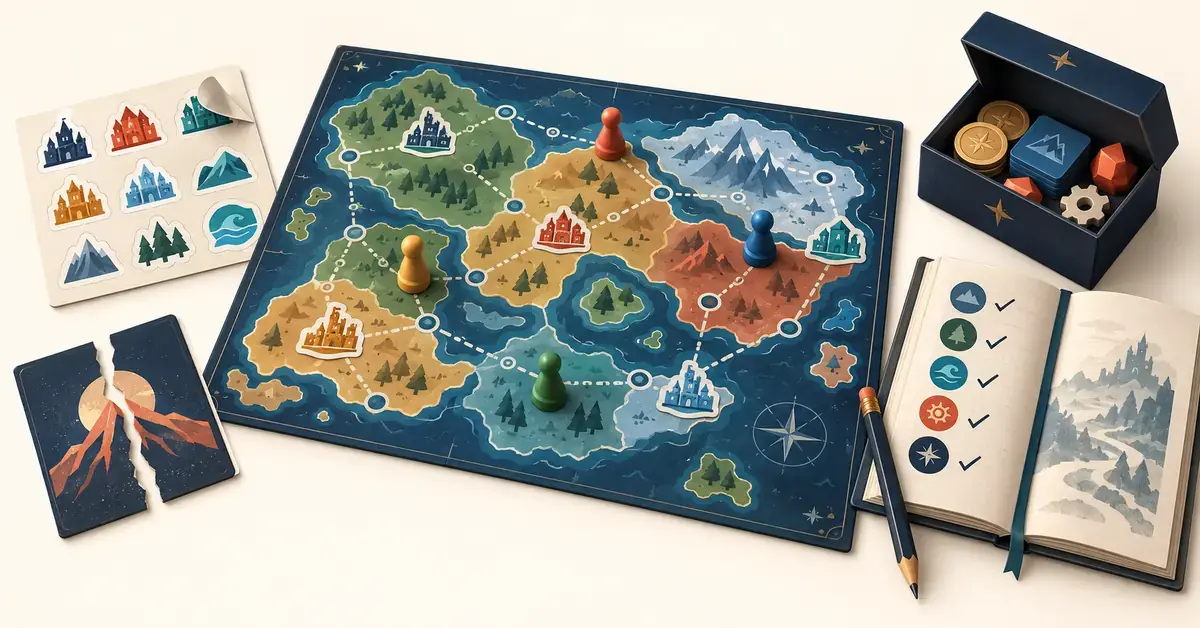
A legacy board game is a game that changes permanently as you play it. Instead of resetting to the same starting position every time, a legacy game is played as a connected series of sessions — a campaign — in which the choices you make leave lasting marks on the cards, the board and even the rulebook. You might write your name on the board, peel a sticker onto a city, tear a card in half, or open a sealed box that introduces brand-new components. Those changes stay. The next time you open the box, you are playing your copy, shaped by everything that happened before. This guide explains how that works, where the format came from, which games define it, and whether a game you can “use up” is right for you.
Key Points
- Legacy game: a board game whose components and rules change permanently as you play a connected series of sessions called a campaign.
- Permanent changes: you write on cards and boards, apply stickers, tear up cards and open sealed boxes — and those changes stay.
- Firsts: Risk Legacy (2011) launched the format; Pandemic Legacy: Season 1 (2015) made it mainstream.
- Campaign length: typically 10–24 sessions; Pandemic Legacy runs 12–24 games across 12 in-story months.
- Played once: most legacy games are designed for a single play-through, though some sell reset or “recharge” packs.
- After the story: you keep a customised copy you can still play casually once the campaign ends.
What is a legacy board game?
A legacy board game is a campaign game whose components and rules are altered permanently over the course of play, so the game physically evolves from one session to the next. The term was coined for Risk Legacy in 2011 and has since become its own recognised category, sitting alongside other board game genres and mechanics.
Two ideas sit at the heart of the format:
- Persistence. Results carry over. A city that suffered last game may start the next one already in trouble; a region you conquered may still bear your mark.
- Permanence. Many of those changes are irreversible by design. You are meant to write, sticker and sometimes destroy components, and there is usually no “undo.”
Because of this, a legacy game is normally played through once, by the same group, in order. When the story ends you are left with a customised copy you can keep playing casually, but the one-time journey — the surprises, the rule reveals, the slowly changing board — happens only once.
How do legacy games actually work?
Legacy games work by giving you explicit, in-game instructions to modify the components, usually delivered through a story deck or a changing rulebook. You never decide on your own to tear something up; the game tells you when, and part of the tension is not knowing what a change will unlock. The mechanics fall into a few clear groups.
Writing, stickers and torn cards
The most visible legacy mechanics are the physical ones. You write on the board and on cards with a pen (naming a faction, recording a scar, upgrading a location). You apply stickers that permanently add rules, bonuses or penalties to a space. And in some games you tear up or otherwise destroy cards that are leaving the game for good. In Risk Legacy, for example, players choose one of a faction’s two powers by applying a sticker — and then destroy the card showing the power they did not pick, so that choice can never be taken back.
Sealed boxes and hidden content
Legacy games are famous for sealed envelopes, boxes and compartments that you are forbidden to open until the game instructs you. Risk Legacy shipped with sealed packages opened only under specific conditions; Pandemic Legacy: Season 1 includes a set of sealed boxes containing new components. Each reveal introduces fresh rules or pieces, so the game you finish with can be substantially more complex than the one you started.
Carrying results between sessions
Beyond physical changes, legacy games track state. Who won, which objectives were met, what damage the world took — all of it can feed into the setup of the next session. This is what turns a stack of individual games into a single evolving story, and it is the feature that separates a true legacy game from a game you simply replay with the same group.
Legacy games vs. campaign games vs. regular games
A legacy game is always a campaign game, but not every campaign game is a legacy game. The difference is permanence. Understanding the three categories helps you know what you are buying.
- Regular (reset) games. Chess, Catan or Ticket to Ride reset to the same starting state every time. Nothing carries over and nothing is destroyed. These offer effectively unlimited replays.
- Campaign games. These link several sessions into a continuing story and may track progress between games, but they do not require you to permanently alter or destroy components. Many app-driven or scenario-book games fit here; you can usually reset and play the campaign again.
- Legacy games. These are campaign games that deliberately make permanent, physical changes — stickers, writing, torn cards, opened boxes. The story is designed to be experienced once.
If you are new to the hobby and these labels feel slippery, the glossary of board game terms defines campaign, legacy and related words in one place.
How a campaign plays out: Pandemic Legacy as an example
Pandemic Legacy: Season 1 is the clearest example of how a legacy campaign unfolds, because it layers permanence onto a game many people already know. The base experience resembles standard Pandemic: a cooperative game in which a team of specialists travels the world treating four diseases and racing to find cures before the outbreaks spiral out of control.
The legacy structure adds four things on top:
- A twelve-month story. Each session represents one calendar month in a year-long struggle, so the campaign runs through twelve chapters in order.
- Two attempts per month. If your team fails a month’s objective, you get one more try before the story moves on regardless. That is why a full campaign takes anywhere from 12 games (if you win every month first time) to 24 games (if you lose every month once).
- A Legacy deck. Each month you read new Legacy cards that advance the plot and introduce new rules and components — the engine that drives the permanent changes.
- Sealed content and accumulating damage. Sealed boxes open when instructed, and cities that keep breaking down get stickers marking rising “panic,” which changes how the board behaves for the rest of the campaign.
Because it is cooperative, the whole table shares the consequences — a design that rewards the planning and teamwork covered in general board game strategy.
A short history of legacy board games
The legacy format began with Risk Legacy in 2011, designed by Rob Daviau and Chris Dupuis and published by Hasbro. Daviau has said the idea grew from a simple question about why board games always start over from scratch, and from a joke about the murder-mystery characters in Clue being invited back to dinner every game. Risk Legacy turned a single game of Risk into a 15-game campaign in which players wrote on the board, applied stickers, tore up cards and opened sealed boxes. It impressed reviewers but was divisive, and the format stayed quiet for a few years.
The genre broke through in 2015 with Pandemic Legacy: Season 1, which Daviau co-designed with Matt Leacock, the creator of the original Pandemic (Z-Man Games, 2008). By marrying familiar cooperative play to legacy permanence, it drew huge acclaim and spent years at the top of community rankings, prompting a wave of legacy titles across many genres.
The Pandemic Legacy line itself expanded with Season 2 in 2017 and a prequel, Season 0, in 2020, set during the Cold War of 1962. Daviau went on to design other legacy games and helped develop reusable systems for carrying permanent change through a franchise. Today the format spans dungeon crawlers, deck-builders, worker-placement and tile-laying games.
The major legacy board games
The best-known legacy games span almost every style of play, from cooperative crisis management to competitive city-building. The table below compares the titles that defined and expanded the format, with their real player counts and campaign lengths. Links go to the publishers’ official pages.
Comparison
| Game | Released | Core type | Players | Campaign length |
|---|---|---|---|---|
| Pandemic Legacy: Season 1 | 2015 | Cooperative crisis / campaign | 2–4 | 12–24 games (12 months) |
| Risk Legacy (out of print) | 2011 | Competitive area control | 3–5 | 15 games |
| Gloomhaven | 2017 | Cooperative dungeon crawler | 1–4 | 95+ scenarios |
| Charterstone | 2017 | Competitive worker placement | 1–6 | 12 games |
| Betrayal Legacy | 2018 | Semi-cooperative horror | 3–5 | 13 games |
| Clank! Legacy: Acquisitions Incorporated | 2019 | Competitive deck-building | 2–4 | ~10-game campaign |
| My City | 2020 | Competitive tile-laying | 2–4 | 24 games (8 chapters) |
Note that campaign lengths are approximate: your exact number of sessions depends on wins, losses and how a group chooses to play. Some of these games (notably Gloomhaven and Frosthaven) are more properly “campaign” games with legacy-style elements, because much of their progress is tracked rather than destroyed.
What you need to start a legacy campaign
Starting a legacy campaign takes a little more commitment than a normal game night, but the requirements are simple. Plan for the following before you open the box.
- A stable group. Most legacy games assume the same players continue the story. Agree up front who is in, because a campaign can run for months of game nights.
- Time across many sessions. A full campaign is typically 10–24 sessions of one to two hours each. You do not play it all at once, but you do need to keep coming back.
- A fine-tip pen and a flat storage spot. You will write on components and your copy must survive between sessions without being disturbed, so keep the box somewhere safe.
- Acceptance of permanence. Everyone should be comfortable with the idea of marking and sometimes destroying components. If that bothers a player, choose a non-legacy campaign game instead.
- The base rules. Legacy games teach themselves as you go, but knowing how to read a rulebook and run a first turn helps; our guide to learning a new board game fast covers the method.
Can you reset or replay a legacy game?
Usually only partly — a finished legacy game is meant to stay finished, though a growing number of titles offer ways to play again. There are three common situations.
- Play on in the end state. Most legacy games leave you with a fully customised board and deck that you can keep playing as a one-off game, even though no further story changes happen.
- Official reset or “recharge” packs. Some publishers sell add-ons that restore the altered components so a new group can experience the campaign fresh. Charterstone was an early example, with a recharge pack announced in 2017 (around US$30 at launch) that replaces the stickered and written-on parts. BoardGameGeek classifies these as expansions rather than accessories.
- Built-in replayability. A few newer designs sidestep destruction entirely. My City, for instance, ships with a double-sided board offering a repeatable, non-legacy setup once you finish the 24-game campaign.
If replay value matters a lot to you, check for a reset option before buying — and remember that buying one copy per group is the norm, not a second full game.
Common mistakes with legacy games
The most common mistakes come from treating a legacy game like an ordinary one. Avoiding them keeps the campaign fun and intact.
- Opening sealed content early. Peeking into sealed boxes or reading ahead spoils the reveals the whole design is built around. Open only when instructed.
- Swapping players mid-campaign. Because choices are permanent and often personalised, changing the group partway through can break the story and the balance.
- Expecting unlimited replays. A legacy game is largely a one-time experience. If you want a game to bring back repeatedly, a reset-friendly or non-legacy title is the better buy.
- Chasing a perfect record. In games like Pandemic Legacy, losing a month still advances the story and is a designed part of the arc. Treating a loss as a reason to restart undermines the campaign.
- Storing the copy carelessly. A half-finished legacy game is a work in progress. Jumbling the components or losing the box between sessions can be hard to recover from.
Who are legacy board games for?
Legacy games suit groups who value story and surprise over endless replayability, and who can commit to a shared campaign. They reward tables that like watching a game world change in response to their decisions, and they can turn a regular game night into an ongoing event people look forward to.
They are a weaker fit if your group changes often, if you prefer games you can set up and reset forever, or if marking and destroying components feels wasteful to you. In those cases a non-legacy campaign game, or a classic reset game, will serve you better. If you are still finding your footing in the hobby generally, start with the fundamentals in our beginner’s guide to playing board games before committing to a months-long campaign.
Sources
- NPR — New ‘Risk’ Game Remembers Where You Left Off (Risk Legacy, 2011)
- PC Gamer — The Making of Pandemic Legacy
- Z-Man Games — The Beginning of a Legacy: From Pandemic to Season 0
- Matt Leacock — Pandemic Legacy: Season 0
- Tabletop Gaming — Charterstone recharge pack announcement
- Stonemaier Games — Charterstone
- BoardGameGeek — Misc: Reset/Recharge Packs
- Cephalofair Games — Gloomhaven and Frosthaven
Frequently Asked Questions (FAQ)
What does “legacy” mean for a board game?
It means the game changes permanently as you play a connected series of sessions. You follow in-game instructions to write on components, apply stickers, tear up cards and open sealed content, and those changes carry into every future session.
Can you play a legacy game more than once?
The campaign story is designed to be played through once. Afterwards you can keep playing the customised end state casually, and some games offer official reset or recharge packs, or a built-in repeatable mode, so a new group can start fresh.
What was the first legacy board game?
Risk Legacy, released in 2011 and designed by Rob Daviau and Chris Dupuis, introduced the format. Pandemic Legacy: Season 1 in 2015 made it mainstream and inspired most of the legacy games that followed.
How long does a legacy campaign take?
Most run 10 to 24 sessions of roughly one to two hours each, spread over many game nights. Pandemic Legacy: Season 1, for example, takes 12 to 24 games because each of its twelve months allows a second attempt after a loss.
Do you really have to rip up and destroy cards?
In some legacy games, yes — destroying components is a deliberate part of the design and the drama. Not every legacy game destroys as much as Risk Legacy, though, and a few avoid it entirely, so check a title’s approach if permanence concerns you.
