

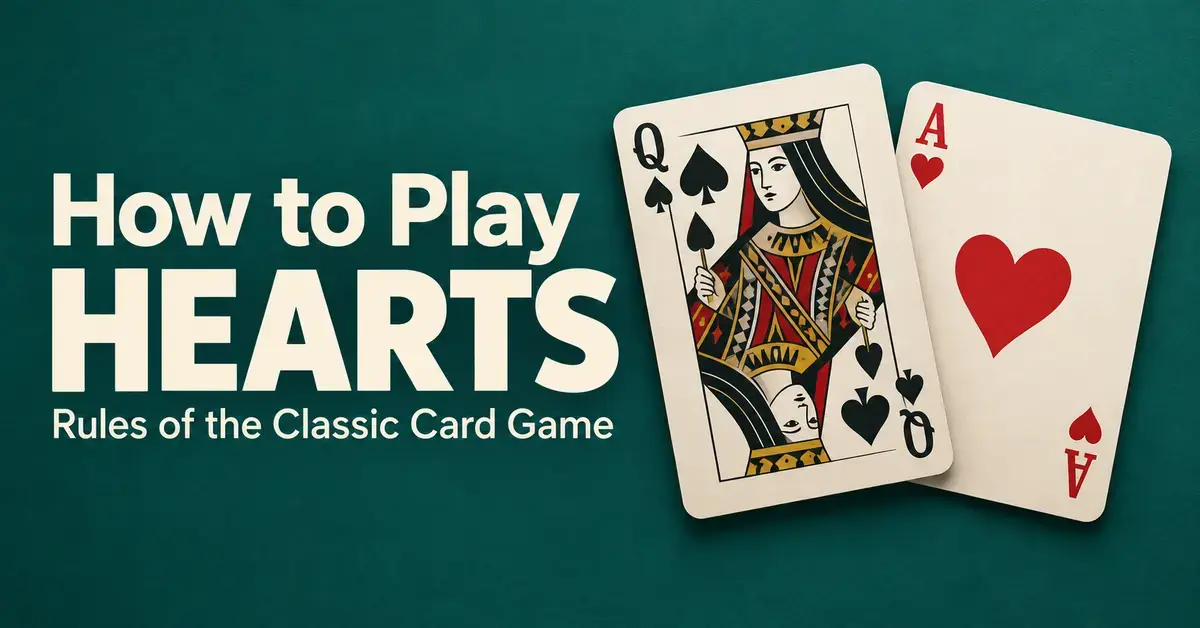
Hearts is a classic trick-taking card game for four players, played with a standard 52-card deck, where the goal is to score as few points as possible. Unlike most card games, you win by avoiding certain cards rather than collecting them: every heart and the dreaded Queen of Spades count against you. This guide explains the full rules from scratch — dealing, passing, how a trick works, breaking hearts, scoring and the famous “shooting the moon” move — plus the most common variants and beginner mistakes.
Quick Facts
| Players | 4 (best); also 3, 5, or 6–10 in variants |
|---|---|
| Equipment | Standard 52-card deck (no jokers) |
| Game type | Trick-taking, evasion (avoid points) |
| Objective | Finish with the lowest score |
| Cards rank | Ace (high) down to 2 (low); no trump suit |
| Penalty points | Each heart = 1; Queen of Spades = 13 (26 per hand) |
| Game ends at | 100 points (some play to 50) |
| Typical length | Several hands, roughly 20–40 minutes |
What is Hearts?
Hearts is an “evasion-type” trick-taking game, meaning you try to avoid winning tricks that contain penalty cards. It descends from a family of 18th- and 19th-century games such as Reversis and Black Lady, and the modern four-player version became a staple of Western card tables and later shipped with Microsoft Windows, which introduced it to millions of players. A trick is one round in which each player plays a single card; the player who plays the highest card of the suit that was led wins — or, in Hearts, gets stuck with — that trick. If the term is new to you, our board game glossary explains “trick,” “void” and other card-game vocabulary.
There is no trump suit in standard Hearts, and no partnerships — every player competes for themselves. That combination of simple rules and sharp tactical decisions is why Hearts sits alongside other card and dice games as a kitchen-table favourite.
What do you need to play Hearts?
You need just two things: four players and one standard 52-card deck with the jokers removed. No board, score pad aside, no extra equipment. Hearts is best with exactly four players, but it adapts to three, five or more with small adjustments covered later.
Players and the deck
- Players: Four is the classic and best count. Three, five and six-or-more player versions exist (see Variants).
- Cards: A standard 52-card pack. Within each suit, cards rank from Ace (high) down to 2 (low).
- Score sheet: Any paper works; you track running totals across several hands.
How to deal the cards
Deal the entire deck out one card at a time, face down and clockwise, so each of the four players receives 13 cards. The deal passes to the left after each hand. For three players, remove the 2 of Diamonds and deal 17 cards each; for five players, remove the 2 of Clubs and deal 10 cards each. Once everyone has their hand, the passing phase begins.
What is the goal of Hearts?
The goal of Hearts is to finish the game with the lowest score, because every point is a penalty. You collect points by winning tricks that contain hearts or the Queen of Spades, so good play means ducking those cards and letting opponents scoop them up. The game is played over multiple hands, and it ends when any player reaches or exceeds a set target (usually 100 points). When that happens, the player with the fewest points wins. For the bigger picture of how objectives shape play, see our beginner’s guide to board games.
How do you pass cards in Hearts?
Before each hand is played, every player chooses three cards from their hand and passes them face down to another player. You select and pass your three cards before looking at the cards coming to you, so passing is a blind, simultaneous exchange. This is your chance to dump dangerous high cards — especially high spades and high hearts.
The passing direction rotates with each hand in a fixed four-hand cycle, then repeats:
- Hand 1: pass three cards to the player on your left.
- Hand 2: pass three cards to the player on your right.
- Hand 3: pass three cards to the player across the table.
- Hand 4: no passing — play the hand you were dealt.
The cycle then starts again from the left. Passing adds a layer of hidden information: the cards you receive hint at what your neighbours feared holding.
How is a hand of Hearts played?
A hand is played as 13 tricks. On each trick, one player leads a card, everyone else plays a card in clockwise order, and the highest card of the led suit wins the trick. The winner gathers those four cards face down and leads the next trick. Play continues until all 13 tricks are taken, then you score the hand.
Who leads the first trick?
The player holding the 2 of Clubs must lead it to the very first trick — you do not get to choose your opening card. In the five-player game (where the 2 of Clubs is removed), the holder of the 3 of Clubs leads instead. After the first trick, whoever won the previous trick leads the next one.
Following suit
You must follow the suit that was led if you can. If clubs are led and you hold a club, you must play a club. If you have no cards of the led suit (you are “void” in it), you may play any card — including a penalty card to offload it onto whoever wins the trick. There is no trump suit, so a card of a different suit can never win a trick; only the highest card of the led suit wins.
Breaking hearts
Hearts cannot be led until the suit has been “broken.” Hearts are broken the first time a heart (or, by common rule, the Queen of Spades) is played to a trick because a player was void in the led suit and discarded it. Until that happens, no one may lead with a heart. The one exception: a player whose entire remaining hand is nothing but hearts may lead a heart anyway.
First-trick restrictions
On the very first trick you may not play any penalty card. That means no hearts and no Queen of Spades, even if you are void in clubs — you must discard a safe card from another suit instead. Only if your hand somehow contains nothing but penalty cards are you allowed to play one on the opening trick.
How does scoring work in Hearts?
At the end of each hand, players count the penalty cards in the tricks they won. Each heart is worth 1 point and the Queen of Spades is worth 13 points, so a full hand always distributes exactly 26 penalty points. These points are added to each player’s running total — and because the whole point is to stay low, taking penalty cards is bad.
Hearts Scoring
| Card | Points | Notes |
|---|---|---|
| Each heart (♥) | 1 point | 13 hearts = 13 points per hand |
| Queen of Spades (Q♠) | 13 points | The single worst card to take |
| All other cards | 0 points | Safe to win |
| Total per hand | 26 points | Always distributed among players |
| Shooting the moon | −26 to self / +26 to others | Taking all 26 penalty points |
| Jack of Diamonds (Omnibus variant) | −10 points | A bonus card, if played |
The Queen of Spades, nicknamed the “Black Lady” or “Black Maria,” is the single most dangerous card in the deck. Avoiding it is often more important than avoiding hearts, since one unlucky trick with the Queen can hand you 13 points at once.
What does “shooting the moon” mean?
Shooting the moon is a high-risk play in which a single player deliberately tries to win every penalty card — all 13 hearts and the Queen of Spades, worth 26 points in total. If you succeed, the scoring flips in your favour: instead of taking 26 points, you choose either to subtract 26 points from your own score or to add 26 points to every other player’s score. Either way, you come out far ahead.
The catch is that it is all or nothing. If even one heart or the Queen slips to another player, you simply collect every penalty point you managed to take — a disaster. Opponents who spot a moon attempt can often spoil it by deliberately taking a single heart. Attempting the moon usually requires a hand loaded with high hearts, control of the spade suit and a bit of luck. For more tactical thinking across games, see our board game strategy guide.
When does a game of Hearts end?
A game ends at the end of the hand in which any player’s running total reaches or exceeds 100 points. Some groups play a shorter game to 50 points instead. When the threshold is crossed, scoring stops and the player with the lowest total is the winner. Because everyone is racing to stay low, a single bad hand — especially one where you get stuck with the Queen of Spades — can knock you out of contention.
What are the main variants of Hearts?
Hearts has several widely played variants that change the card counts or add bonus cards. The core trick-taking and passing rules stay the same.
Three- and five-player Hearts
For three players, remove the 2 of Diamonds so the 51 cards divide evenly into hands of 17. For five players, remove the 2 of Clubs for hands of 10, and the holder of the 3 of Clubs leads the first trick. Everything else plays as normal.
Omnibus Hearts
Omnibus Hearts adds the Jack of Diamonds as a bonus card worth minus 10 points to whoever takes it. This gives players a reason to win one specific trick, adding tension to an otherwise avoidance-focused game. The moon-shooting rule still applies, and the player who takes the Jack keeps the 10-point bonus even while shooting the moon.
Black Maria
Black Maria is a British three-player version. The 2 of Clubs is removed and each player receives 17 cards. Passing always goes in the same direction (usually to the right), the player to the dealer’s left leads and may lead anything, and some tables add penalties for the King of Spades (10 points) and Ace of Spades (7 points) on top of the Queen.
Cancellation Hearts
Cancellation Hearts suits larger groups of six to ten players. Two full decks are shuffled together and dealt out as far as they go; any leftover cards form a small pile claimed by the winner of the first trick. When two identical cards are played to the same trick, they cancel each other and neither can win, though both still count their penalty points.
Common mistakes beginners make
New Hearts players tend to lose points in a handful of predictable ways. Knowing them is half the battle.
- Keeping high spades: Holding the Ace or King of Spades leaves you exposed to the Queen. Pass them away early unless you are deliberately trying to control the suit.
- Passing the Queen carelessly: Passing the Queen of Spades to an opponent can backfire if they dump it right back onto you in play. Pass it only when it genuinely cleans up your hand.
- Forgetting the first-trick rule: You cannot play a heart or the Queen on the opening trick — plan a safe discard in advance.
- Not tracking the Queen: Pay attention to whether the Queen of Spades has been played. Leading a low spade while it is still out is a common way to accidentally win it.
- Ignoring a moon attempt: If one opponent is sweeping up hearts, break up the run early by taking a single heart yourself rather than letting them shoot the moon.
Simple strategy for new players
The fastest way to improve is to stay flexible: aim low most hands, and only chase the moon when you are dealt a genuinely dominant hand. Create “voids” by passing away an entire weak suit so you can discard penalty cards onto others later. Hold a few low cards so you are not forced to win tricks you do not want. And watch the table — Hearts rewards players who track which penalty cards have appeared and who is void in what. These habits carry over to many other games covered in our overview of classic board game rules.
Sources
Vanliga frågor (FAQ)
How many players do you need for Hearts?
Hearts is best with exactly four players, each playing for themselves. It can also be played with three players (remove the 2 of Diamonds) or five players (remove the 2 of Clubs), and the Cancellation Hearts variant uses two decks to handle six to ten players.
What is the Queen of Spades worth in Hearts?
The Queen of Spades is worth 13 penalty points, making it the most dangerous card in the game. Combined with the 13 hearts (1 point each), every hand distributes exactly 26 penalty points among the players.
Can you lead with hearts at any time?
No. You cannot lead a heart until hearts have been “broken” — that is, until a heart or the Queen of Spades has been played to a trick by someone who was void in the led suit. The only exception is a player whose entire hand is nothing but hearts.
What happens if you shoot the moon?
If you take all 13 hearts and the Queen of Spades in one hand, you shoot the moon. Instead of scoring 26 points, you either subtract 26 from your own total or add 26 to every other player’s total. If you miss even one penalty card, you simply keep all the points you took.
How do you win a game of Hearts?
You win by having the lowest score when the game ends. The game finishes at the end of the hand in which any player reaches or exceeds 100 points (some play to 50), and the player with the fewest penalty points is declared the winner.
